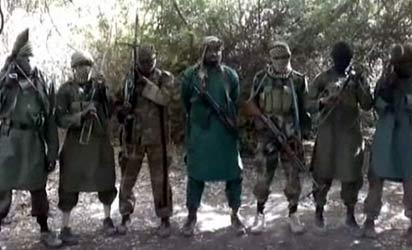
Boko Haram
*US: Why the elections cannot be stopped
By Ndahi Marama
As the Independent National Electoral Commission (INEC) began the distribution of Permanent Voter Cards (PVC) preparatory to the February 14 general elections in Borno State, there has been an increase in the spate of bomb blasts and deadly attacks by insurgents.
This could have been possible because the terrorists seem well armed and better motivated than the military operatives. Meanwhile, the United States (US) said the February polls are a factor in the sharp increase in the attacks suspected to have been carried out by Boko Haram fighters.
Spokeswoman for the US State Department Marie Harf, however, said the elections should go forward despite the violence.
“There has been a sharp escalation in the number of reported casualties. We do believe the elections are a factor”, Harf said.
According to her, Boko Haram previously used such elections to stir up tensions. The February 14 presidential election is expected to be a close contest between President Goodluck Jonathan of the PDP and his leading challenges Muhammadu Buhari of the APC.
“Boko Haram has tended to, particularly around something like an election, use political issues or sensitivities to try to enflame tensions”, she said.
“We have seen that as one of their tactics and that is why it is so important to move forward with the election because we believe it is important.”
The Independent National Electoral Commission (INEC) also expressed doubts about the elections holding in the states under emergency rule – Borno, Yobe, Adamawa – due to the increased attacks by insurgents there.
The electoral body ruled out the possibility of the people displaced by the insurgency in the three states participating in the February polls.
Devastating among these ugly incidents was a bomb explosion that erupted at the popular Monday Market in Maiduguri, the state capital, leaving 20 people, including the female suicide bomber dead. 18 others sustained severe injuries.
The blast, which occurred at noon, penultimate Monday, is said to have gone off around the ever crowded chicken sellers section (Yan Kaji) and shops within the market.
Our correspondent in Maiduguri observed hundreds of residents around the popular post office area on that fateful day running helter skelter after the blast.

A resident, who has his shop around the post office area, told our correspondent that one bomber was arrested in the market and wondered why bombers were always targeting that particular part of the market.
The National Emergency Management Agency, NEMA, spokesman, Ibrahim Abdulkadir, confirmed the blast at the market, but said he was yet to get the details of the casualty as a rescue team was on its way to the scene.
Borno State Police Command Public Relations Officer, PPRO, Mr. Gideon Jubrin, in a text message said, “ 20 people were confirmed dead including the suicide bomber, while 18 were seriously injured and are now receiving treatment in some undisclosed hospitals in Maiduguri.”
Jibrin, however, appealed to residents to remain calm as security operatives were working round the clock to ensure protection of lives and property in the state.
On the heels of the market attack, suspected Boko Haram gunmen, in a convoy of Toyota Hilux vehicles and motorcycles laden with Improvised Explosive Devices (IEDs) and petrol-bombs, re-attacked the council headquarters of Askira town; torching several public
buildings, including a secondary school, the Divisional Police Station and telecom masts.
Askira is a predominantly farming community bordering Adamawa, and 252 kilometres south of Maiduguri. The armed militants, according to Yunusa Pinkwir, who escaped to
Maiduguri, penultimate Tuesday along with some residents said: “As we were about to depart the motor park yesterday afternoon, the insurgents were chanting ‘God is great’ in Arabic, before this school was burnt to ashes. They did not stop there, they proceeded to our police station and a health centre and threw IEDs at the buildings.
“Residents in the streets and market started to run for safety, because the insurgents did not spare people, as the vehicles mounted with Rapid Propelled Grenades (RPGs) continued to shoot sporadically.”
He said he had to flee along with six passengers in a taxi to Maiduguri through Mbalala and Chibok Road.
“I cannot give you the casualty of civilians and security personnel, but we saw some bodies on the road, while we were fleeing towards Mbalala,” he added.
According to him, the extent of the attack on the town could have been minimized if there were soldiers to protect lives and property in Askira.
Confirming the incident in Maiduguri, a source in the Borno State Police Command said that there was a report of insurgents’ attacks on one of the towns in southern Borno.
“I cannot give you the details but some public buildings were burnt, including our station in Askira, 60 kilometres west of Uba near Mubi town in Adamawa State”, said the police source.
Another attack on Baga, a border town with Chad Republic, was described as the deadleast yet. But the District Head of Baga, Alhaji Baba Abba Hassan, debunked the report of a second attack on the town which said that over 2,000 people were killed, describing the report as outrageous.
He said, “ Although hundreds of people were killed in last (penultimate) Saturday Boko Haram attack on Baga in Kukawa local government area of Borno State, there was no second attack on the town”.
Hassan told newsmen on phone that the corpses of those killed still littered the streets and the bushes of the town and there was no way to bury them.
He insisted that there was no fresh attack on Baga as widely reported by some foreign media which put the figure of people killed at 2,000, adding that the actual figure of those killed could not be ascertained but admitted that hundreds of people were killed with many others displaced.
The traditional ruler said most of those killed were women and children when the insurgents pursued them into the bushes before unleashing terror on them.
He said the information they received that insurgents from Sambiza forest and Gwoza hills were coming to attack Baga the second time could not be verified, and prayed for restoration of peace in the land.
According to him, many of his people had crossed to Chad, Niger Republic and Maiduguri for safety. He stressed that many also drowned in the Lake Chad while others were killed in the bushes while trying to escape.
Capsized boat
Another survivor, Muktar Audu, who fled to Chad, said the gunmen burst into Baga through Cross Kauwa village and Mile 3 and 4 of the Multinational Joint Task Force, MJTF Barrack; and attacked soldiers at their duty posts, before proceeding to the main town to kill residents.
The MJTF has troops from Nigeria, Cameroun, Niger and Chad. It was established by the four countries to combat Boko Haram.
“The soldiers at the barrack and their duty posts ran away when the gunmen stormed Mile 3 and 4 of Baga Road. Some of the soldiers had to ride motorcycles to Doron Baga Primary School, where other soldiers had fled for safety to take cover. The militants
overpowered the soldiers, and that is why they were begging people for dresses to change; after removing their uniforms, because the militants targeted security personnel, before killing residents, but I was able to escape to Chad with three of my family members in an overloaded boat,” Audu said in an interview on phone.
He said the militants had planned since last year to attack Baga when they wrote a threat letter that the MJTF personnel could not guarantee the safety of fishermen and residents in the Lake Chad Basin Area.
“At the time of fleeing, I could not ascertain the number of people killed because everyone had to flee to Chad through Lake Chad. Many houses and shops were also torched and looted by the insurgents.”
He added that one of the boats capsized because of overloading, as every fleeing resident wanted to cross to Chad.
Senator Maina Ma’aji Lawan, representing Borno North, confirmed the incident, stating that it was “shocking, unfortunate and terrifying” for insurgents to sack Baga and the barracks of MJTF.
He said the military should intervene to save the people now taking refuge at Chadian border villages and towns.
According to him, Bindanaram and five other villages were also sacked by insurgents in their Saturday dawn attacks.
“With these attacks and killings at Baga and other villages in the Lake Chad Basin Area of Borno, the insurgents have taken control because soldiers that were supposed to provide security in the area were chased away along with civilians to Doron Baga Primary School and Chadian border villages,” said Lawan in an interview.
He said the people of his senatorial district had no any other place to flee because Abadam, Damasak, Gashigar and Kala/Balge council areas were attacked and taken over by Boko Haram last year.
“All their means of livelihood and economic activities of fishing and farming in the Lake Chad Basin Area have been cut off,” the senator said.
Abubakar Gamandi, head of Borno’s fish traders union and a Baga native, also confirmed the attacks, adding that hundreds of people who fled were trapped on the islands on Lake Chad.
Worst atrocity
The intensity of the insurgents attacks forced the United States Secretary of State, John Kerry, to brand Boko Haram’s attacks in Baga and Doron Baga in Borno State a crime against humanity.
He said this following satellite images of the massive destruction in the two towns reportedly razed by the insurgents.
“What they have done is a crime against humanity, nothing less,” Kerry said as first images of what was feared to be the worst atrocity of the six-year insurgency emerged.
“Boko Haram is evil and a serious threat not just in Nigeria and the region but to all of our values,” Kerry said during a visit to Bulgaria.
He said he had spoken to his British counterpart, Philip Hammond, who was also in Sofia, about the possibility of “a special initiative with respect to Nigeria and with respect to Boko Haram.”
Amnesty and New York based watchdog, the Human Rights Watch, published separate satellite images claiming to show massive destruction in Baga and environs.
The two organisations added that they feared the areas attacked might have suffered the deadliest strike yet in Boko Haram’s bloody campaign.
Amnesty’s images showed aerial shots of the towns on January 2,the day before the attack, and January 7, after homes and businesses were razed.
The group said the images suggested “devastation of catastrophic proportions”, with more than 3,700 structures — 620 in Baga and 3,100 in Doron Baga — damaged or completely destroyed.
HRW said 11 per cent of Baga and 57 per cent of Doron Baga was destroyed, most likely by fire, attributing the greater damage in Doron Baga to the fact that it houses a regional military base.
But the military said that 150 died and dismissed as “sensational” claims that 2,000 may have lost their lives in the attacks.
Local officials said at least 16 settlements around Baga were burnt to the ground and that at least 20,000 people fled.
HRW said the exact death toll was unknown and quoted one local resident as saying: “No one stayed back to count the bodies.
“We were all running to get out of town ahead of Boko Haram fighters who have since taken over the area.”
Harrowing testimony
Amnesty said Boko Haram was believed to have targeted civilian vigilantes helping the army after they overran the MJTF base for troops who have been involved in operations against them.
Harrowing testimony emerged from survivors about the scale and brutality of the assault in Baga, including one woman reportedly killed while in labour
Witnesses who spoke to newsmen described seeing decomposing bodies in the streets and one man who escaped after hiding for three days said he was “stepping on bodies” as he fled through the bush.
Amnesty said it received accounts from survivors of Boko Haram fighters killing a woman as she was giving birth, during indiscriminate fire that also cut down small children.
“Half of the baby boy (was) out and she died like this,” the unnamed witness was quoted as saying.
A man in his 50s added: “They killed so many people. I saw maybe around 100 killed at that time in Baga. I ran to the bush. As we were running, they were shooting and killing.”
Another woman said: “I don’t know how many but there were bodies everywhere we looked.”
Medical charity, Doctors Without Borders, said that its team in Maiduguri, the state capital, was providing assistance to 5,000 survivors of the attack.
The UN refugee agency said that more than 11,300 Nigerian refugees fled into neighbouring Chad.
Some 300 women were said to have been rounded up and detained at a school, witnesses told Amnesty, adding that older women, mothers and children were released after four days but younger women were kept.
Amnesty said the witness accounts and images reinforced that the fears that the attack was Boko Haram’s “largest and most destructive” in its fight to establish a hardline Islamic state in the North-East, which has killed over 13,000 people since 2009.
“The deliberate killing of civilians and destruction of their property by Boko Haram are war crimes and crimes against humanity and must be duly investigated,” it added.
Military help
Chad said it was ready to actively help Cameroun fight Boko Haram militants attacking it from Nigeria, and called on other countries in the region to translate pledges of support into concrete action.
Chad’s offer came days after an appeal by Cameroun’s President Paul Biya for international military help to fight the Islamist militant group that has seized swathes of northern Nigeria and is threatening neighbours who share borders with the northeastern zones occupied by Boko Haram.
Cameroun’s north is now regularly attacked by the Islamists.
“Faced by this situation that seriously threatens the security and stability of Chad … the Chadian government will not sit here and do nothing,” government spokesman Hassan Sylla Bakari said in a statement.
“The government expresses its solidarity with Cameroun and is ready to provide active support in the courageous and determined response of its armed forces against the criminals and terrorists of Boko Haram.”
The statement did not give any detail on what form the support would take but it followed a visit to Chad by Cameroun’s defence minister.
Also the United Nations urged Nigeria, Niger, Chad and Cameroun to put aside mutual distrust and agree on a command structure and strategy for a fledgling regional force if they want to defeat the insurgents.
Mohamed Ibn Chambas, the UN Special Representative for West Africa, said the international community could only help Nigeria and her neighbouring countries once they clearly laid out the assets they lacked to fight Boko Haram.
“It is clear now that the countries should not be left to tackle it individually. That has been the approach so far and it is not winning the fight,” Chambas said.
He said it was up to the four states bordering Lake Chad to draw up better coordinated plans.
He called for a clearer command structure and rules of engagement, amid resistance from some countries to see their troops deploy outside their borders under foreign command.
“They have not been able to agree the idea of joint operations and right of hot pursuit, which is very, very crucial in fighting a movement like Boko Haram which can engage in battle in one country and then run into another,” he said.
Chambas said defense and foreign ministers due to meet in Niger on Tuesday will have to agree on tough issues such as the ground rules and leadership of the regional military response.
“The challenge is to have the political will to agree and come to an understanding,” he said.
Arms carted away
On Wednesday, February 14, 2015, suspected members of Boko Haram, in the morning, launched an attack on a check point near the military barracks in Biu Local Government Area of Borno.
The terrorists, according to sources, had, on Tuesday evening, attacked the Divisional Police headquarters in Azare town of Hawul Local Government Area and carted away arms before proceeding to Biu and met their waterloo as the military repelled the attack killing dozens and arresting some.
Biu is the largest council area apart from Maiduguri, the state capital, and about 185 kilometres south of Maiduguri.
Residents and sources said the insurgents, large in number, came through the Garkida- Yimirshika -Biu Road and attempted to invade the military barracks situated along the road before military operatives engaged them in gun battle.
Aerial attacks from two air force fighter jets overwhelmed the terrorists who retreated to Azare before setting ablaze the house of the Divisional Police Officer, some offices including that of the Chairman of the council at the secretariat and two houses belonging to serving policemen in the area.
Confirming the incident, the Caretaker Chairman of Hawul Local Government Area, Dr. Andrew Usman Malgwi, said “the terrorists who attempted to launch a deadly attack on Biu later invaded Azare and burnt down a police station, the DPO’s house, two houses accommodating two policemen and some parts of the council secretariat including my own office”.
Military authorities said 78 Boko Haram insurgents were killed during the two-hour gun battle with the insurgents who tried to capture the military base in Biu.
“Hundreds of terrorists, including foreign nationals, in the early hours of Wednesday invaded Biu, in an attempt to capture a military base with the aim of carting the weapons in the armoury, thus expanding their operational base,” a military statement said.”
Contacted, Defence spokesman, Major General Chris Olukolade, noted that the military was more concerned about the success of the operations than the figures of terrorists killed.
Olukolade, nevertheless, confirmed that mopping up exercise in the area was continuing, adding: “What is important now is for us to consolidate on the victory, recapture areas where the terrorists are presently operating and restore peace to the entire North-East”.
Jonathan in war zone
President Goodluck Jonathan on Thursday, February 15, 2015 paid a surprise visit to Borno State where he reassured the military of his administration’s total support in the ongoing fight against terrorism.
He disclosed this while addressing over 20 officers and 100 rank and file of the 7 Division, Nigerian Army at its headquarters in Maimalari Barracks, Maiduguri.
Jonathan said he was in Maiduguri as part of the programme marking the Armed Forces Remembrance Day and to identify with the military, particularly those who were in the war zone tackling Boko Haram in the North-East sub-region.
“I want to sincerely thank members of the Nigerian armed forces in your sustained effort in the fight against Boko Haram and other extremism in the country,”the president stated.
“Day and night, you have been on the field to curtail this madness of Boko Haram, you have paid the supreme price to your fatherland and we as government will do everything possible to support you and kitted you in all ramifications.
“Your total commitment and dedication to duty to ensure peace and tranquility is much more appreciated and I want to assure you that your welfare will be adequately taken care of by the Federal Government.”
He visited officers and men who sustained injuries and were receiving treatment at the Military Hospital in the Maimalari Barracks.
Jonathan also visited thousands of internally displaced persons, IDPs, from Baga, Kukawa, Monguno and other places taking refuge at Teachers Village and other camps in the state.
The president sympathised with those who lost their loved ones and the displaced and assured them that the government and security agencies would ensure peace for them to go back to their homes and continue their normal lives.
He said that the Federal Government, through NEMA, had begun the distribution of relief materials to victims of the insurgency.
Jonathan, who landed at the Maiduguri International Airport at 3pm, was received by Governor Kashim Shettima.
He was accompanied by the National Security Adviser, Sambo Dasuki; the Chief of the Defence Staff, Air Marshal Alex Bade, and the Chief of the Army Staff, Lt. General Kenneth Minimah.
It was the second time Jonathan would visit Borno since he came to power.
The first time was in June 2013, and since the abduction of the Chibok school girls, the president had made several attempts to visit the troubled state but to no avail.
Disclaimer
Comments expressed here do not reflect the opinions of Vanguard newspapers or any employee thereof.