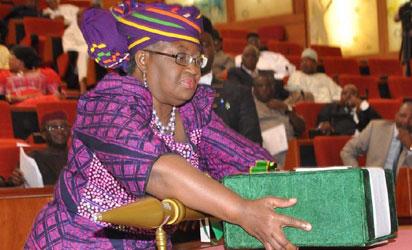
File: Okonjo-Iweala
BY DELE SOBOWALE
Fortune, ever fickle, will assail with sudden stroke, the kingdoms of the proud. Geoffrey Chaucer, 1342-1400. (VANGUARD BOOK p 64).
CHANGE OF FORTUNE
Earlier on, this year, we were beating our chest with pride. Our economy had been rebased and Nigeria had become the largest economy in Africa and the twenty-sixth in the world. Our GDP had been racing along at over seven per cent for several years, thanks to the price of crude oil which had been rising steadily since 1997 from $22 per barrel to over $110 for the past two years. There was no reason, or so thought our leaders, to expect there would ever be reversal so soon as to have the nation now wondering what to do and how to budget for 2015.
In 2013, crude oil benchmark was fixed at $77 even when the average for the year was over $100 per barrel. Ordinarily, that differential should have produced a bumper harvest into the illegal Excess Crude Account, ECA. But, it was not as high as expected. A warning was given and it was ignored. Then in 2014, we set out basing our budget on crude selling again in the mid-70 dollars per barrel. And, for a while, the price of crude actually went as high as $118 per barrel. Again, that variance should have yielded another bumper crop into the ECA. Then something curious happened. From January till now, instead of generating a favourable variance every month, and swelling the ECA, the country recorded negative variances every month except July of this year. We received stronger warnings; which we again ignored to our peril. It is quite possible that if the Economic Management Team, EMT, headed by the Minister of Finance, had paused as early as April, to find out why we were generating negative variances, instead of positive, they might have been able to alert the President and Nigerians about the dangers we now face and plans to minimize the damage would have been at an advanced stage of development; instead of being cobbled together under distress. What went wrong?
Several things, but, perhaps the place to start is to revisit our notion of when excess revenue is generated from crude oil. Every revenue budget consists of two variables unit price and volume. Positive variance, another synonym for excess crude revenue, can only arise when the combination exceeds the budget. In most of 2013 and for several years before that, Nigeria enjoyed positive variance. The tide of fortune turned against us late last year, when we stared collecting less revenue from crude than was budgeted. At least we should have learnt one of the verdicts of economic history: the price might stay up, but, if volume stays way down, you are in trouble. The downturn persisted until today and will continue until 2015-2016; at the least. Why?
The answer is simple. When you lose your best customer, the one accounting for 40% of your sales, the entire business is in jeopardy. Worse still, when the same former customer becomes a competitor, as the United States had become to Nigeria, it is a safe bet that recovery will not come about very soon. And, when finally, you add to those two misfortunes, the fact of depressed global economy, and loss of market share to other competitors, then the forces threatening absolute catastrophe have, for now, seized control. All of them are beyond the control of the government of Nigeria. At this point, the reader is probably thinking that budgeting for 2015, under the circumstances, is impossible. Not so.
Thinking about the problems associated with budgeting, I also thought of Napoleon Bonaparte, 1769-1821, who was reported to have said that the word impossible does not, or should not exist. He has a point. For one thing presenting a budget is one of the constitutional functions of the President and passing an Appropriation Bill is also a major function of the National Assembly, NASS. So for Jonathan and for the NASS, agreeing on a budget for 2015 is inescapable otherwise, they could both be impeached. Since, this difficult task is unavoidable, the most important question now is: on what do you base the budget since fixing the benchmark price of crude oil has now become as difficult as trying to sew a button on a lump of pounded yam?
The Federal government had tried twice, $78 and $73, and failed. The two previous attempts are now in trash cans at the Three Arms Zone. The third should not suffer that fate. That is, of course, easier said than done. It will not be easy for the simple reason that nobody can now get a fix on the two variables, price and volume, which will produce the projected revenue. On the face of it, that would make the whole exercise appear hopeless. But, there is hope. In fact, without hope, most Nigerians would have died long ago. And, I recollect the words of Miguel de Unamuno, who said: It is despair and despair alone that begets heroic hope, absurd hope, mad hope. (VANGUARD BOOK OF QUOTATIONS p 38). Hope inspired what follows.
BUDGETING UNDER ABSOLUTE UNCERTAINTY.
NOTE: What follows applies to the Federal Government of Nigeria, State Governments, Local Governments as well as private firms. Anybody, which means virtually everybody, whose livelihood depends on the drift of exchange rate has a lot to learn from this when preparing their budgets.
For a nation which had for decades had its annual budgets packaged for it neatly, with the major components fairly well-known, or supposed to be, to suddenly find itself searching for answers to ill-defined questions can be totally disconcerting. To begin with, few, if any of the government officials, who had participated in the preparations of budgets in the past, had ever experienced something like this. Almost total uncertainty is alien to them. Clearly, those charged with the responsibility of developing budgets for their entities in 2015, will receive very little assistance from their colleagues who cannot adapt to uncertainties and deal with them. Some of the inputs they might be getting might even be misleading.
Perhaps, the best way to be re-assuring, is to point out to our readers, leaders and Nigerians, that like an earthquake or tsunami, devastating as they are when they occur, this situation has happened before in other countries and what we are attempting to do is to adapt the remedies, with appropriate modifications to suit our unique environment, to help solve a difficult problem. It is not perfect; to be candid, no solution can be perfect under the circumstances.
INDISPENSABLE CONDITIONS
To prepare a budget for a country or even a company under such conditions of absolute uncertainty, regarding key variables, calls for unity of purpose among the leaders of the nation and the people. In this particular case it means the Presidency and the NASS, the Governors and their Houses of Assembly, Chairmen and Councilors, the Council of States, Governors Forum, yes, the Forum, and the rest of society. Given the frosty relationship between the Presidency and the NASS, and the Governors, at the moment, that might appear like asking for the moon. Yes, it is a tall order. But, we must all hang together now or die separately. We, starting with Jonathan, must all make the supreme effort in order for this thing to work.
Second, there must be absolute trust in those executing the budget. At the moment the trust deficit attaching to governments in general will again make this appear like a pipe dream. But, without trust the sacrifices which will be required of various stakeholders will not be forthcoming. Zero tolerance will mean, for instance, cleaning the executive branches of Ministers and Commissioners of suspects.
However, because trust cannot always be guaranteed, there must be checks and balances in the implementation. The current EMT will have to be disbanded. It is a club of multi-billionaires working solely in their own class interest. A new EMT will include nominees from the President, the NASS, the judiciary, Labour, ASUU, NBA, NMA, media etc. If we are all in this leaky boat together, then all stakeholders must be represented on the decision making body. That is the only guarantee we will have that one group will not seek its own self-interest at the expense of the rest of us. If ever we need Jeremy Benthams, 1748-1832, principle of the greatest good for the greatest number of people to save ourselves, this is it.
This is important because the Executive branches will be asking the lawmakers to sign on a FLEXIBLE BUDGET.
FORMULATION OF A FLEXIBLE BUDGET
The first question to answer is: what is a flexible budget? The short answer is: it is budget which is not anchored on a fixed benchmark, like $78, $73 or even $60. It is scary to contemplate just as some people almost died of apoplexy when the world went off the gold standard. The world, they said would come to an end! Since the global crude market has become so dynamic, for reasons too numerous to discuss, and which need not delay us at the moment, nobody can, with any degree of certainty, forecast what will be a safe anchor. Any attempt to insist on a fixed benchmark might lead us to a situation in which a budget is thrown away every two weeks. That wont do for obvious reasons.
Does that then mean we will move along without any idea of a benchmark? No; instead of one benchmark, we will have three benchmarks high, middle and low say $65, $55 and $45. But, we have not finished yet remember, revenue has two components, price and volume. We will again have three targets for volume. The EMT will then work out the broad outlook for each of those scenarios; then recommend one as starting point.
The absolute trust referred to earlier, comes into play if, and when, one of those two variables suddenly varies significantly from the starting estimate. The Executive branch will not have to return, during the financial year, to the lawmakers to obtain approvals for measures which might have to be taken in a hurry. This is a radical departure from what obtains at the moment. But, dangerous situations call for speedy departure from business as usual. In short, the situation in which we find ourselves now demand that we give more free hand to the executive branch and, in return, declare zero tolerance for corruption and incompetence.
None of these will avert the hardships most Nigerians will experience in the next few years. But, they will minimize them and allow for a more speedy recovery. As someone has observed, Good times never last forever. But, bad times never last forever either as long as leaders rise to the challenge and followers hold them totally accountable. Even this storm will pass away. As President Babangida (he led us into a hurricane such as this) told us, in an address he delivered at the National Institute for Policy and Strategic Studies, on October 26, 1985, I believe wholeheartedly in the promise of God; that in the middle of the utmost adversity, He creates and brings forth a new and greater glory and more auspicious circumstances for people that suffer. (TOWARDS A BETTER SOCIETY, President Ibrahim Babangida, p 7).
That was on the eve of the Structural Adjustment Programme, SAP, and crude oil was racing downwards towards $9.90 per barrel. Who would have thought then that we will ever reach $118?
LAST LINE: We have survived worse before; I strongly believe in the resilience of Nigerians and their ability to overcome the looming adversities. The leaders can either help or hinder them.
Disclaimer
Comments expressed here do not reflect the opinions of Vanguard newspapers or any employee thereof.