By Abiodun Owonikoko, SAN
In this piece, I have endeavoured to chart the legal and spatial perimeters of the fundamental rights entrenched in Section 38 of the Constitution( hereinafter referred to as “the Constitution”). The ‘extent’ element of the topic is addressed first. I have also addressed the ‘veracity’ of application of the right. The latter is with a view to ascertaining whether indeed that right truly enjoys recognition in our legal jurisprudence; and lastly if it does, how is it applied in real life by relevant state actors?
I then concluded with some thoughts and recommendations on the way forward for enhancement of the guarantee with particular reference to religious freedom both in conviction and external manifestation by way of observance.. It is in the second and third contexts that two contrasting judicial pronouncements are revisited namely- PROVOST KWARA STATE COLLEGEOF EDUCATION, ILORIN & 2ORS v. BASHIRAT SALIU & 2 ORS and MISS ASIYAT ABDULKAREEM (MINOR) and 2 Ors. V. LAGOS STATE GOVERNMENT & 2 ORS.
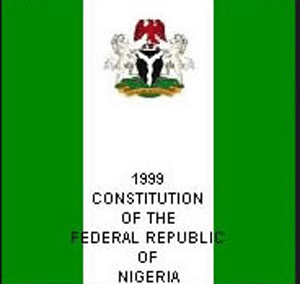
These two cases are then contrasted with yet another decision of our courts where the Constitutional guarantee of freedom of religion and observance of its tenet were expounded but with reference to a sister religious faith- JENEBU OJONYEV ALEYI ADEGBUDU, Particularly the excerpt from the judgment quoted by the learned author Fred F. Odibei EXTENT OF FREEDOM GUARANTEED: The starting point is to identify the right protected by the Constitution. The relevant section provides –Section 38 (1) of the 1999 Constitution of the Federal Republic of Nigeria (as amended) provides as follows;1. “Every person shall be entitled to freedom of thought,conscience and religion, including freedom to change his religion or belief, and freedom (either alone or in community with others, and in public or private) to manifest and propagate his religion or belief in worship, teaching, practice and observance.2.
No person attending any place of education shall be required to receive instruction or to take part in or attend any religious ceremony or observance if such instruction, ceremony or observance relates to a religion other than his own, or a religion not approved by his parents or guardian.3. No religious community or denomination shall be prevented from providing religious instruction for pupils of that community nor denomination in any place of education maintained wholly by that community or denomination. Nothing in this section shall entitle any person to form, take part in the activity or be a member of secret society.
EXTENT OF FREEDOM GUARANTEED:
The starting point is to identify the right protected by the Constitution5.The relevant section provides –Section 38 (1) of the 1999 Constitution of the Federal Republic of Nigeria (as amended) provides as follows: 1. “Every person shall be entitled to freedom of thought,conscience and religion, including freedom to change his religion or belief, and freedom (either alone or in community with others, and in public or private) to manifest and propagate his religion or belief in worship, teaching, practice and observance.2. No person attending any place of education shall be required to receive instruction or to take part in or attend any religious ceremony or observance if such instruction, ceremony or observance relates to a religion other than his own, or a religion not approved by his parents or guardian.3. No religious community or denomination shall be prevented from providing religious instruction for pupils of that community nor denomination in any place of education maintained wholly by that community or denomination.4. Nothing in this section shall entitle any person to form, take part in the activity or be a member of secret society.
Interestingly, the same or analogous provisions can be found in the previous Constitutional provisions since the first republican Constitution was enacted in 1963. See Section 24 1963 Constitution; Section 35 of the 1979 Constitution, respectively. By way of analogy, however, the American Constitution, in its first amendment promulgated as far back as 1791 projected similar rights of man when it states-“Congress shall make no law respecting an establishment of religion, or prohibiting the free exercise thereof ; or abridging the freedom of speech, or of the press ; or the right of the people peaceably to assemble , and to petition the Government for redress of grievances.[ Emphasis supplied by me]
As far as religion is implicated, the Nigerian Constitution differs slightly from the American Constitution on which it was modelled when we adopted presidential system of government in 1979. Whereas in the United States, the same first amendment prohibits adoption of preference of a religion for the State, in Nigeria by contrast, the provision which forbids the Nigerian Government or State Government from adopting any religion as a state religion is not entrenched as a fundamental right; although it is a Constitutional provision.
Interestingly, the same Constitution recognizes and enjoins the state to facilitate propagation of diverse religious beliefs. In the Constitution, under its Social Objectives, the Constitution prescribes that “The State shall direct its policy towards ensuring that –(b) Conditions of work are just and humane,and that there are adequate facilities for leisure and for social, religious and cultural life.” Needless to say that the first recorded and documented covenant for the protection of religious freedom is to be found in the Holy Quran8 wherein it was revealed to mankind as follows:
Let there be no compulsion in religion — the right way is indeed clearly distinct from error. So whoever disbelieves in the devil and believes in God, he indeed lays hold on the firmest handle which shall never break. And God is Hearing, Knowing. And with regards to right of observance and worship according to one’s faith, a whole chapter of the Quran is devoted to right of each person to worship his or her religion without undue interference from persons of other faith. Quran Chapter 109 is reproduced hereunder in Arabic transliteration and English translation for ease of access and reference. Arabic Transliteration.
- Bismillah Rahmaanir Raheem “Say : O ye that reject Faith 2. I worship not that which ye worship. Nor will ye worship that which I worship.4. Nor will I worship those whom you have worshiped;, . Nor will ye worship that which I worship.6. To you be your Way, and to me mine.
It is submitted that, save as qualified under section 45 (1) (a) (b) the right to freedom of religion, both as a matter of conviction and in its observance, is inviolate and cannot be derogated from by the state either in pursuance of its own objective or in aid of persons of other faith;and this restriction applies to exercise by other persons of their own right to religious
To be continued
Disclaimer
Comments expressed here do not reflect the opinions of Vanguard newspapers or any employee thereof.