•Insecurity, mass failures still recurring trends
By Amaka Abayomi & Ikenna Asomba
WITH seven days to year 2015, and in line with our tradition, Vanguard Learning takes stock of events that shaped the nation’s education sector, especially as the year is not ending on a striking note.
Though this relative calm is a far cry from the sector’s rocky start at the beginning of the year, Vanguard Learning explores the pains and gains of the education sector in 2014.
No more strikes —Minister
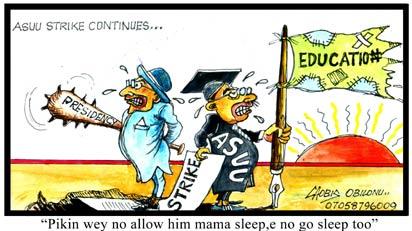
Undoubtedly, stakeholders of the nation’s education sector, comprising of students, their parents, teachers and non-academic staff, as well as government at different tiers will be basking in the euphoria of witnessing the end of the year without an ongoing strike across the basic or tertiary levels of education in the country.

FILE PHOTO: Cross section of stakeholders at a meeting to review the ongoing strike by ASUU held at the Trenchard Hall of the University of Ibadan. Photo by Dare Fasube
This is the first time in a long while that this relative peace would be recorded in the education sector. Perhaps, it was on this premise that the boisterous Minister of Education, Mallam Ibrahim Shekarau, on November 4, 2014, said that the era of industrial action in the education sector in Nigeria is over.
This assurance was given by the Minister when he was in Lagos for impact assessment tours of federal tertiary institutions in the state – University of Lagos, UNILAG, Akoka; Federal College of Education, Technical, Akoka; and the Yaba College of Technology, YABATECH.
The minister, who met prolonged industrial actions by the Academic Staff of Polytechnics, ASUP and Colleges of Education Academic Staff Union, COEASU, boasted that the suspension of the strike by the two aggrieved staff unions less than 24 hours after he resumed office was a clear pointer to his commitment to fulfil that mandate.
He added that part of the measures to nip strikes in the bud was his commitment to ensure the dignity of teaching service in Nigeria through adequate welfare packages, training and retraining of teachers at all levels, provision of conducive teaching and learning environment, among others.
He said these are targeted towards achieving the two fundamental objectives of the transformation agenda of President Goodluck Jonathan in the education sector, which he listed as increasing access and improving quality.
Grappling challenges
Despite the relative peace in the education sector, stakeholders are worried that Nigeria is still grappling with challenges bordering on rot, incessant strikes by staff unions over welfare and the state of teaching and learning facilities, kidnapping and killing of innocent school children in their schools by Boko Haram insurgents, increase in the number of out-of-school children and the dying prospect of meeting the 2015 United Nations’ deadline for Education for All.
There are also; mass failure in national examinations, inadequate access to tertiary education, steep hike in tuition fees in some tertiary institutions, the rising army of unemployed graduates roaming the streets, craze for foreign education, and brain-drain as a result of mass exodus of teachers to foreign institutions, among other worrisome issues.
A rejected budget
In what looked like an early punch to the Federal Government, the Senior Staff Association of Nigerian Universities, SSANU, in January, kicked against the N373.4 billion allocated to the education sector in the 2014 budget, claiming that it is way below the 26 per cent minimum budgetary allocation recommended by the United Nations Educational Scientific and Cultural Organisation, UNESCO.
The SSANU Chairman, Federal University of Agriculture, Abeokuta, Ogun State, Abdussobur Salam, said though education got the second highest allocation in the budget, the fund was too paltry to have the desired impact on the sector.
Army of unemployed youths
A recent survey which puts the figure of the nation’s unemployed youths at 54 per cent became glaring on March 15, when no fewer than 19 innocent job seekers, including pregnant mothers, lost their lives in stampedes that occurred during a nationwide recruitment exercise by the Nigeria Immigration Service, NIS, in different stadia in the country.
For just 4,000 job spaces, over 70,000 job seekers stormed the venues of the recruitment test, a worrisome situation which stakeholders say is a direct opposite of government’s claim that over 1.6 million jobs were created in 2013, while the National Enterprise Development Programme, NEDEP, will create 3.5 million jobs for unemployed Nigerian youths this year.
Chibok girls/rising insecurity
Nigerians were yet to get over the news of the Immigration stampede when, on the night of April 14, over 260 female students who were writing their SSCE were whisked away from the Government Secondary School, Chibok, Borno State, by members of the Boko Haram group.
As today makes it exactly 255 days since their disappearance, it is so sad that Nigerians are celebrating Christmas and would most likely cross over to 2015 with over 200 of the girls still missing.
Since the abduction of the Chibok girls, the insurgents have continued to abduct, maim and kill innocent school children across the North-Eastern states, while schools in Borno State just reopened in November following their closure in April.
JAMB’s new directives
Worried that the nation’s higher institutions have only been able to accommodate about one third of the over 1.5 million candidates who write the Unified Tertiary Matriculation Examinations, UTME, annually, the Registrar, Joint Admissions and Matriculation Board, JAMB, Professor Dibu Ojerinde, earlier in the year, disclosed that beginning with the 2014 UTME, candidates will be given the choice to pick only one university, polytechnic and college of education of their choice, as against the traditional first and second choice options of universities and/or polytechnics.
Ojerinde further stated that as part of efforts to improve education in Nigeria in line with global best practices, the Board introduced Computer Based Test, CBT, for all its examinations.
To this end, he announced that beginning from 2015, any student or candidate who was not computer literate would have no business with JAMB conducted examinations.
WAEC/NECO shocker
Just as Nigerians were getting over JAMB’s directive, the Head of National Office, West African Examinations Council, WAEC, Mr. Charles Eguridu, also dropped a shocker that signifies a decline in the performance of students in external examinations as 529,425,000 candidates, representing 31.2 per cent of the total 1,692,435,000 candidates who participated in the examination, recorded credit pass in five subjects, including English Language and Mathematics, as against 36.57 and 38.81 per cent in 2013 and 2012 editions, respectively.
Unaccessed N100 billon
Against the backdrop of incessant strikes by staff unions of tertiary institutions, which have usually been blamed on inadequate funding, stakeholders were inundated on July 17, when the Chairman, Board of Trustees, BOT, Tertiary Education Trust Fund, TETFUND, Dr. Musa Babayo, revealed that some N100 billion TETFUND was lying fallow in a CBN account because federal and state tertiary institutions were being passive to access it.
Represented by Dr. Hana Kolawole, at a two-day interactive workshop on TETFUND organised for Vice Chancellors, Rectors and Provosts of tertiary institutions in the six states of the South-West, held at the University of Lagos, Babayo urged institutions to come up with proper documentation to access the fallow funds.
NYSC imbroglio
Towards the last quarter of this year, public outcry greeted the new policy of the National Youth Service Corps (NYSC), for imposing N4,000 fee on prospective corps members for printing of call-up letters on-line.
Despite explanations from the NYSC Director General, Brig-General Jonhson Olawumi, that the fees was neither for the scheme nor the corps producing institutions, but for services and infrastructure to be deployed by the collaborating firm, Messrs. SIDMACH Technologies Nigeria Limited, the controversy continued.
However, it took the intervention of the National Assembly to calm nerves as the implementation of the fees has kicked-off from the 2014 Batch ‘C’ corps members deployed in November.
…then Ebola came knocking
Unfortunately, the nation was overwhelmed mid third quarter of the year when Patrick Sawyer, a Liberian-American diplomat, imported the deadly Ebola Virus Disease into the country on July 20.
This development led to the closure of schools across the country, which were billed to resume in September.
However, following concerted efforts by the Federal Government, as well as the 36 state governments, the EVD was successfully contained, as Nigeria was declared Ebola free on October 20, by the World Health Organisation (WHO).
Schools were thus re-opened across the states, even though a recent investigation by Vanguard Learning shows that schools have abandoned the precautionary measures of preventing the EVD.
Disclaimer
Comments expressed here do not reflect the opinions of Vanguard newspapers or any employee thereof.