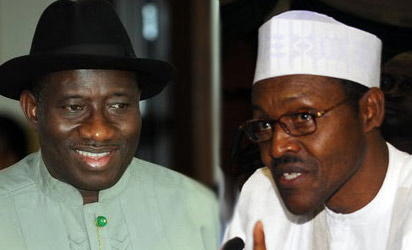
President Goodluck Jonathan and Gen. Muhammadu Buhari (rtd)
By Douglas Anele
In the last series of articles of this column, I tried, albeit briefly, to determine the electability of two major frontrunners in next year’s presidential elections, namely, President Goodluck E. Jonathan and former military head of state, Muhammadu Buhari. From the analysis, I concluded that despite the egregious failings of the incumbent President and the anti-corruption reputation of Buhari, Jonathan who has been chosen by the ruling Peoples Democratic Party (PDP) as its presidential candidate will defeat Buhari of the All Progressives Congress (APC) in 2015 if the latter emerges as APC’s presidential flag bearer. That conclusion flows from two undeniable facts.
One, Buhari’s fourth attempt is riddled with inconsistencies between his dictatorial legacy and unconvincing attempts by Buharists to present him as a disciplined democrat capable of navigating the treacherous and muddy waters of Nigerian politics. Two, APC, the opposition party, is too similar to PDP in terms of ideological hollowness and questionable antecedents of its prominent members that for most Nigerians the difference between the two parties is like the difference between six and half a dozen. These, coupled with the incumbency factor, will work in favour of President Jonathan during the elections.
It must be remarked that entrenchment of the incumbency factor in the DNA of Nigerian politics implies that genuine democracy in terms of Abraham Lincoln’s definition as “government of the people, by the people and for the people” is yet to evolve in Nigeria and, indeed, in most African countries. Of course, there can never be a perfect democracy in this world. But in Africa what obtains mostly is a caricature of democracy that subordinates the interests of the vast majority to those of the political and economic elite.
The kind of governance in Nigeria since 1999 cannot really be characterised as genuine democracy, principally because of the selfish, primitive, immature and myopic attitude of politicians and Nigerians generally to important issues of governance and leadership. The best description for it is agbata ekee democracy, which is aptly captured by Fela Anikulapo-Kuti’s poignant notion of “democrazy” or “demonstration of craze.”
But what is agbata ekee democracy? Logically, before one can grasp the concept of agabta ekee democracy, a prior understanding of the expression agbata ekee is necessary. Agbata ekee is an Igbo expression that connotes the practice of sharing things obtained through theft, fraud, deceit, and other immoral means. Hence, armed robbers sharing what they had forcibly taken from their victims, police officers distributing money collected from motorists during illegal roadblocks, and legislators scrambling for their own share of bribes paid either by the executive to get a certain bill passed or by a multinational company to secure favourable contracts and concessions from government – all these belong to the category of agbata ekee behaviour.
From the foregoing, agbata ekee democracy is a debased form of civilian administration in which members of the ruling elite manipulate the mechanics of power and law to appropriate resources of the country and distribute same among themselves, thereby alienating majority of the populace from the benefits of organised society and community life. Crumbs that manage to reach the masses from the master’s sumptuous table barely keep the masses alive and primed for further exploitation, marginalisation and pauperisation by the ruling class.
One of the essential attributes of agbata ekee democracy is the culture of inverted leadership. In a genuine or mature democracy, people go for power after prolonged soul searching, because they are interested in giving service to improve the living conditions of compatriots. Consequently, the most influential politicians in such a setting are successful professionals or businesspersons desirous of giving back to the community that gave them opportunities for successful life. Largely, when such people take up the reins of political power, the urge to engage in primitive accumulation would be low. Bulimic corruption is antithetical to genuine democracy: it leads to massive misappropriation of public funds. In a genuine democracy, political leaders recognise that they hold power in trust for the electorate and willingly step down when it is necessary to do so in the interest of the people. That is why in the mature democracies of Europe and North America, the level of corruption by top political office holders is relatively low if compared to what obtains in Nigeria and other fledgling democracies in Africa.
In Nigeria, a sizeable percentage of those engaged in politics are either jobless people trying to survive or unsuccessful professionals who believe that politics is the quickest way of rehabilitating their dwindling economic and social standing in the society. So, it is not surprising that Nigerian politics is rapidly being dominated by greedy and unscrupulous ruffians coarse in both mind and intellect who do not understand that democracy, according to my friend, Obi Nwakanma, is a slow and graceful dance of ozo titled men, not the aggressive surugede dance of roughnecks. Generally, our politicians have not grown beyond the mental age of schoolchildren who maltreat a colleague whose opinions differ from their own. This explains the pernicious continuation of politics-with-bitterness, which has prevented the emergence of authentic democratic culture in Nigeria.
Those who denigrate Nigerian politics as a dirty game hardly consider the role of education, both informal and formal, in generating the kind of mentality politicians manifest either in the pursuit of their political ambitions or in carrying out their duties as public officials. In a developed society, education inculcates two mental dispositions conducive to democracy, namely, the willingness to back one’s judgment and readiness to submit to the decision of the majority even if one disagrees with it. Unfortunately, our educational system has failed in this respect. Recently in Ekiti state, minority lawmakers removed the Speaker of the State House of Assembly, Adewale Omirin. Similar scenario is playing out in the House of Representatives after Aminu Tambuwal refused to resign as Speaker after defecting from the PDP to the minority opposition party, APC. All this stems from obdurate refusal of the minority to conform to the democratic practice of submitting to the majority.
An essential feature of agbata ekee democracy is prevalence of the spirit of ferocious dogmatism and megalomania in some of the most prominent politicians. Shortly before the 2011 presidential elections, two presidential candidates made highly inflammatory remarks and threatened violence if they lose the elections. Threat and actual use of violence to win elective political positions is a negation of true democratic practice. Nigeria has had a chequered history of political violence instigated and engineered by power-hungry politicians intent on capturing power at all cost, since politicians for whom public office is an avenue for power and primitive accumulation tend to see violence as a legitimate means of acquiring and retaining power.
To be continued
Disclaimer
Comments expressed here do not reflect the opinions of Vanguard newspapers or any employee thereof.