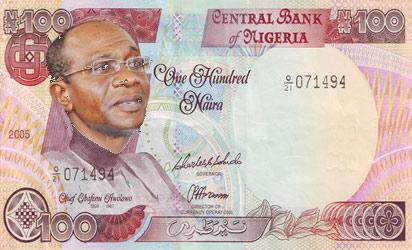
Emefiele
By Babajide Komolafe
The Central Bank of Nigeria (CBN) on Friday moved to further curb speculative activities in the foreign exchange market as it introduced a 48 hours limit on utilisation of dollars purchased at the interbank market.

Emefiele
Meanwhile the nation’s external reserve continued its downward trend last week, as it fell to $35.27 billion, implying $1.53 billion decline since the beginning of this month.
The limit was announced by Mr. Olakanmi Gbadamosi, Director, Trade and Exchange Department, CBN via a circular titled, “Utilization of funds purchased from the autonomous/interbank foreign exchange market by authorized dealers”. He said, “Further to our circular ref Ref:TED/FEM/FPC/GEN/01/026 of 17th December 2014, which requires banks to maintain zero percent of their shareholders funds as foreign exchange trading position as at the close of each business day, we write to inform all authorized dealers and the general public that with effect from the date of this circular, funds purchased from banks by their respected customers at the autonomous/interbank foreign exchange market must be utilized within 48 hours from the date of purchase, failing which such funds must be returned to the CBN for re-purchase at the bank’s buying rate.
For the avoidance of doubt, all authorized dealers are to note that the requirement to maintain zero percent of bank’s shareholders funds as foreign exchange trading position as at close of each business day remains in force.
Any observed case of infraction of this circular, in any way whatsoever, will attract appropriate sanctions both to the bank and the customers, which may include suspension from the foreign exchange market. This circular supersedes our earlier with ref: TED/FEM/FPC/GEN/01/028 of 18th December 2014. Please ensure strict compliance.”
On Thursday, the CBN had reduced banks’ dollar holdings or Net Open Position from one percent to zero percent of shareholders funds umpired by losses.
Titled, “Foreign Exchange Trading Position of Banks at the closure of each business day”, the circular was signed by Mr. Mr. Olakanmi I. Gbadamosi, Director, Trade and Exchange Department. The circular stated, “The Central Bank of Nigeria has observed the recent development in the foreign exchange market and its consequences on the stability of the exchange rates. In order to preserve the stability of the market, the foreign exchange position of individual authorised dealer, which currently stands at one percent of its shareholders funds (SHF) unimpaired by losses, has been temporarily reviewed downward to zero percent with immediate effect.
“Consequently, Authorised Dealers are therefore required to maintain zero percent of their shareholders fund as foreign exchange trading position at the close of each business day. Any infraction of the requirement of this circular, in any way whatsoever, will attract appropriate sanction, which may include suspension from the foreign exchange market.”
A retired top official of CBN who spoke to Vanguard on condition of anonymity said the implication of the circular is that banks cannot hold dollar asset or create dollar liability, except for dollars in the domiciliary accounts of their customers.
A market analyst who spoke on condition of anonymity said that the CBN introduced the restriction because it believes the banks are using their net open position dollars to speculate in the foreign exchange market. He said this means that banks cannot purchase dollars in the interbank market for trading the following day. They must ensure that any dollar they buy is sold at the end of the day. He said the implication is that for any bank to purchase dollars at the interbank, it must ensure there is a demand from customers for that dollar, adding this has effectively shut down the interbank foreign exchange market.
Measures can trigger further naira depreciation
In Middle Africa Briefing Note titled, “Nigeria: Will Tighter FX Market Regulations Work?”, analysts at Ecobank Nigeria said that the new restriction will increase volatility of the exchange rate and lead to further depreciation of the naira to N195 per dollar at the end of the year.
They stated, “By this regulation, the CBN aims to remove the banks’ ability to hold FX position, and subsequently limiting their speculative motive. The revised regulation also tighten how dollars can be used, as well as restrict access to foreign exchange to only legitimate and official document-backed FX transactions, thereby clamping down on FX flows.
“Tightening the conditions that allow access to dollars while making no changes to how foreign exchange is supplied will further heighten naira volatility, with further depreciation most likely; as such we expected naira to trade between N190 and N195 per dollar month-end December 2014.”
In the immediate, the OTC FX market liquidity is eroded, thereby creating a non-competitive market devoid of price transparency and discovery.
Tightening the conditions that allow access to USD while making no changes to how FX is supplied will further heighten NGN volatility, with further depreciation most likely; as such we expected NGN to trade between USD1: NGN190-195 month-end December 2014. ? By this regulation, the oil company bids will be on effective demand basis, as the banks are not allowed to keep position. The likely implication of this is that most of the oil companies will explore the option of selling directly to CBN.
While the CBN’s reason for the circular is to maintain the stability of the NGN, it is not clear how the CBN intends to achieve this objective, given following recent, sharp fall in Brent oil prices, and uncertainty over the normalization of US monetary policy following the end of QE III in October.
Meanwhile, over regulation of the FX market, which is underpinned by a free-float exchange rate policy, could be counter-productive by deterring portfolio inflows seeking to buy high yielding government securities.
Overall, the circular will create more volatility that will require another set of CBN’s circulars to address USD supply and demand bottlenecks.
As such, the CBN might need to continue to intervene in the interbank FX market.
Don’t close interbank, CBN warns banks
Meanwhile, the CBN has warned banks against shutting down the interbank market. Vanguard investigation revealed that following the reduction in banks NOP to zere percent on Thursday, banks’ foreign exchange dealers held a meeting to brainstorm the impact of the reduction on the foreign exchange market. It was gathered that, when the apex bank got wind of the meeting and the possibility of the meeting ending with a resolution to suspend interbank market trading, a top official of the CBN called some of the banks and threatened to withdraw the foreign exchange dealership if they make such decision.
A source at the meeting said that though he could not confirm if the CBN called the banks, he said the meeting however resolved to continue to trade in the interest of the nation. He said though dealers at the meeting believed that the reduction of the NOP to zero, has effectively shut down the interbank market, it was resolved that banks would continue to trade to ensure customers have dollars to meet their foreign exchange needs.
Naira gains N2.5
The naira closed the week on a positive note, as it gained N2.5 between Thursday and Friday at the interbank market. This followed N7.5 depreciation from Monday to Wednesday, which pushed up the interbank exchange rate to N187.1 per dollar from N179.6. However, fearing that the depreciation might persist and push the interbank rate over N190 by the end of the week, the CBN intervened on Thursday, selling intervention dollars to banks. This intervention coupled with the reduction in banks’ NOP, forced the interbank rate to drop to N184.6 per dollar on Friday.
Disclaimer
Comments expressed here do not reflect the opinions of Vanguard newspapers or any employee thereof.