By Ebele Orakpo
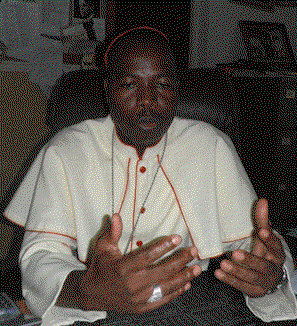
Boko Haram insurgency in parts of the North-East has seen many people killed and those who survived managed to escape after losing all their possessions to the insurgents. Sunday Vanguard visited the Most Rev. Stephen Dami Mamza, Catholic Bishop of Yola Diocese who, in conjunction with other organisations, is seeing to the welfare of thousands of internally displaced persons taking refuge in the homes of friends and relations in and around Yola.
 In this chat, Mamza speaks on the enormity of the situation faced by victims of Boko Haram and how the church and other organisations have tried to help. He calls on public-spirited individuals and organisations to come to their aid to alleviate the victims’ sufferings. Excerpts:
What is the situation on ground now?
The situation of the internally displaced persons (IDPs) in Adamawa State has been very critical since the people of Madagali, Michika and part of Southern Borno were displaced over two months ago.
The situation is getting worse. We have thousands of displaced people in Yola now. (Since this interview, more towns and villages have been sacked by Boko Haram, rendering thousands more homeless.)
Three groups of displaced people:
There are three categories of displaced people –first are those that ran to the mountains around Michika and Madagali and to other bushes. These people are still living there and they have no food.
As a matter of fact, some of those that left the mountains and came to Yola about two weeks ago told me that if you go to the mountain now, you will not find any edible green leaves because foodstuff completely got exhausted, so all the edible green leaves have been consumed by people as there is nothing else to eat.
Now, there is no food there and you cannot even carry relief materials to the place. People trekked more than three, four days to reach Mubi before coming to Yola. One of my relations actually had her daughter strapped at her back as they moved and she didn’t know when the daughter died on her back. So the situation is really very critical.
The second group of displaced people are those that have come into Yola and other places and they are at the NYSC camp and few schools in Jimeta metropolis. These people’s situation, I can say, is not too bad in the sense that they have enough foodstuff and enough relief materials; the only thing is that they are not in their homes and so, they can never be comfortable but at least, they are being taken care of.
The third group is the one I feel their situation is actually very critical. These are the ones that live with family members and friends. You hardly see somebody that comes from either Madagali, Shuwa, Baza or southern Borno who does not have a relative in Yola and our people are not used to living in camps so unless the situation is so difficult that there is just no option, if not, people will not go to the camp as a good option.
Most of them will live with their relations. Even in my house, the first two weeks after it happened, I had over 100 people in my house and right now, my domestic quarter is full.
Some of these family members and friends are low income earners; one of them may be the only person from a particular village living in Yola and everybody from that village will come to him and he has no option than to accommodate them. He cannot ask them to leave.
He may probably be earning N10,000 – N15,000 a month and now he has more than 50 people in his house, he cannot ask them to go and he has his own family to cater for. Some of them live in one room and parlour apartment with more than 30 people living there. I have gone round and seen some of these places. These are the ones that are badly in need.
Fending for the displaced:
Our people are not used to begging so they would prefer to manage and even die in silence than to go and beg. We have so many of them now. In fact, those living in camp are less than two per cent of the whole population of displaced persons.
In St. Theresa’s Cathedral, we have had three major food distributions and what we did was to start by registering people.
I decided to ignore those living in the camp because they have enough food and relief materials. People from Abuja and other places, NGOs, both federal and state governments send things to them but those that are neglected are those living with families so I decided to register only those living with their families.
We decided, under Justice and Peace, to register one person representing the whole family so we are not registering every member of the family. We took an average of five persons per family and the first distribution we had, we prepared packages for 1,500 families because we registered about 1,500 at that time but when we started distribution, those that came were getting to 2,000.
Then the second distribution was meant for 2,000, but then again, more came. Today (October 22, 2014), we actually prepared for about 3,000 families and we started last week but unfortunately, the number became so large, they were more than 5,000 so we had to stop distribution when it started getting rowdy.
I discovered that those that are more critical are the women – they do the cooking and take care of the children so the message I sent out was that we would concentrate on women and it is easier to control women and to take care of them so today, we shall be expecting between 2,500 and 3,000 women at St. Theresa’s Cathedral and it is hoped that the distribution will be very successful. (It was indeed very sucessful as witnessed by Sunday Vanguard. Nobody left the church empty-handed.)
How do you get relief materials?
The materials come from different individuals and also from some organisations and societies within the church. As a matter of fact, what I am getting as donation is not only from the Catholic Diocese of Yola, there are some that sent relief materials even from Port Harcourt; the Daughters of Charity came here about three weeks ago, they were here for 10 days giving free medical treatment to all the displaced people living with family and friends.
After they left, we had to continue with what they started so we had to buy medications and engage some of our medical personnel from St. Francis Hospital and also some displaced medical doctors and nurses who assist in taking care of them medically. Even Bishops Conference from different dioceses in Nigeria sending their own contributions and that is what we have been using to assist the displaced people.
Situation getting worse:
It’s even getting worse because we discovered that the number of the displaced people is increasing and the simple reason for the increase is that those on the mountain are coming down because of lack of food.
One of the problems that I feel is there now is that some of the family members are getting tired of taking care of their relations. I heard that some of them had to leave for the camp because there is no food. Most of those that were trapped in their houses must have died due to hunger. Either they are killed by the insurgents or they die of hunger.
When they took over Madagali, they proceeded to Michika and Bazza so the military had to go there and when the military saw the pressure, the Airforce had to destroy the bridge that links Bazza with Mubi side so that the insurgents could not cross and that was why they stopped there.
Michika and Mubi are Christian-dominated areas. In fact, when the Catholic Church came to Adamawa State, they started from these areas.
More than 85 per cent of the population is Christian. They are called Nyamirin Arewa, (Igbos of the North) because they are mostly into business and also mostly Christians. In my home town, Baza, 90 per cent of the population is Catholics and in Michika, EYN (Church of the Brethren Mission) dominates.
Disclaimer
Comments expressed here do not reflect the opinions of Vanguard newspapers or any employee thereof.