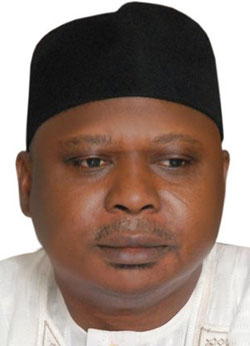
Kabiru Turaki
By Bisi Lawrwnce
I am in one of my dull moments again when simple situations that are as clear as daylight fail to emerge from the depths of confusion for me to grasp and comprehend like all others around seem to do. Why can’t I understand what is going on? Just when I think I am on top of the unfolding events, something that leaves me panting turns up again.
We at last arrived at the point where we were going to convene a meeting between some leaders of the Islamist insurgent group, Boko Haram, with the intention of working out an arrangement by which they could be considered for clemency— I beg your pardon, amnesty.

Kabiru Turaki
That was over a year ago. I did not get the impression that President Goodluck Jonathan was entirely for the idea until there were suggestions that members of the group call them terrorists or whatever—were going to shed the heavy veil under which they operated so far. The President was openly pressurized, almost blackmailed even, to yield grounds in the proposition to participate in a confab with “ghosts.” He averred that he was all for a meeting with real people but had no faith in communicating with masquerades. But he was given the assurance that it would not be case.
Accordingly, the government commissioned a technical committee to “review fresh ways” of tackling the security problems in the North— in other words, the Boko Haram menace. Based on a report submitted by this committee, the National Security Council recommended a Presidential Committee on Dialogue and Peaceful Resolution of Security Challenges in the North.
Twenty-six good men and true were promptly appointed as members of the panel which have become known as the “amnesty panel”. They were to engage members of the Boko Haram in a parley to find a way out of the unrest unleashed by the group on the rest of the country; to “design a framework” by which amnesty can be processed; to prescribe an agenda for the disarmament of the belligerent group within a period of 60 days; to invent a programme for the support of the victims of the Boko Haram terror; and fashion a plan for eradicating, or, combating, the root causes of insurgency in the country.
A tall order; an ambitious project; if you ask me, but a beginning of some kind.
Twenty-six Nigerians, good and true, were appointed to serve on the panel, headed by the Minister of Special Duties, Kabiru Turaki. Every member seemed to be of Northern extraction with the exception of Professor Bolaji Akinyemi, a former Minister of Foreign Affairs who, at the last check, was a South-western and by all accounts, still is. His inclusion in the list raised an eye-brow or two, not for being a Non-Northerner, but as the only Southerner appointed to serve in the group.
In the first pace, the emphasis of this issue as it is usually given an absolutely Northern coloration, neglects the important aspect of its effect on the entire country. It also seems to deliberately twist the resolution in a northerly direction in spite of the fact that many of the victims are Southerners. So there ought to be an infusion of Southern elements in the resolution of an issue that has affected them as much, at least, as it affects any other group, not a just a token representation.
This tendency to cast an overlay of Northern concern over this tragedy only deepens the division that the Boko Haram scourge has thrust upon the country. That was why we had always felt that the voices that are raised loudest for amnesty could have spared a decibel or two also for the cause of the victims. The scourge is not only inflicting havoc on our slender chances of nation-building, it is set on re-orienting our vision of development as a people. In these past several months, each ethnic group’s consciousness of itself as a distinct entity has become heightened.
Other objections had been made to the constitution of the panel. For instance, according to the Executive Director of the Civil Rights Congress, Shehu Sani, the appointment of the panel was precipitate. An earlier meeting should have taken place between the Boko Haram members and people they could have confidence in. He gave out the names of three of such people. That had been his standpoint before the creation of the panel, to which he was all the same named; he therefore had no qualms in withdrawing his membership from the body. Yet, at least one other nominee also pulled out.
But you must have heard that in the midst of all this, the Boko Haram has remained its old self—steady of purpose, unconcerned with other people’s anxieties, and totally unflappable. They have seen no rationale in the clamour by a section of the community for amnesty, since they hold themselves to be innocent of any crime. That is the point at which I really get nonplussed… that is, confused, concerned, baffled, bewildered, at a loss …
Who needed the amnesty? For whose benefit was it? Who should be asking for the amnesty? THEY SAY THEY HAVE COMMITTED NO CRIME! If so, they indeed deserve no pardon since they had committed no offence. But what name do you give the murders, the bombings, the demolitions? The laws of this country call them felony, that is, what felons do. And yet the country was made to witness that farce of peace-making with people who pleaded innocence? WHO IS TO BE PACIFIED? WHO IS TO BE APPEASED? Who should apologize? Who is to make amends? I am not clear. There must be some facts that I am unaware of.
Since then, that is before the middle of last year, these self-confessed jihadists have committed mayhem of an unprecedented scale. Most sensational, but not most brutal, was the abduction of over 220 school-girls from their dormitory in Chibok. But beyond that there have been the murder, and bombing, and maiming of thousands of Nigerians and the destruction of homes, climaxing in the proclaimed acquisition of our soil. Our consolation in that regard has been the re-capturing of territories lost to these brigands. A meeting with their delegation was supposed to have been arranged, but ended like a spent breeze that drifted away in the wind.
Of course, we all blame the government, personified by President Goodluck Jonathan—who else? Whose responsibility is it? Who asked for the job – and got it? Who promised that he could do it? But the job is still there. It has not been done. There are so many, many aspects to the questions it has raised and continued to raise. And so are the reasons for our disappointment and complaints. The President has often said, without much pleasure, that hardly had any other President been criticized like him in the history of this country. That cannot be very far from the truth since no one has ever been placed in the situation of being an elected head of state in such dire circumstances. We are never at a loss to reel them out— poor power supply, bad roads, unsteady economic situation, deteriorating educational standards, devastating insecurity and much more besides. Yes, he is to blame, but is he solely at fault?
Let us briefly cast our minds on the instruments provided for him to accomplish his job of correcting the ills that his office is called upon to address. As the Chief Executive, he is in charge of the administrative arm of government made up mainly by the police and the civil service. But although he has no direct control over the two other arms of government, that is the legislative and the judiciary, it is clear that he has, and exerted tremendous influence on their conduct. Without any attempt at criticizing his conduct, it might be justifiably remarked that his impact on the two other arms of government has not often been of salutary benefit to the process of governance during his term of office.
So, regrettably, is the pattern of succession that is being engrafted into our political culture. It springs from the general inclination under which high officials in political office aspire to perpetuate, or prolong their presence in the corridors of power. And so a local government councillor lunges for the chairmanship of the council; the chairman himself reaches out for a legislative seat; the legislator wants to become a state governor; a governor covets the more permanent seat of a senator; the president wants to be re-elected—or else! This generates a whirlwind of compromise, concession, carpet-crossing, and confusion that weakens the entire system, but moulds and hands over the power to an unconstitutional extent to the recipient,
Now is the time for succession into several powerful positions in the country. The season for declarations, sycophancy, disloyalty, schemes and plans and intrigues, is here. So many men and women are asking for the job.
Which one you dey?
Time out
Disclaimer
Comments expressed here do not reflect the opinions of Vanguard newspapers or any employee thereof.