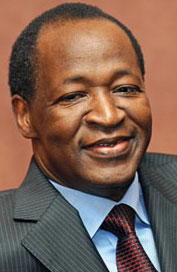
Blaise Compaore
BLAISE Compaore, 63, was in power for 27 years. If he had got another five-year term next year, he would have spent almost half his life as the ruler of Burkina Faso, one of the world’s poorest countries, whose misfortunes have benefitted from stalled leadership.
Angry Burkinabes ejected Compaore from power on Friday, but the chaos that his forced departure is causing is not new. Almost every African country with long-lasting dictatorships remains in ruination after the demi-gods leave.
Cote d’Ivoire has not fully recovered 22 years after the death of former President Felix Houphouët-Boigny, its first president. He ruled for 33 years.
Africans are tired of long-term dictators who have no plans to leave, or at best prepare their relations to succeed them. Benin, Burundi, Congo-Brazzaville, the Democratic Republic of Congo, and Rwanda are some countries whose leaders have sit-tight tendencies.

Blaise Compaore
Compaore should have learnt from Niger’s Mamadou Tandja who the army evicted in 2010 following his third-term bid. Senegal’s President Abdoulaye Wade lost the 2012 election after changing the constitution to run for a third term.
Paul Biya, 80, Cameroun’s President, perennially in France tending his health, has been President for 32 years. He was Prime Minister for seven years. Robert Gabriel Mugabe of Zimbabwe, 90, his country’s only President in its 33 years, has his wife as possible successor. Eritrea’s Isaias Afwerki (21), Angola’s Jose Eduardo dos Santos (35), Chad’s Idriss Deby (24), and Uganda’s Yoweri Kaguta Museveni (28) are among African leaders who refuse to leave office.
If Compaore intended anything for Burkinabes, years of his draconian rule, intolerance of opposition and futile economic policies have washed them away. Like in Zimbabwe where inflation has hit incalculable heights and there is scarcity of everything from food to fuel, Burkina Faso suffers harsh economic circumstances from poor leadership.
Dangers of Compaore’s 27 years of misrule and the decimation of the opposition include the difficulty of finding a worthy successor whenever he signs off. Anyone who could lead Burkina Faso or nursed the slightest ambition to do so has been disgraced, humiliated, jailed or killed. Dictators in the continent apply the same tactics. Fighting has ensued over who succeeds Campaore, a re-play of the Cote d’Ivoire scenario.
There must be more creative ways of rescuing countries that their leaders put in bondage as is increasingly common in Africa. Economic sanctions are not enough, for they tend to hurt the poor more.
Serial condemnations of forced leadership changes, as the Economic Community of West African States, ECOWAS, and the African Union, AU, often do, would not solve the problem. Burkina Faso, if unchecked, could be on its way to irredeemable collapse.
Disclaimer
Comments expressed here do not reflect the opinions of Vanguard newspapers or any employee thereof.