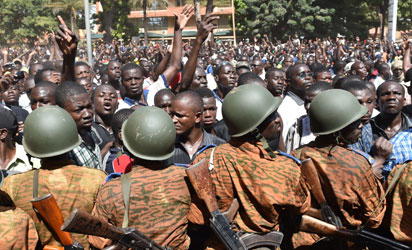
A crowd gathers on October 31, 2014 in front of army headquarters in Ouagadougou, demanding that the army take over following the resignation of the president. Burkina Faso’s army chief Navere Honore Traore said he was taking power on October 31 as head of state after President Blaise Compaore announced his resignation as tens of thousands of protesters demanded that he quit immediately after a day of unrest that saw mass protests and the storming of parliament and other public buildings. AFP PHOTO
By Is’haq Modibbo Kawu
“This is a sub-Saharan spring and it must continue against all presidents trying to hang onto power in Africa.”
IT was a Law student, Lucien Trinnou, speaking last Friday in Ouagadougou, that gave this description of the uprising in Burkina Faso, which swept away, Blaise Compaore, one of the most despicable characters to ever seized power in any African country. When Compaore murdered the revolutionary icon, Thomas Sankara, in Octtober 1978, he murdered the hopes of millions of the working people, the youth and poor people, not only in Burkina Faso, but all over the African continent.
This was because in his depth of analyses of the conditions in his country and the continent; in the charismatic and openly transparent leadership as well as genuine commitment to liberation from imperialism, Thomas Sankara embodied the very best values of all the African peoples. His murder by Blaise Compaore, an agent of imperial powers, was one of those genuinely felt pains by the African peoples and oppressed peoples around the world.
Thomas Sankara had belonged to the Union of Communist Officers, along with Henry Zongo, Jean-Baptise Lingani and Compaore. But it was clear that the assassin, Blaise, nursed a different vision of power and in cahoots with Zongo and Lingani, had conspired against Sankara; and determined to wield absolute power, Blaise Compaore would eventually kill the other two to become the sole leader of a country whose soul had been interred along with the hero of the people, Thomas Sankara. Murder was a central instrument of Compaore’s27 long years in power and one of the most notorious came at the end of 1998, when Norbert Zongo, the investigative journalist, was killed. Zongo’s murder became a turning point for the country.

People celebrate in the capital Ouagadougou after Burkina Faso’s embattled President Blaise Compaore announced earlier on October 31, 2014, he was stepping down to make way for elections following a violent uprising against his 27-year rule. Blaise took power in a coup in 1987 but quickly swapped the “democratic revolution’s” Marxist ideals for authoritarian rule. AFP PHOTO
Over the past twenty-seven years, the Burkinabe people and the African continent, witnessed the spectacle of the assassin’s desperate search for legitimacy and acceptance. He was a major organizer of insurgencies around West Africa and walking on both sides of the road, he also postured as the regional peacemaker. In recent years, he became one of the greatest collaborators with the Franco-American anti-terror campaigns in West Africa; a role that he milked for his own survival and the deep-seated hope of leaning on, to extend his stay in power.
It became clear that Blaise Compaore had overreached himself and miscalculated the portents. The opposition was beginning to abandon its fractious ways and had found the elusive unity; it was becoming more difficult for Compaore to play one party against other. A vibrant civil society had also evolved in Burkina Faso willing to play a crucial role to stop the assassin’s tenure extension plan; and there was also the important demographic situation: 60percent of the Burkinabe population of about 17million people are under the age of 25. According to a 2013 Gallup Poll, only 5% of the working age adults are employed full time. The educated young people have known no other leader except Blaise Compaore.
While his Western backers had often praised the stability he allegedly presided over and his ready embrace of neoliberal policies, the Burkinabe economy was not creating the jobs to absorb its very frustrated young population. And despite the bluster, Burkina Faso was 181st out of 187 on the UN Human Development Index. It was a combination of all these factors that hastened his cowardly departure. And to underline his role as an asset of imperialism, French President, Francois Hollande, this week Tuesday, told a press conference, in Canada that: “we made sure Compaore was evacuated to Ivory Coast by making available all useful resources”.
He departed owing to the determined resistance of the Burkinabe people.Last Thursday, parliament was poised to approve legislation that would have facilitated Compaore’s extension of stay in power for another five years. Tens of thousands of Burkinabe, most of them young people, took to the streets in Ouagadougou, BoboDioulasso and other parts of the country. In BoboDioulasso, Compaore’s statue was toppled, while parliament was set on fire, disallowing the complicit parliamentarians from sitting. Other government buildings were also touched along with hotels, shops and residences of regime supporters. French diplomatic sources said about thirty people were killed in the demonstrations.
It was a shell shocked and drained Blaise Compaore that addressed the nation from a private television station, because the state broadcaster had also been taken off air. He desperately attempted to use the military to shore up his position in what appeared like a coup against the mass uprising; but his time was up! The imperial powers had become willing to sacrifice the assassin and there are even reports that General Olusegun Obasanjo, who was visiting Dakar, Senegal, made a detour to Ouagadougou, to encourage Blaise Compaore to leave the scene.
In the end, he ran with tail between his legs and is holed up in an Ivorian resort. Blaise Compaore must not be allowed to find the peace and tranquility he denied millions of people. Not only that, he must get his day in court to answer for the crimes he committed against the Burkinabe people and Africa, with the murder of Thomas Sankara and Norbert Zongo. He must also explain why he executed Henry Zongo and Jean Baptiste Lingani and several other Burkinabe patriots. The Burkinabe people have put on notice all other African sit-tight leaders. They have called it a sub-Saharan spring! Africa deserves democratic cultures genuinely rooted in the aspirations of the African peoples. Last week in Ouagadougou, the people spoke and kicked out one of the most despicable rulers to ever appear on the horizon of leadership in our continent, Blaise Comp aore!
Nasir El-Rufai and Hakeem Baba-Ahmed
I MUST start with some disclosures. I have written very scathing commentaries on Nasir El-Rufai in the past; these were especially during his years as Minister of the FCT. I was always ideologically opposed to his effusive defense of the neoliberal policies of the Obasanjo administration. That much I openly stated, without failing to acknowledge his commitment to duty.
In the years that he has left service, and against the backdrop of the subsequent deterioration in the quality of public service in our country, Nasir El-Rufai’s application, vision and achievements have come to be appreciated by a lot of Nigerians. In the same period, Nasir and I have become closer. We have discussed his years in power and I have come to know his views of developments better. I still have reservations his ideological perspectives but I respect his patriotic fervor and commitment to Nigeria’s development.
When I heard a few months ago, that he was likely to run for Kaduna state governorship, I phoned him to express my support and endorsement. Kaduna is one of the three cities I live in and it is my family’s favourite place. I feel a strong emotional attachment to the city and state. For my generation of Northerners, it remains the capital of the old Northern Nigeria that we were born into and grew up in.
I have always believed that whoever would make success of leadership in Kaduna state, must have an appreciation of its historical place in Nigerian development. It is such a broad understanding of history and a nuanced appreciation of the complex relationships between and within communities and peoples in that state and city that will condition successful leadership. Over the past couple of years, especially after Ahmed Makarfi, Kaduna has suffered very much.
That is why I sincerely believe that Nasir El-Rufai will make a good governor of Kaduna. He understands the intricacies that I have described; he has the intellectual capacity to analyze the issues and he possesses a tremendous team building ability to galvanize the best brains to work. Kaduna today needs a leader like Nasir El-Rufai; I do hope he wins his party’s ticket and then goes on to win a free and fair election, to be able to provide the leadership and development that my second home, Kaduna state deserves! Similarly, Dr. Hakeem Baba-Ahmed is seeking to go to Senate from Kaduna.
Anyone who has read Hakeem Baba-Ahmed or has had the privilege of listening to him, the intellectual and policy wonk rolled up into one, knows that Nigeria’s Senate will be eminently enriched by his presence there. I think we must begin to go for the highest denominators in our search for leadership so that we can get the very best of our country, coming to work for its development. Hakeem Baba-Ahmed will certainly be a major asset for Nigeria’s Senate if he wins his election.
A month out of Nigeria
I AM writing these lines from a hotel room in Dubai. I commenced a month-long vacation on Saturday and in the next four weeks, I will be writing about Nigeria and the wider world from here, Buena Park in California; Dallas in Texas; I will make a stopover in Warsaw, Poland and the move on to England before returning to Dubai on my way back home in December. I have had a very crowded 2014, including the five-month long National Conference and I have been unable to take the break to rest as well as reflect on life and its tapestry. But even a vacation does not take away that compulsion to take a peek into the entrails of our country. And these are very interesting times in Nigeria: the 2015 elections have become the only issue for our rulers; the country appears to be dangerously listing, like a distressed ship. Huge swathes of the Northeast have been taken over by the Boko Haram insurgents and our army seemed to have completely abandoned its very rich regimental tradition, as whole battalions run away from a ragtag but ideologically driven insurgency.
It is appearing clearer now, that the country has been conned with all that talk about a ceasefire. It never held; Boko Haram did not respect it and there is clearly a lot of eggs on the faces of many officials of the administration in power: from the Chief of Defense Staff, Alex Bardewhose hometown was taken over by the insurgents to Hassan Tukur who told us he was negotiating with a ” General Secretary” of Boko Haram that was denounced by the insurgents and President Jonathan, on whose table the buck stops! Our nation burns, and for all the president’s people, what matters is the 2015 elections. Along the way, they are also fighting wars of attrition, including the ridiculous step to strip House Speaker, Aminu Tambuwal, of security cover. They just don’t ever learn!
Disclaimer
Comments expressed here do not reflect the opinions of Vanguard newspapers or any employee thereof.