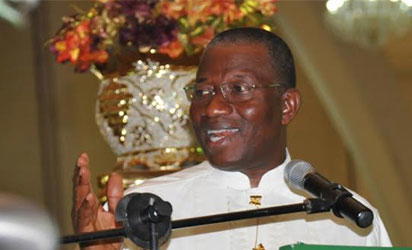
President Goodluck Jonathan speaking at the 54th Independence Anniversary Interdenominational Church Service at the National Christian Center, Abuja On Sunday (29/9/14)
By Bashir Adefaka
President Goodluck Jonathan, in the last ten months, has made two major speeches that got Nigerians glued to television and radio sets hoping to be told new things. Speeches of Presidents and Heads of State, in the past, had one of such that either put smiles on the faces of the people or did otherwise.
Of particular reference was President Umar Musa Yar’Adua’s speech that cut fuel pump price from N70 to N65. They are little, little things in a President’s speech but they matter to the common man.
Much as many people agreed with Jonathan that he actually won the war against the deadly Ebola Virus Disease, EVD, a source in Lagos, speaking to Sunday Vanguard anonymously, last week, said his centenary and 54th independence anniversary speeches fell short of expectation.
The respondent, who was asked about the missing point in the speeches, said, “One expected a statement in the speech which would lift our spirits as Nigerians like saying, ‘Fellow Nigerians, I put it to you today that the Minister who has been alleged to be responsible for so, so and so missing billions of dollars from our economy is hereby not only sacked but also has been handed over to the police with immediate effect.’.
“We had expected a presidential speech that would say, ‘My good people of Nigeria, it has come to my notice that kerosene that is the common means of cooking by the generality of Nigerian masses henceforth will not only be available unhindered but also it will be available at N50 per litre either at NNPC mega station or non-NNPC retail stations’ and that ‘all those who have been frustrating Nigerians’ ability to enjoy the subsidy on petrol have been apprehended and will be paraded for Nigerians to see who their enemies of progress are.”
He explained that, that sort of presidential speech was one of hope that would to tell Nigerians why they should embrace unity and Boko Haram members should surrender. This aspect, he said, is the missing point that needs to be addressed.
In a related development, a retired military officer, Colonel Gabriel Ajayi, linked the reason
Nigeria’s problems seem unsolvable to lack of concern about using the opportunities afforded the leadership of the country to heal the wounds of the past.
“We had 50 years of independence anniversary. That was golden jubilee. Do you know the meaning of that? Year of relief! Year of re-compensation! Was there any amnesty granted to any prisoner in Nigeria to mark the anniversary? They did it in Ghana and that was the turning point for that country. It was not the killing that was done all over Ghana. What changed the life of Ghana for better was the visit to prisons by government to do justice,”Ajayi told Sunday Vanguard in an interview.
“So many people were there for no just cause and the president said, ‘Okay, if you have been in prison for the past three years, you are free from today. If you come back, that is your own problem but you are free.’ Amnesty to all! We couldn’t do that in Nigeria. People that had been wronged, Nigerian government failed to seize the opportunity of the golden jubilee to do justice and reconcile with them.”
He went on, “The basic problem is our perception of justice. There is no justice in Nigeria. I, myself, am a victim of injustice! And so, we say, ‘Oh, forget about the past.’ But injury to a soul does not vanish easily. How can you move forward when you have not been able to come to terms with the past so that we can unchain the present and free the future? We must come to terms with our past to unchain the present and free the future. If we do not do that we are going to remain like this. All we will be doing will be taking one step forward and many steps backward.”
Such new thing is the creation of hope, assuaging of strained nerves which was said to be missing in both centenary and 54th anniversary speeches delivered by the President in the last 10 months.
It is not government at all levels that is guilty. Governor Emmanuel Uduaghan of Delta State, who is of the ruling People’s Democratic Party, PDP, led the way by granting state pardon to a 77-year-old man, Dickson Umukoro, among others, as part of the activities to mark Nigeria’s 54th independence anniversary. Jonathan had the opportunity to do same but did not.
Uduaghan, using his power of prerogative, in line with Section 212 of the 1999 Constitution, freed Umukoro alongside condemned 53-year-old Monday Tom and an unnamed adolescent, who was sentenced to death seven years ago.
Others pardoned by the Delta State governor included Dele Mokwunye, Ufuoma Paul Eto, Moses Orakpor, Uche Dike, Jonathan Igbi, Chukwuemeka Igwebuike, Chijioke Edeh, Augustine Okoroh and Joshua Musa, all sentenced to varying prison terms. Umukoro and Tom were freed based on their good conduct. Edeh, Okoroh and Joshua Musa however had their death sentence commuted to life imprisonment, a development the state Attorney-General and Commissioner for Justice, Mr. Charles Ajuyah (SAN), commended as a kind and rare gesture from Uduaghan, pursuant to his power of prerogative of mercy and in the spirit of the celebration of Nigeria’s 54th independence anniversary.
Jonathan has a backlog of pardon on his hands which, if pronounced in any of the two speeches, would, by now, spell for him another reason Nigerians should love him the more. On March 12 2013, more than a year and a half ago, he made a pronouncement pardoning General Oladipo Diya’s group convicted in the 1997, a former governor of Bayelsa State, Chief Dieprieyie Alaimeseigha and few others.
Even as controversial as the list of the pardoned Diya’s group was, being that only three of the six involved were announced, the gazette authenticating that pardon remains hanging between the offices of the President and the Attorney-General of the Federation. And like the widow of the late General AbdulKarim Adisa, Rahmat, said, the Army Headquarters could only act to restore the status and payment of entitlements to those affected only when the gazette is published.
Things like this would have lifted the spirits of many Nigerians if Mr. President had touched it in his centenary or 54th independence anniversary of Nigeria hence the missing point that people talked about. And many eminent Nigerians like Afenifere chieftain, Ayo Adebanjo; legal luminary, Tunji Abayomi, SAN, and more had spoken about the need for Mr. President to do this pardon and pay entitlements of the officers, particularly of the Diya’s group, without any one left out.
The spirit of presidential pardon to political offenders is known to have paid off for Nigeria in the past and the story, many believe, cannot be different in the modern day life of the country. This reporter gathered that despite the fact that a former Head of State was implicated in the Lt. Col. Buka Suka Dimka-led coup that killed the then sitting
Head of State, General Murtala Muhammed, in February 1976, the implicated former Nigeria leader was pardoned by the General Ibrahim Badamosi Babangida’s regime. He was not alone. Ex-Biafran warlord, Odumegwu Ojukwu, who traumatized Nigeria with war for four years, was also pardoned and both men were restored into normal lives as they both separately contested to become civilian presidents of Nigeria and they were very useful for the country thereafter.
Disclaimer
Comments expressed here do not reflect the opinions of Vanguard newspapers or any employee thereof.