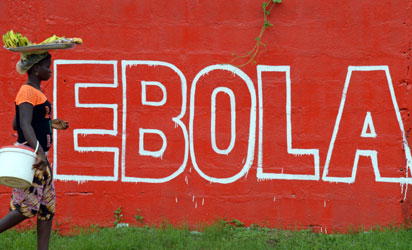
File: A seller of bananas walks past a slogan painted on a wall reading “Ebola” in Monrovia on August 31, 2014. Liberia on August 30, 2014 said it would deny permission for any crew to disembark from ships at the country’s four seaports until the Ebola epidemic ravaging west Africa was under control. AFP PHOTO
Conakr – From Guinea’s forests to Sierra Leone’s capital, here are key dates in the current Ebola epidemic, which since it emerged late last year has spread beyond its west African hotspots.
According to the latest toll given by the World Health Organization (WHO), the worst ever outbreak of the haemorrhagic fever has left 4,877 dead out of 9,936 cases registered.
Three countries have borne the brunt, with Guinea seeing 904 deaths, 2,705 deaths in Liberia, and Sierra Leone 1,259.
— DECEMBER 2013 —
– 6: A two-year-old child dies in Meliandou in southern Guinea and is later identified as “patient zero”. The virus remains localised until February, 2014, when a careworker in a neighbouring province dies.
— MARCH 2014 —
– 24: Authorities in Guinea and the WHO say that since January the country has recorded 87 suspected cases of viral haemorrhagic fever, including 61 deaths.
Scientists studying samples in the French city of Lyon confirm it is Ebola.
– 31: Liberia confirms two cases of the virus.
— MAY —
– 26: Sierra Leone confirms its first case.
— JULY —
– 20: The virus spreads to Nigeria, as a Liberian-American arrives by plane in Lagos and dies in quarantine.
– 30: Ebola is “out of control” according to the aid group Doctors Without Borders (MSF). Liberia closes its schools after shutting some border crossing points.
— AUGUST —
– 8: The WHO declares the Ebola epidemic a “public health emergency of international concern”.
– 11: A separate epidemic appears in the Democratic Republic of Congo, and is responsible for 49 deaths.
– 12: The WHO authorises the use of experimental drugs in the fight against Ebola after an ethical debate.
A Spanish missionary contaminated in Liberia dies in Madrid, the first European fatality.
– 18-27: Several African countries close their borders with the affected countries, as the last remaining airlines suspend its links.
— SEPTEMBER —
– 5: The United Nations says it will take six to nine months to stop the virus from spreading.
– 16: The United States announces a plan to send 3,000 military personnel to Africa.
– 18: The UN Security Council declares the Ebola outbreak “a threat to international peace and security”.
– 19: Sierra Leone launches a three-day shutdown to contain the virus. Six days later it places three districts under quarantine which, added to two already locked down, hems in 2.2 million people of a population of six million.
– 30: In the United States, a Liberian is hospitalised in Texas, the first Ebola infection diagnosed outside Africa, and dies on October 8. Two careworkers who had been at his bedside are infected, one has been cured since.
— OCTOBER —
– 6: First infection outside Africa, of a Spanish nurse in a Madrid hospital. On the 19th she tests negative for the virus.
– 9: A top US health official from the US Centers for Disease Control and Prevention warns that Ebola could become the next AIDS.
– 14: A Sudanese UN employee infected with the virus in west Africa dies a week after arriving in Germany for treatment.
– 17: The United Nations says it has received 38 percent of the $1 billion it has appealed for.
It declares the end of the epidemic in Senegal, with the only patient, who had arrived from Guinea, having been cured.
– 20: The WHO declares that Nigeria is Ebola-free, after eight people died out of 20 cases there.
– 23: Mali records its first confirmed case, a two-year-old girl who came from Guinea with her grandmother.
First confirmed case in New York, the biggest US city, a doctor who worked with MSF in Guinea.
– 24: The European Union says it will increase its aid to one billion euros ($1.26 billion).
Disclaimer
Comments expressed here do not reflect the opinions of Vanguard newspapers or any employee thereof.