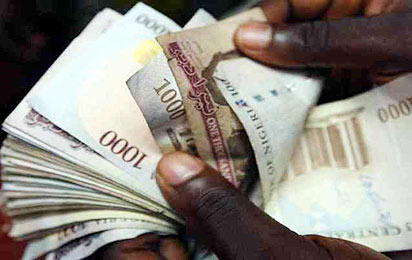
Naira
By Babajide Komolafe
The Central Bank of Nigeria (CBN) last week stepped up its intervention in the foreign exchange market in order to halt the depreciation of the naira in the interbank market.
 Vanguard investigations revealed that in addition to foreign exchange sold through the bi-weekly Retail Dutch Auction System (RDAS) sessions on Monday and Wednesday, the apex bank conducted special foreign exchange sales on Tuesday, Wednesday and Thursday.
The intervention followed sharp increase in foreign exchange demand which caused the naira to depreciate to N165.5 per dollar at the interbank market.
The previous week, the naira depreciated by 75 kobo due to demand pressure caused by anxiety over falling crude oil prices. This persisted till Monday last week, leading to 129 percent increase in demand at the RDAS session on Monday.
Failure of the CBN to meet the increased demand worsened the situation in the interbank market; hence the interbank exchange rate rose to N165.55 per dollar at the close of business on Tuesday.
Though the apex bank sold intervention foreign exchange on Tuesday, it decided to repeat the intervention on Wednesday and Thursday to reverse the depreciation of the naira.
This caused the naira to appreciate steadily in the interbank market from Wednesday till the close of business on Friday. Data from the Financial Market Dealers Quote (FMDQ) show that the interbank market exchange rate dropped from N165.5 on Tuesday to close the week at N164.6 per dollar.
Reflecting the apex bank’s frantic efforts to save the naira, foreign exchange sales at the RDAS sessions for the week rose by 43 percent to $999.88 million from N699.94 million the previous week. Consequently the apex bank has sold $2.1 billion this month and N28.2 billion this year through the RDAS sessions.
External reserves down by $290m
On the other side, the nation’s external reserve dropped by another $290 million last week to $39,063 billion from $39.353 billion the previous week. Consequently the external reserve has fallen by $458 million from $39.521 million at the end of September.
The persistent decline in the external reserves as well as increased foreign exchange demand are due to response of foreign portfolio investors to the sharp fall in crude oil price in recent times.
Vanguard was reliably informed that much of the increased demand for foreign exchange is occasioned by foreign portfolio investors divesting from the country. Rather than roll-over matured investments, the foreigners, it was gathered, are taking out their money, due to uncertainty over impact of the falling crude oil prices on the nation’s external reserves and the exchange rate of the naira.
Market liquidity falls to N389bn
Excess liquidity in the interbank money market fell by 10 percent last week to N389.37 billion from N431.67 billion.
The decline revealed the impact of the huge outflow from the market to fund foreign exchange purchased at the RDAS session. The CBN also sold treasury bills to mop up inflow from payment of treasury bills that matured during the week.
Analysis of treasury bills (TBs) sales for the week revealed that demand fell by 5.1 percent while the amount sold rose by 8.4 percent.
Unlike the previous week when it offered N120 billion worth of OMO (re-issued) TBs, the CBN last week offered N96.27 billion worth of primary market (fresh) TBs, apparently to mop-up N96.27 billion worth of primary market TBs that matured last week. On the other hand, demand rose to N201.97 billion from N212.94 billion the previous week. The CBN allotted N96.27 billion, hence N105.7 billion returned to the market as excess liquidity.
AMCON N866.73 bn bond matures this week
Meanwhile, the N866.73 billion Asset Management Corporation (AMCON) bonds would mature Friday this week as expected, with focus on its impact on level of liquidity in the interbank money market. The bonds are the third tranche of AMCON bonds held by private investors.
Amcon’s spokesman, Mr. Kayode Lambo confirmed to Vaguard that the debt instruments would mature on Friday October 31st and it would be redeemed using a combination of treasury bills and cash depending on what the request of the bondholders.
Vanguard investigation revealed that in anticipation of the impact of the redemption of the bonds on interbank liquidity, the CBN, has been holding meetings with bank treasurers to discuss how to ensure the redemption of the bonds does not aggravate the problem of excess liquidity in the market.
According to an industry source, who had knowledge of the meetings, “various options and scenarios were considered, and the consensus was that the bonds should be redeemed using a combination of cash and treasury bills. It was also agreed that the treasury bills would be tradable in the secondary market, so that banks can use them to enhance their liquidity situation as whenever the occasion arise.”
Biometric Verification Number now condition for bank loans
Last week, the CBN moved to accelerate the enrolment of bank customers for the Biometric Verification Numbers (BVN). In a circular to all banks, signed by Mr. Dipo Fatokun, Director, Banking and Payment System Department, the apex bank said that the BVN would now be part of conditions for customers to access loans from their banks.
“All new loans must have the BVN as a condition precedent to drawdown, with effect from November 3rd 2014”, the CBN said.
In addition, the CBN gave banks till March 31st 2015 to enrol 70 percent of their customers for the BVN.
The circular, titled, “Clarification circular on Bank Verification Number (BVN) Enrolment”, stated, “As part of the overall strategy of ensuring the effectiveness of Know Your Customer (KYC) principles, the BVN gives each bank customer, a unique identity across the Nigerian Banking industry.
The CBN has observed that Deposit Money Banks are making steady progress towards the enrolment of their customers. However, the attention of the CBN has been drawn on the need to clarify certain grey areas in the process of enrolment of the customers on BVN.
It is therefore necessary for the Bank to issue the under-listed clarifications for stakeholders to note and implement:
Where an existing customer wishes to register the BVN with his/her bank, capturing his signature and photo identification document may not be necessary, as the bank is expected to have those records during account opening.
Where an existing customer wishes to do a change of name after his/her enrolment on the BVN, due diligence should be exercised and appropriate legal documents obtained, before the change is effected
In order to fast-track the enrolment process: DMBs are expected to give attention to enrolment of their customers; All DMBs are required to enrol at least, 40 percent of their customers on or before 31st December 2014, and 70 percent on or before 30th March 2015; All DMBs are required to fully integrate their core banking system, latest by 31st October 2014, to ease the enrolment process; All new loans must have the BVN as condition precedent to drawdown, with effect from 3rd November 2014; All credit customers must have BVNs by 31st December 2014; The Central Bank of Nigeria will monitor compliance”.
BRIEFS
Gen. Gowon speaks at ICC Nigeria dinner
General (Dr.) Yakubu Gowon, GCFR, former Head of State, Federal Republic of Nigeria, who recently turned 80 years, would be speaking as the chairman of the occasion at the 2014 edition of the International Chamber of Commerce Nigeria’s Annual Dinner & Dance.
The Special Guest of Honour at the event is Otunba Michael Subomi Balogun, CON, Founding Chairman, First City Monument Bank Limited while Prof. Fidelis Oditah, QC, SAN would be delivering the keynote address.
Other confirmed special guests include Chief Emeka Anyaoku, GCVO, CON, former Secretary General of The Commonwealth, Chief Richard Akinjide, CON, SAN, Mr. Sami Houerbi, ICC Headquarters representative and a cross-section of carefully selected corporate Chieftains, notable business Leaders and Captains of Industry in both the private and public sectors of the economy as well as members of the Diplomatic Corps.
In a statement by the Secretary General of the International Chamber of Commerce Nigeria (ICCN), Mrs. Olubunmi Osuntuyi, the 2014 edition of the Annual Dinner is to mark the official launch of the ICC Mediation Rules which came into force on January 1, 2014.
Other activities lined up for the day according to her, is the award of certificate to successful participants of the International Finance Corporation Finance of International Trade (IFC FIT Initiative programme). The successful participants are drawn from Guarantee Trust Bank Plc, Skye Bank Plc, Diamond Bank Plc and Union Bank Plc.
Enterprise Bank launches SME product for graduates
Enterprise Bank has again tailored its unique products and services to specially cater for young graduates who are brimming with ideas but do not have the financial capacity to bring their dreams into reality.
Called Enterprise Graduate Empowerment Scheme (EGES), the product which was inspired by a personal experience the Managing Director/Chief Executive Officer of the bank, Mallam Ahmed Kuru, had in an encounter with a bright but unemployed young graduate, “is designed to bridge the gap that exists between the innovative entrepreneurial ideas of young school leavers and access to the right financial support to transform these ideas into concrete money making enterprises.”
According to a statement from the bank, such candidates who must be university or polytechnic graduates of not more than three years prior to the time of application are to apply through the bank’s website for a pre-qualification exercise.
Those candidates who meet with the criteria will now be invited, taken through an intensive business appreciation programme, where they will learn practical book keeping, market intelligence, human resource management, conceptualization and implementation of business proposals among others.
At the end of the programme, a test will be administered to select those that will participate in the Enterprise Graduate Empowerment Scheme.
Speaking during the launch recently in Lagos, the Managing Director/CEO stated that EGES is in line with both the Federal Government transformation agenda and that of the Central Bank of Nigeria (CBN) on growth towards promoting the Micro, Small and Medium Enterprise (MSME) sector of the economy.
Mallam Kuru said that EGES is also meant to access the relatively unbanked sector of the economy by altering the negative mindset of the public that Nigerian banks do not support new and growing businesses.
Disclaimer
Comments expressed here do not reflect the opinions of Vanguard newspapers or any employee thereof.