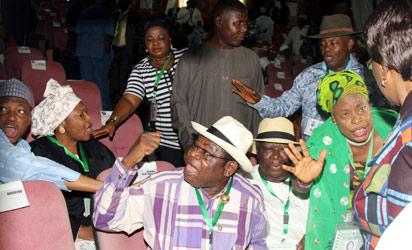
UPROAR OVER Revenue formula: Delegates to the National Conference argue during debate on revenue sharing formula as the conference degenerated into a rowdy session, yesterday.
By Adisa Adeleye
IN a week free of the usual news of violence, it is not out of place to look at other national matters of great importance. This does not exclude funny comments, howbeit uncharitable, on political events.
The National Conference nicely set up by President Jonathan to examine the various aspects of Nigeria affairs has now ended and its agreed Report submitted to the convener. Contrary to the expectation of failure by the usual pessimists and aggressive alarmists, the deliberations in the National Conference proved to be robust and sincere, even as it was not unexpected, there were some outbusts and theatrical exhibition by some delegates.
It looks as if there is an enduring hope for the continued stability of this country as sincerely expressed by many delegates if the current politicians (who constitute the political leadership) are serious about the elusive unity of the country.
Disastrous breakup
Although the consideration of the dissolution of the country was an unfortunate executive taboo for the Conference, the real observed mood that prevailed at that Conference was to find solutions to prevent the disastrous break-up of the country. The delegates tried, as many analysts have observed, within the time limit and prevailing deficient political structure of the country, to do a patch-work, leaving the rest to the Executive (led by President Jonathan) and the Nigerian people to complete the reconstruction.
It may be a political deceit or perhaps, political illusion to think that all Nigeria`s political and economic problems have been properly examined at the Conference. At least, an avenue of fruitful discussion has been opened for lasting solutions which would rest on the ideal form of government and how political power is shared and operated. The fear of the dreaded Northern Stand is still there, even if it is known that the North of today is a different proposition to the politically monolistic North of past era. Some are even confusing Nigerians by the bogey of the old North and new North in an analysis which portrays a comical misunderstanding of how power should be exercised in a plural society.
History is replete with annuls of broken empires and failed states; it is also full of examples of modern states that have risen from the ashes of political dissolutions. There is always a choice for people under able political leadership to make a wise choice.
In the art of making the right political choice, it is also instructive not to forget the accompanying economic imperatives. During the dark days of imperialism, the sonorous chorus of political leaders was: we prefer self-government with danger to servitude in tranquility. However, the reality of independence has altered the tune to: we prefer political unity and economic prosperity to chaos and poverty. Unfortunately, the lovely twin objects of peace and wealth have become elusive.
It has been pointed out by many analysts in different gathering and also in this column that the goals of political unity and economic prosperity are achievable only if the current political leaders and their followers could change their attitudes and shun divisive and destructive politics and apply commonsense economic policies.
It is uncharitable, if not outright dishonest, to continue to push the country into 2015 elections, even in the face of political disunity with the characteristic features of mistrust and violence. It is also strange to continue to talk about free and fair polls in an atmosphere of destabilizing insurgency and mass unemployment in every part of the country. The main problem lies in the attitude of the leading political parties towards 2015.
The sycophants of the ruling party are pushing the President to claim his right to contest in 2015 and with strong incumbency factor, to win the second term ticket. The Opposition (APC) is adamant on getting the President out of the office on the ground of non-performance and the flimsy excuse of “power” returning to the North
If it may be asked for analysis, what is the romance of the “Second Term” agenda in politics? Another interesting point is the assurance that President Jonathan and his party or the Opposition party could win in 2015 under an election requiring a militariced environment in a country under the visible threats of insurgency and armed robberies. Many Nigerians are of the opinion that no Nigerian President would prefer a phyrhic victory in 2015.
If it is the intention of President Jonathan to tackle some ailments of Nigeria is responsible for his setting-up of the National Conference, then, this is the time to discuss its implications of the Report. If the ruling party is desirous of building economic prosperity for the country, this is the time to find out why the President`s economic transformation agenda seems to be increasing the level of poverty.
In terms of critical analysis, not many would find much difference in the political idealogy or economic philosophy of both the ruling PDP and the Opposition, APC. The leadership of both parties (being capitalistic in action) has shown no sufficient interests in eradicating poverty or reducing inequality in the distribution of income.
Distribution of income
The executive and the legislative arms of their fiefs are blessed with good and regular salaries (supported by generous allowances) while the poor workers (toiling labourers) are condemned to eke out a miserable living condition on N18, 000 per month. It is understood that some States find it difficult to pay their workers regularly.
On the economic scene, the nation is bogged down on laughable and often quoted macro-economic stability with its elegant statistical figures but with large pool of unemployed youths – hungry and angry. There is what is called Conscience, which may be lacking in the Nigeria`s political culture. And that is why many citizens are poor, hungry, angry and obviously, sad.
Some economists would prefer a policy of “cheap money policy” (low lending interest rate) to a policy of “tough monetary stance” with its punishing interest rates and oppressive exchange rate of the Naira.- a policy which is anti people.
Disclaimer
Comments expressed here do not reflect the opinions of Vanguard newspapers or any employee thereof.