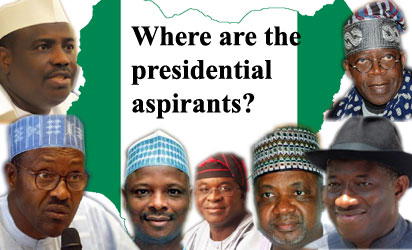
6 months to election,who and where are the presidential aspirants?
By Adisa Adeleye
As Nigerian politicians are busy preparing for the 2015 elections, perhaps the murderous gangs of insurgents are also busy perfecting the logistics of throwing their deadly weapons on their selected spots at the time of their choice. There is that simple theory that notorious insurgents have infiltrated everywhere.
It seems as if our politicians are using the unusual lull in bomb attacks to practice their own trade of invidious politicking; especially when the Osun gubernatorial election is at hand. On Boko Haram insurgency, a political spokesman said on television that “APC is the political wing of Boko Haram”.
Another politician retorted saying, `sooner those behind and sponsoring Boko Haram insurgency would be revealed` The inference is that the PDP as a party knows more about the activities of the insurgents than could be imagined. Afterall, the argument goes on and on, Borno State is ruled by the opposition party, as well as two other states under Emergency Rule .
Another ugly dimension has unfortunately been added to the puerile argument – that the people of Borno (though Muslim) were not conquered by the Fulani jihadists during the religious cleansing of Uthman Danfodio in the 18thcentury. It could mean that the modern jihadists in the hierarchy of the PDP would want to settle the political and religious issues this time.
The descendants of the 18thcentury jihadists belong to the Fulani race and are Muslims while Borno people are not and have substantial non-Muslim minority. Personally, I don‘t subscribe to what looks like a dangerous religious and political theory which represents warped thinking. The prolonged insurgence and the inability of the security operators to bring it to speedy end is perhaps responsible for the emergence of spurious thoughts
It is now clear, more than ever before, that the Boko Haram insurgency is a serious affair beyond the realm of party politics. This is a civil war which is daily threatening the stability and unity of the country and might damage its present and future economic prospects, if not effectively resolved.
The buck-passing attitude of some political leaders (jesters) is not appropriate for such a serious matter. The expectation is that all hands must be on deck to save the nation from the devastating war that shows no respect for religion or ethnicity.
The Boko Haram insurgency could be traced to other vices of armed robbery, kidnappings and political and ritual murders that have ravaged the country for some time. The inadequate security forces‘ responses tend to encourage the enemies of the state to continue to rejoice and cause more havoc.
Many patriots have suggested loudly that the counter measure to crippling security challenges lie only in a united action by all Nigerians and not a policy of scoring political points. There should be a joint attempt by the government and the opposition to wardoff the menace of insurgency and the devastation of other serious crimes now, and not in 2015 – the year predicted for the country‘s dissolution.
Another serious but unresolved problem is the electoral process. Many Nigerians believe, and rightly so, that impediments to a free and fair election should have been removed by now.
However, it seems that a Court‘s judgment has become the more reliable result than the ballot box. The acts of ballot box stuffing and snatching have been challenged by heavy presence of security personnel at the polling booths.
However, there are serious challenges posed by INEC corrupt officials at the central collation centres, inserting of wrong figures and announcing of fake results or lateness or non supply of electoral materials. It is also suggested that the present technique of first voter accreditation and voting later, by itself, could contribute to voters‘ apathy or create room for mischief.
It would have been easier for the voter to cast its vote immediately after he is accredited without going home and come again. Such method has greatly affected the number of voters who actually voted against the number of voters accredited.
I have taken part in many voting exercises in Britain and Nigeria without any fear of ‘accidental discharge‘. So far, the security officials have been reported to be behaving well in spite of their intimidating presence.
The argument rests on the perception of the people of the country that, INEC must be seen to be impartial in conducting what is regarded as a free and fair election. The act of setting up an Election Tribunal after elections and the heavy deployment of security forces during election period say much about INEC integrity. If an election is seen by majority of patriotic Nigerians as free and fair, the less would be the patronage of Tribunals and appeals to the busy Supreme Court.
On the economy, it is assumed by many that mass unemployment has direct links to abject poverty and the sudden growth of crimes and insurgency, which often lead to both political and economic instability. Another similar problem is that of unequal and inequitable distribution of income or resources, especially in a plural society.
Since the depressions of the 1930s, the Western European nations have tamed unemployment by fiscal means of Budget Deficit to stimulate a dormant economy to expansion. Also, by judicious means of taxation, discrepancy in income distribution has been greatly reduced. In Britain, abundance of social security provisions has minimized greatly the effects of poverty and deaths through hunger.
Unfortunately, Nigeria is yet to evolve a spirit of political unity and attitude of mind to tackle most of the problems of Insecurity, Abject poverty and Instability. It has been proved by current events that the formidable problems of the country are more than the capability of a single party in spite of the alluring prospects of the Transformation Agenda.
Disclaimer
Comments expressed here do not reflect the opinions of Vanguard newspapers or any employee thereof.