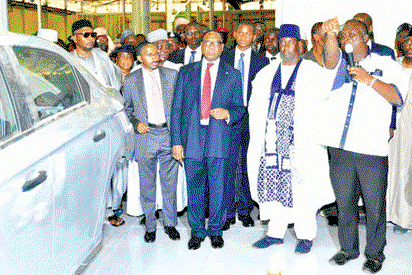
The Chairman of PAN Nigeria Ltd, Alhaji Munir Ja’afar, has called on the Federal government to jealously monitor the implementation of the national automotive policy to ensure its success.

The chairman who spoke during the flag-off of Peugeot 301 production in Nigeria and the commissioning of the proposed site for automotive cluster park at PAN, Kaduna recently, warned that lack of monitoring of the implementation of the policy will dampen the moral and confidence of investors in the auto sector.
To this end, he called on the Federal Executive Council to follow its directives and ensure that government agencies and ministries patronise locally made automobiles.
“I also wish to use this forum to call on the Federal Executive Council to follow its directives with political will and ginger-up ministries and government agencies to patronise made in Nigeria vehicles as this is the only way the government can create market for locally produced vehicles in addition to duty differentials recently introduced to encourage local production,” he stated.
The chairman who also commended the support of their technical partners, AP France/PSA Group for their cooperation in restoring the assembly plant back to production status promised to build Peugeot cars for Nigerian environment.
According to him, “Factors such as our road conditions, climate, geography, motoring attitudes and performance are highly considered in packaging the car with the sole aim of satisfying our esteem customers at affordable price.”
Earlier in his speech, the Vice President, Arc Namadi Sambo who was represented at the occasion by the Minister of Industry, Trade and investment said that the production of the Peugeot 301 at the plant was vital, not only to PAN but also to the nation’s automotive industry.
“The decline of PAN and correspondingly that of suppliers is a story of Nigeria’s industrial sector in the last three decades” the vice president noted.
He argued that it is impossible for a nation to move from poor to rich by exporting raw materials alone, as we have done in decades without having a strong industrial and servicing sector.
According to him, the exportation of raw materials translates into the exportation of jobs, adding that for decades, the country has exported oil and gas but this has not made her rich and will never make her rich. Rather, he said what will make Nigeria rich is what it does with its agricultural commodities, its 44 solid minerals in commercial quality, its crude oil and its gas. To him, this was the reason for industrialisation and what led to the launch of industrial revolution pact by the present government.
Sambo explained that for these sector to succeed, there must be affordable financing in the country, improvement in skill, adding that the president’s aspiration was not only to assemble cars in Nigeria but to also to improve local content, moving from iron ore to steel, from gas to plastic from rubber to tyres.
Also speaking at the event, Managing Director of PAN Nigeria, Mr. Ibrahim Boyi, said that the policy has made it possible for them to re-open their industrial production for Peugeot vehicles after six year of inactivity attracted the full support of their original equipment manufacturers pastners (OEM) AP France, and created window opportunities for potential employment and re-engagement of their disengaged workers and also resuscitate the businesses of the largely moribund local component manufacturers.
According to him, the PAN plant in Kaduna will be the benchmark for all incoming auto plants in Nigeria. “It remains the biggest and most comprehensive auto plant not only in Nigeria but also in West and Central Africa, he stated.
Boyi noted that PAN was committed to providing affordable vehicles to Nigerians, having realised that their biggest market opportunities lies in converting the second hand automobile market currently at over 80 percent, to new vehicle market.
To this end he urged the minister of trade and industry to fast track the arrangements on provision of affordable vehicle acquisition finance scheme as an element of the market developments
The Managing Direct8or noted that they will take the project step by step.
Today, we are launching our production lines with the assembly of Peugeot 301 model, amongst 2 other models that will be rolled out in the following 6-12months, Peugeot 508 and 408, in SKD programme. In 2015, we shall launch the Peugeot 301 CKD program, which will offer greater opportunities for local content development, skills acquisition and technology transfer. Our planned investment in CKD programme will be in the region of Euro 15m. This will be another reason to achieve stability in the implementation of the AIDP to justify these investments.
Our plant has now been modified, thanks to the expertise, skills, dedication and long years of training of our technical teams, to simultaneously carry out SKD11, SKD1 and CKD operations with a capacity of 250 cars per day. The plant is now equally fitted to handle multiple OEM brand assembly. When operational, we will require additional 250 works at SKD level and over 1,000 workers when we migrate to CKD.
Disclaimer
Comments expressed here do not reflect the opinions of Vanguard newspapers or any employee thereof.