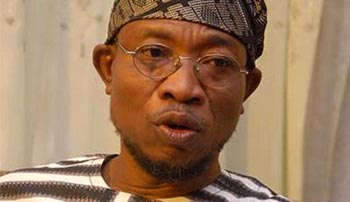
Aregbosola
BY OGAGA IFOWODO
I had sworn that my first visit to Osogbo would be to its world-famous Osun Sacred Grove. Instead, I attended a “mega” rally in the historic town of Iwo, one of many at which Ogbeni Rauf Aregbesola is asking the Osun people to renew his mandate as their governor.
I set out from Osogbo at about 11 am with Mr Solagbade Amodeni, former Commissioner for Natural Resources in Ondo State, childhood friend of Ogbeni’s and now a voluntary political associate.
His mission of gauging the level of preparedness and mood of the people for the rally coincides with mine. Very early in the morning, we saw buses, some screen-painted with campaign posters, ferrying supporters to the venue, small roadside crowds brandishing brooms, the symbol of Ogbeni’s party, the All Progressives Congress (APC). We arrive in Iwo just after noon and feel immediately the energy in the air.
On Bowen University Road in the Oke Odo area, all feet, it seems, are heading to the township stadium (actually, only a fenced field), venue of the rally, about a kilometre away.
A record store is blasting Aregbesola’s praise in Yoruba. Various tee-shirt groups, walking campaign posters: brown tee-shirts that say “’D’Team proudly support (sic) Rauf;” red-and-black shirts are the Progressive Torchbearers and say only “Rauf 2014 OK;” green shirts proclaim him “Oranmiyan— Yoruba Legend;” lemon-green shirts matched with baseball caps are “DeRaufs,” among many other political aso-ebi.
Finally, we are at the venue, a third full, the crowd swelling by the minute. Sounds of competing talking drum groups, in uniforms, can now be heard underneath the amplified music of King Wasiu Ayinde Marshall, KWAM I, leading his Fuji band to entertain the crowd.
Brooms, banners and posters everywhere, and even more tee-shirt groups, among them a clutch of women in navy-blue shirts advertising Aregbesola’s” tablets of knowledge” programme with the slogan “Opon Imo, Empowering minds, Enriching lives.” I make my way towards the stage—two actually, one covered, with seats for dignitaries, and an open deck with the microphone stands.
With the help of Amodeni, I am allowed past security and onto the speakers’ deck where I can more clearly see the crowd. To get there, I have to walk past the covered stage, at the back of which is a big banner announcing Ogbeni’s signature programmes: “O’Reap (rural enterprise and agriculture), O’Schools (rebuilding schools), O’Meals (balanced diet nutrition for pupils), O’Yes (employment).
At the bottom of the banner, a sense of rhyme with O’seun! I climb up the speakers’ stage and scan the “stadium,” nearly half-full and quite agog by now.
The atmosphere is getting more electric, a red helicopter is hovering above the thickening crowd, circling the vicinity in wide surveillance arcs, and there is very little time to reminisce —that must wait till after the rally. Basiru and Semiu dart off and I turn to read the banner on the wall at the back of the speakers’ stage.
“Òrànmíyàn, Leekansi!” it says. “Òrànmíyàn, Once more.” It is a clever pun, as another banner more baldly asserts: “The Return of Òrànmíyàn.” Ogbeni as the re-incarnation of the legendary son of Oduduwa whose fabled staff in Ife is probably the most treasured ancestral relic in Yorubaland. Ogbeni has even had the staff stitched onto the breast pockets of some of his shirts and wears it as a personal logo.
If the fastidiously austere Aregbesola can be accused of self-regard, it would be in this appropriation of a hallowed ancestor, but I strain in vain for any outward sign of insincerity. I see, instead, the clever use of myth, blended with pop culture. For soon, Fadeyi Oloro, a popular Yoruba actor famous for his roles as Ifa priest, comes on stage with his entourage, all in danshiki and blackened faces and hands, one of them carrying a basket of horns adorned with feathers, cowries, strips of red cloth; incantations follow.
At their exit, pop culture takes the stage. KWAM I has left his band on a stage 50 meters away to join Sir Shina Peters (Afro-juju/Aregbesola, the difference is clear), Weird MC and Tony Tetuila for banter and photos with their fans among the technical crew and campaign and security teams. Then Peters, Tetuila and Weird MC perform. Back with his band, KWAM I leads sweeping-dance choruses in-between his colleagues’ acts: “Igbaletim’owa, DEMO nimotigba.”
With this broom, I will sweep the reactionary party away, DEMO being a reference to S. L. Akintola’s Nigerian National Democratic Party which allied with the Northern People’s Congress in the First Republic to break the dominance of Awolowo’s Action Group in the old Western Region.
Disclaimer
Comments expressed here do not reflect the opinions of Vanguard newspapers or any employee thereof.