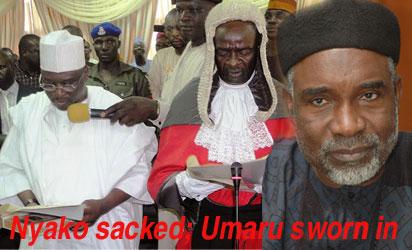
ADAMAWA—Acting Chief Judge of Adamawa State, Justice Ambrose Mammadi (L), administering Oath of Office on the Acting Governor of the state, Alhaji Ahmadu Umaru, at the Government House in Yola after impeachment of Nyako yesterday.
By Adisa Adeleye
To many Nigerians and foreigners, Nigeria is a complex country, baffling in its complexity, difficult to manage and seemingly impossible to govern. Nigeria‘s newspapers‘ brilliant columnists are often caught and placed in confusing circumstances.
This week which carried the news of the visit of the Pakistani‘s “wonder” girl (shot in the head for her pursuit of Western Education but resuscitated by Western medical science), also announced the usual carnage in Borno and Plateau States. The political atmosphere was not so much disturbed by the PDP‘s penchant for impeaching its own governors. The exception is the vengeance on governors of the opposition party – Nyako (former PDP) of Adamawa and Governor of Nassarrawa States. The Adamawa State is one of the three States of the North-East under Emergency Rule where peace and stability would be required.
Nassarrawa State had just witnessed a ‘cult‘ uprising which consumed many innocent lives, including those of the National Security Officials. Nassarrawa State happens to be the home of the Minister of Information – the apostle of Peace and Security. The State is ruled by a governor elected in 2011 under the banner of CPC (now APC) but with the House of Assembly dominated by PDP members.
The Malala‘s visit was salutary – she advised President Jonathan to visit the parents of the abducted girls and reminded the nation of over 10 million girls out of school (not receiving any form of education).
The Nyako case is carefully understood – changing political alliance is a political offence that could not be tolerated under the new PDP offensive. At the time when patriotic Nigerians are calling for national unity in the face of insurgency and disunity, others are battle ready for 2015 contests at any cost, including political destabilization.

ADAMAWA—Acting Chief Judge of Adamawa State, Justice Ambrose Mammadi (L), administering Oath of Office on the Acting Governor of the state, Alhaji Ahmadu Umaru, at the Government House in Yola after impeachment of Nyako yesterday.
The passing event have so confused some columnists, especially after the last Ekiti elections that suggestions have been made for opposition parties to look for a new winning strategy in the future elections. It may be difficult to propose a winning formula in a situation where the government and the opposition parties wear the same clothes of political and economic ideologies. The countervailing factors are the attitudes of electoral officers, freedom of party riggers and perhaps, the intimidating appearance of security officials. The concept of “infrastructure of the stomach” has now become a focal point in electoral success.
However, if a winning strategy is required, as a layman, I reproduce below what I wrote some years ago on winning a free and fair election. It reads thus, “It may not be too late to start to sort out our priorities from the confusion of the past. First, action should be taken to strengthen the import substitution industry, so as to ensure its survival against foreign competition and also, to be able to produce enough for home demand and for export. The fiscal measures required are prevention of smuggling, substantial reduction or complete eradication of import duties on plants, machinery, spare-parts and raw materials which cannot be produced at home.
A complimentary policy is that which will stimulate demand for the locally produced goods. Since the lower income groups are more likely to prefer these goods, it would be better to put more money in their pockets by a moderate increase in salaries and wages or substantial reductions in personal income tax and purchase tax (vat). The other group with higher propensity to consume home goods is the old-age pensioners who need substantial increase and regularity of payment of their pensions. The third group embraces those unemployed graduates (after the National Youth Service) who need a form of income to sustain their current level of demand. They should be supported by stipends until they are employed.
The next development strategy is the orientation of the domestic industry towards foreign markets. The local beer and malt drinks, textiles, plastic goods and oil and lubricants are common in the West African region either through smuggling or under unorganized trade structures. To survive as a nation, we must produce enough at home and sell more abroad to earn foreign exchange.
Some countries have successfully re-organised their industry into, Home and Export, and have created export free zones under this structure, different incentives are given as the conditions demand to ensure a flourishing home market and a promising foreign market. The giant super stores of old were a sad reminder of lost opportunities through unco-ordinated fiscal policy and foreign exchange management. The old giant stores disappeared because of difficulties in procurement and the cost of foreign exchange,
The practice of economic diversification is not new to Nigeria except that it has remained a mere executive theory or parliamentary jargon during the annual budget sessions. A concrete policy is needed to be faithfully executed. In the area of economic diversification, some are suggesting the intensification of the electronics sub-sector. In view of its requirements of high technology and capital, direct foreign investment would be appropriate, necessary and rewarding. The advantage of direct foreign investment is that it releases domestic savings for other productive uses.
However, care should be taken that profits remitted home in respect of foreign investment do not quickly outstrip the annual rate of fresh capital investment as to adversely affect the balance of payments position.
As initially pointed out, the problems with Nigeria and its economy had nothing to do with suitable plans but principally, the inability to priotise, and when the country is lucky to select some good plans, the unwillingness to pursue or operate them to successful ends becomes a major problem.
If the Nigerian economy is to improve, it would be necessary to have full or near full capacity utilization in the industrial sector, to enable increase in techniques and equipment (plant and machinery) to raise productivity; to have technical education, training on the job and communication in simple way and provision of simple implements to raise agricultural outputs in the rural areas. This should be complemented by substantial investments in good roads, reliable railways, power stations and irrigation systems in the arid areas of the North.
However, rapid expansion of the economy is possible under a visionary leader who makes sure that the country‘s macro-economic policy produces overall stability. Such a leader needs a clear perception of what it takes to have full employment, stable foreign exchange and non-volatile price movements in the economy.
Disclaimer
Comments expressed here do not reflect the opinions of Vanguard newspapers or any employee thereof.