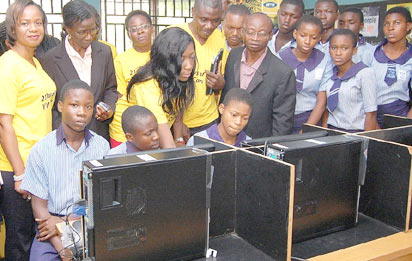
From left: Company Secretary, MTN Nigeria, Mrs. Ukpanah Utoh ; Principal, Lanre Awolokun Senior High School, Gbagada, Mrs. Adams Ibironke Abiodun; Executive Secretary, MTN Foundation, Ms. Nonny Ugboma and Project Manager, MTN 21 Days of Y’ello Care, 2013, Mr. Omojola Felix during the donation of a digital library to the school, in Lagos.
By EMEKA AGINAM
The unveiling of the national standards blue print for IT education of the Nigerian educational systems recently was a convincing signal that building digitally literate Nigerian schools through IT education has begun.

F
The blueprint was officially launched in Abuja recently at the just concluded Information Technology Assembly of the Computer Professionals Registration Council of Nigeria, CPN.
The CPN IT Assembly/Annual General Meeting is a yearly gathering of IT practitioners in Nigeria and the Diaspora with the objective of discussing and strategising on emerging issues in IT with recommendations and decisions that will impact positively on the industry and the nation.
Designed by the Ministry of education, the National Information Technology Development Agency and the Computer Professionals Registration Council of Nigeria, CPN, the standard document which was also a major highlight at the 2014 IT Professionals Assembly, if well implemented, the participants believe would retool both the students and the teachers for e-learning.
The national curriculum on IT education which was applauded by the participants at the assembly is a standard document at all levels for teachers, students, educational administrators and other stakeholders in education.
The new policy has IT education standards for early childhood care education, ECCE, basic education, post basic education, NCE awarding institutions, enterprise institutions, polytechnic education, diploma, national diploma, universities, among others.
A look at the 146 pages comprehensive document showed a set of standards to guide the development of IT curricula, teaching, learning and assessment at all levels of the Nigerian education system.
However, these standards provide the minimum requirements which should be improved and elaborated upon by various schools and institutions to enhance the quality of knowledge, skills and attitude in IT imparted to learners.
21st century ICT skills
For majority of participants at the event that discussed industry issues including developing the capacity of Nigeria IT industry/local content development, strategies for enhancing collaboration between IT Professionals , stakeholders and government, solving national security challenges using IT, E-agriculture, improving education , research and development in Nigeria among others , it is essential that core 21st century skills and knowledge associated with the use of technology and computers embedded in the document are retooled into education systems.
Although majority of teachers in the Nigerian schools are not skilled enough to teach IT education needed to survive the knowledge society, the forum believes that the document which form a central part of students’ school experiences from early child education will serve as an intervention strategy to retool them for tomorrow’s workforce.
Now that the national standard for IT education is compulsory at all levels, greater efforts, the forum noted must be made at all levels to further embed digital literacy into schools and thus ensure that the skills acquired are those that will be needed by Nigerian citizens of tomorrow.
The Minister of Education, Barrister Ezenwo Nyesom Wike while formally launching the document at the event that attracted capacity audience with the theme: Harnessing the potentials of IT Professionals for national development, told the gathering that the document which sets clear standards for IT education will be implemented immediately at all levels of education starting from early childhood to tertiary education.
Disclaimer
Comments expressed here do not reflect the opinions of Vanguard newspapers or any employee thereof.