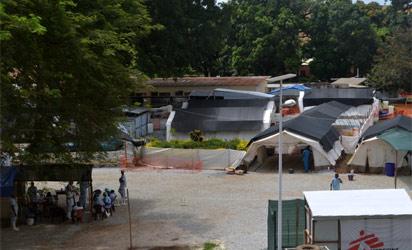
– A file photo taken on June 25, 2014 shows the isolation ward at the Donka Hospital in Conakry where people infected with the Ebola virus are being treated. A regional centre is being set up in Guinea to coordinate the response to the worst-ever outbreak of Ebola that has killed hundreds of people in West Africa, the World Health Organisation said on July 11, 2014. The haemorrhagic fever sweeping through Guinea, Liberia and Sierra Leone has left an estimated 539 people dead, according to the latest WHO figures. AFP PHOTO
By Sola Ogundipe
As the World Health Organisation (WHO) continues to monitor the evolution of the Ebola Virus Disease, EVD, outbreak in Sierra Leone, Liberia, and Guinea and the suspected case in Nigeria, the rend of the epidemic in West Africa remains serious, with about 1,500 cases of infection reported up to 24 July 2014, including suspect, probable, and laboratory-confirmed cases.
 EVD, formerly known as Ebola haemorrhagic fever, is a severe, often fatal haemorrhagic fever which first appeared in 1976 in two simultaneous outbreaks in Nzara, Sudan, and in Yambuku, Democratic Republic of Congo.
Characterised by the sudden onset of fever, intense weakness, muscle pain, headache and sore throat, followed by vomiting, diarrhoea, rash, impaired kidney and liver function, and in some cases, both internal and external bleeding. When EVD first appeared in 1976 in two simultaneous outbreaks, no one had any idea had dangerous it would turn out.
The outbreaks in Nzara, Sudan, and in Yambuku, a village situated near the Ebola River, in the Democratic Republic of Congo, which was then known as Zaire, emerged as a result of transmission to humans from wild animals. In Africa, the fruit bats, particularly species of the genera Hypsignathus monstrosus, Epomops franqueti and Myonycteris torquata, are considered possible natural hosts for the Ebola virus. Originally known as
“Zaire Fever” (coined from the Zaire Ebolavirus), Ebola is introduced into the human population through close contact with the blood, secretions, organs or other bodily fluids of infected animals. Infection has been documented through the handling of infected chimpanzees, gorillas, fruit bats, monkeys, forest antelope and porcupines found ill or dead or in the rainforest.
Ebola then spreads in the community through human-to-human transmission, with infection resulting from direct contact (through broken skin or mucous membranes) with the blood, secretions, organs or other bodily fluids of infected people, and indirect contact with environments contaminated with such fluids.
Burial ceremonies in which mourners have direct contact with the body of the deceased person can also play a role in the transmission of Ebola. According to the WHO, infected men who have recovered from the disease can still transmit the virus through their semen for up to seven weeks after recovery from illness. Health-care workers have frequently been infected while treating patients with suspected or confirmed EVD.
This has occurred through close contact. In humans, with a case fatality rate ranging between 60 – 90 percent, the virus is transmitted through close contact with the blood, secretions, organs or other bodily fluids of infected animals. Hunting for “bush meat” in forest and pre-forest areas and eating of bats have been associated with this outbreak.
Disclaimer
Comments expressed here do not reflect the opinions of Vanguard newspapers or any employee thereof.