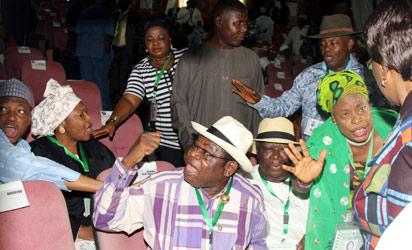
UPROAR OVER Revenue formula: Delegates to the National Conference argue during debate on revenue sharing formula as the conference degenerated into a rowdy session, yesterday.
By Adisa Adeleye
THAT this country is blessed with both human and natural resources is axiomatic. Also, every day or week in Nigeria provides its own events – good or bad. It is the delight of any clever newspapers` columnist to either analyse or satirize. It is always fun.
If the visit of the Pakistan`s girl (Malala) has convinced the presidential advisers of the wisdom of meeting the parents of the abducted Chibok girls, it is graceful that President Jonathan has met in Abuja not only the sorrowing parents but also, those lucky girls who managed to escape from the murderous gang. Even the news would gladden the heart of the television clown (Zebrudaya) that the President “is doos it”, as President Obama is doing it in US (though the American President would have visited the place of incident ninety days ago). This is a case where comparison becomes odious.
As stated in my last two articles, members of the National Conference have performed extremely well beyond the pessimistic sentiments of some doubting Nigerians. The robust debates and clear expression of different opinion by many delegates had shown the capability of many Nigerians outside the professional political class – the proverbial jesters.
Proverbial jesters
The National Conference is showing that Nigeria could be great if opportunities are given to the right people at the right time.
Though the National Conference is yet to submit its Report (to be considered on 4th August), the crucial question on Derivation (in Power Devolution Agenda) remains insoluble or intractable. Members are yet to agree on whether to maintain the status quo of thirteen and half per cent share to oil producing states or to approve 5 per cent to all disaster areas of the country (not only to the three states of the North-Eastern zone under Boko Haram insurgency). The apparent disagreement shows glaringly the absurdity of Nigerian mentality which is plagued with the idea of SHARING of resources – oil money.
It is not difficult to point clearly to some distinguished members of the National Conference that the concept of true federalism which every member wants recognizes the principle of full appropriation of each states resources by the states concerned, subject to taxation
If as all members have recognized that all states have several minerals yet untapped, and if now tapped, would make all states not only economically stable, would also cement the political stability of the country. The easy formula to raise funds is that each state to provide 60 per cent, other states, 20 per cent and Federal Government, 20 per cent of the equity capital. There is no question of `Nigerian `oil` or Nigerian `gold` in any tenets of fiscal responsibility. The Kano groundnut pyramid often referred to was contributed to by individual Kano peasant farmers who sold the produce of their farms to the Northern Marketing Board and were paid fully according to the quantity supplied. There were no government-run plantations except those kept by private companies like UAC, CFAO, and PZ etc.
Another specific question that might arise from shedding of extra loads from the federal government to states is the economic one – the arrangements to fund the states which would now acquire added responsibilities.
It is obvious that the `sharing mentality` which has pervaded the debate on devolution of power has missed the salient point of how to fund the Federal Government itself. The present thinking is that more than 52 per cent of `oil money` now being taken by the federal government should be scaled down to 40 per cent while states with heavier or additional responsibilities should take 60 per cent. If the Federal Government now provides 100 per cent funding for the operations of `our oil`, it stands to reason that alternative method of funding would have to be examined.
It is assumed that the present 1999 Constitution, though federal in appearance, is being run as a unitary one. If states are happy with the present monthly line-up in Abuja to share in the cake they did not contribute to its baking, the issue of true federalism gladly accepted by all is deceptive and misleading. The problem is that the Federal Government would like to cling to the existing arrangement with its sharing imperfections and absurdities in a supposedly federal environment.
Many patriotic commentators have pointed out, and justifiably so, that the members of the National Conference have missed the crucial point of Nigeria`s political instability – how the federal government is formed and run in a country of many nations.
Britain the colonial master designed a government at the centre run by representatives of the three Regions. When federal elections were introduced in 1954, the winning party in each region supplied the Federal Ministers from its members in the House – thus the winning party in the West and East (NCNC) and the winner in the North (NPC) formed the federal government. Before Independence in 1960, a national government was formed under Tafawa Balewa (NPC) to prevent the danger of bitter political rivalry that might damage economic and political stability of the impending new nation. Events after 1960 showed the elusive nature of a genuine national government required for a multi-national state.
It is known to history that the multi-national states which do recognize their differences and peculiarities have been able to survive the prevalent turbulent political and economic divisiveness and restlessness.
Economic divisiveness
As in Belgium, the federal government is negotiated; in Switzerland, the federal government is made of the leading political parties. There is no major difference on national issues by the government and the opposition.
It is painful, if not regrettable, that the Nigerian experience is a sad one where the PDP (ruling party at the centre and many states) and the opposition (APC) do not see eye-to-eye on many crucial and specific issues (though no defined differences in political ideology). Both parties see the prospects of retaining power or change of power in 2015 as the most important political achievement of their existence. In a country engulfed in bloody insurgency, unsteady electric supply, urban congestion and rural depopulation, daylight armed robberies, kidnappings, ritual murders and heavy unemployment, all that matter is the prospects of 2015 and the immediate political gains from bye-election victories and untidy impeachments. What a funny and confused nation with its sly politician!
The country needs consensus and unity to confront the present ravaging dangers that confront it. Unfortunately, bitter political divisions as being exhibited by the political parties are not the answer.
Disclaimer
Comments expressed here do not reflect the opinions of Vanguard newspapers or any employee thereof.