By Adisa Adeleye
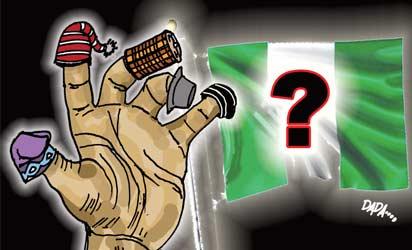
MANY analysts have attributed the many ills of Nigeria to the ‘forced marriage‘ contracted in 1914 through the amalgamation of Northern and Southern Provinces by the British imperialist, Lord Luggard. In spite of many vicissitudes of life, Nigeria had managed to survive as a nation for more than 100 years.
 Of all the politically contrived countries in the 20th century, only Nigeria has survived to remain as one nation. The Soviet Republic containing big Russia and its European and Asian Satellites (under the dreadful aegis of USSR) could not withstand the windy political revolution of the 1990s that blew away the communists and the seemingly dictatorial regimes of the period.
Notable examples of otherwise strong countries that were created after the First and Second World Wars were Yugoslavia (the becon of the non-aligned nations of the world under its President Marshal Tito). Yugoslavia became a country of several republics formed on ethnic and historical bases. In 1945, Yugoslavia became a united country of Croatia, Slovenia, Bosnia and Herzegovina, and Serbia (with Kosovo), Montenegro and Macedonia.
The country prospered under the strong and overpowering stature of the 2nd World hero, Josip Brog Tito, a Croatian. After Tito‘s death, the centre could no longer hold and Yugoslavia disintegrated into separate independent countries of the world.
It could not withstand ethnic and diverse economic interests of its constituent members. The division was sanctioned through civil wars and United Nations armed and peaceful negotiations. The former Czechoslovakia was a classical example of calm or peaceful dissolution of the Czechs and Slovakia. Each is now a separate country.
The two examples above show how ethnic, divergent economic and political considerations could cause the disintegration of ‘many nations‘ within a nation assumed to be economically viable. That ‘many nations‘ within a country would ‘sooner than later, want to assert their different national interests and aspirations, is assuming an interesting theory in modern political science.
Against the examples of disintegration in former Yugoslavia and Czechoslovakia, are two other examples of countries which became countries in the 19th century, but remain united till the present time. Switzerland and Belgium are typical examples of different nationalities living peacefully and in prosperity in their different countries. Switzerland is a country of German, Italian and French nationalities; Belgium has Dutch, German and French nationalities.
It must be recognized that both Switzerland and Belgium are guided by their constitutions which recognize their special peculiarities and differences. Belgium operates a federal system while Switzerland has a loose federation or confederation, each with strong regions and weak centre.
Since the exercise of federal power is often the cause of political and economic tensions in multi-national states, efforts are made to regulate such power. For example, in Belgium, it is clearly noted that, “the power to make decisions is no longer the exclusive preserve of the federal government and the Federal Parliament. The leadership of the country is now in the hands of various partners who independently exercise their authority within their domains”.
In Switzerland, the Federal government is always a product of `all important political parties` – it is a form of a national government. It is, however, recognized that both countries saddle their federal governments with responsibilities of defence, foreign affairs and finance.
Belgium is a federal state, made up of communities and regions. But, the communities and regions have the power to establish and maintain foreign relations like the old regions of Nigeria before independence.
It is becoming clearer that ‘many nations‘ within a nation could only survive if the citizens are prepared to recognize the peculiarities of the different constituent nations and prepare such guidelines to ensure stability and unity. The constitutions of such nations would recognize the concept of dissolution of power from the centre to the states or regions.
At present, ‘many nations‘ now form a country called Nigeria – the largest being Hausa/Fulani, Ibo and the Yoruba and other smaller old kingdoms. It will be foolish to think, that the stability of the country could be achieved without the full support of those powerful entities. The present Constitution (1999) is supposed to be a federal arrangement but now being operated as a unitary one, with the federal government as the arbiter of everything – in fact, the master of all. The federal government holds the financial purse, thus distributing the largesse as it deems fit.
While Nigeria is made of many nations, politically, the President is the ruler of the country through his appointment of all federal ministers from all the States (including States not controlled by his ruling party). By giving all appointments to only his party members shows the immense power of an individual political leader to determine singly the fate of the country.
It may even look odd for a leader from a minority tribe to wield such power in the face of majority tribes who erroneously believe that it is their birth right to rule. Under the present system of ‘winner- takes-all‘ mentality, there would always be room for divisiveness, political rivalry and bitterness within the nation.
If Nigeria must survive as a nation, Nigerians will have to follow the examples of successful federal states where the peculiarities of the people and their nuisances are factored into the Constitution of their country. And this is the more reason why the present attempt by the National Conference to examine the reality of the Nigerian State must not fail.
Many people believe, and sincerely so, that this is the time for all Nigerians to work together to face the problems of general insecurity, insurgency and deepening poverty in the country. While it would be pleasant news of President Jonathan to call on the Opposition and say, come and join me in a National Government to save our dear country, Nigeria.
Akwa Ibom State Pension charter
An advertisement in the Nation newspaper of Saturday, May 31, 2014 by Akwa Ibom State House of Assembly reads that “The Law further provides that a former Governor should be entitled to at least one unit of a 5-bedroom house in Uyo or Abuja and 300% annual basic salary as rent for a former Deputy Governor in addition to salaries and allowances for their personal aides.
Disclaimer
Comments expressed here do not reflect the opinions of Vanguard newspapers or any employee thereof.