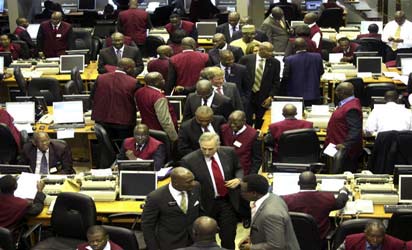
Nigerian Stock Exchange
By WILLIAM JIMOH
Investors in the capital market like every other area of business are always particular about the return they derive from their investment. This, often times, is the motivation for investing.
To shareholders in the equity market, these returns come in form of dividend and sometimes, bonuses which help them to solidify their investment base either by reinvesting on the same stock or looking out for other companies where they hope to get more reward.
Even when some shareholders, who have been clamouring for a more robust market, understand the benefits of trading on their shares for the market, they still prefer to hold on to their shares awaiting the dividend no matter how small it may be.
Some minority shareholders, who spoke with Vanguard Investors Forum, explained why shareholders prefer to hold on to their shares.

File photo: The floor of Stock exchange
Excerpts:
Boniface Okezie, Chairman, Progressive Shareholders Association of Nigeria:
For me, the shareholders who are not trading on their shares are not helping themselves because if you are not trading and the price tumbles, you will lose out. That was what happened to some shareholders of the nationalised banks. If they had sold the shares when the prices were up, it would have resulted to gain on their part.
But some shareholders who have small units cannot be blamed for maintaining this status, because what they are particular about, which is dividend and attending meetings, they often get it.
If you have a good volume of shares of around two hundred units in a company and the price is moving up, take advantage of the upward movement and exit. You can wait again until the price comes down to buy again. But if you buy and hold on to it,, and you don’t move out, you don’t go in, it is a problem.
Monitoring your investment closely involves buying and selling depending on the market condition. Don’t hang on to dividend payment alone because the dividend may be disappointing. What you may eventually get as dividend may not match your expectation at the first instance. So it is better for an investor to sell when the price goes up and buy at a lower price again and that is why we are saying easy entry and exit.
Many shareholders are not seizing the opportunity probably because they are not used to moving to other companies. If for instance a shareholder has GTB shares, he/she may decide to continue to hold on to the shares because the bank pays regular dividend or he/she may be thinking that if he/she sells such shares, he might not be able to re-enter if the price eventually goes up.
This class of shareholders may be investing just for retirement. You must have something in mind; it is either the dividend is what is motivating you to invest or capital appreciation.
Some have the mindset that when they remain loyal to a company by holding the shares for long, they will be given bonus for them to grow their smaller unit.
Basically, it is the retail shaer holders that are having this problem because if you have big volume, you can afford to use it to play the market which also gives you the opportunity to reap some benefits from the market.
The multinationals cannot afford to sell; it is the Nigerian investors that sell. This is because they are the owners of the companies and it is in declaring dividend that they make profit. But for the minority shareholders, when they trade, they make money from the market.
Sunday Olutayo
— an independent shareholder
We are the ones patronising the stock market, because those foreigners will take their share certificates to their countries, making it impossible for them to sell.
The only thing that they always look forward to is the opportunity to buy more while many of them, if it is possible, will want to own it all.
When they call for right issue, it is sometimes at a price which minority shareholders cannot subscribe to. In the process, you find out that the foreigners and institutional investors are still the ones that finally raise the fund and reap all the benefit.
Contrary to what we have during the indigenisation programme whereby the minority shareholders were given 60 percent of companies’ shares while the multinationals had 40 percent, today, the reverse is the case.
I think this market situation is responsible for Nigerian minority shareholders holding on to their shares.
Except in a situation where the multinationals are having financial challenges, they will not think of selling their shares. They seem to be satisfied with the dividend they receive. Again, in a situation where the company is not paying dividend, they still prefer to hold their shares with the hope that one day the price will appreciate.
Trading on ones share is a game of number. Take Nestle Nig. Plc for example, many people that bought the shares long ago while the price was very low sell today because of the capital gain. In order words, whenever the price of any share is rising, people like to offload to make some capital gain.
Today, because not many of the listed companies are doing well, the shareholders may not be encouraged to trade because if they do, it is either they do not gain much or they record losses.
Even though the banks are the ones declaring dividend now, yet one cannot say that the market is very good for them. Many of them that were involved in merger arrangement following the banking sector reform in 2009 are still trying to stabilise after the exercise. Even First Bank does not pay dividend as it used do before now. As shareholders, we still hold on to most of the stocks hoping that one day, they will appreciate.
Disclaimer
Comments expressed here do not reflect the opinions of Vanguard newspapers or any employee thereof.