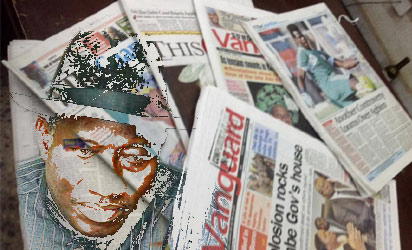
Being excerpts from a paper presented under the auspices of the Nigeria Union of Journalists in Benin city.
MY short stay in the political leadership of the Federal Ministry of Information (and Culture) seemed to have given me a lengthy profile. I am not likely to be wrong if I ask the present audience how many of us can easily recall with pleasantries the names and tenures of previous Ministers of Information from 1960 to date. Some of the Ministers stayed long in office while some others had short tenures.
Mine was a short tenure, 1992/1993. Permit me, therefore, to openly utilize this podium to thank all officials of the Ministry who have continued to recall that once upon a time I headed the Ministry and thoroughly enjoyed the humorous appellation of being “chief journalist and chief media practitioner” when indeed I never possessed media expertise.
Today is not the occasion to say anything about what appears to me as my contributions to the Ministry and to the media, yet, in case people have forgotten the deregulation of the broadcast media by the IBB Military Regime in 1992, the law and the process of deregulation inaugurated the tremendous incorporation of the press and media into the ICT with its by-product of social media which has placed Nigeria in the proper role and context in contemporary global media industry and practice.
Expansive growth of private sector
Can anyone imagine if the broadcast media was not deregulated before social media arrived in our communication shores? It should be duly acknowledged that this phenomenon contained a lot of foresight, as it was with the IBB regime’s democratization of the political process and governance, and of the expansive growth of the private sector in business, banking and finance, and industry and social services. Deregulation of the broadcast media opened many more professionals to enduring activity sectors as well as enormously productive employment and skills, but particularly the exposure of the country to the global society and economy, and advancement of civil liberties and democratic space.
Theme of the Press week: The theme of this year’s Press Week of this Chapel: the Government and the Media: Partners in Progress, conveys very thoughtful elements for discourses at this critical time in the affairs of our country. We are in a season, perhaps a long phase or historical episode in which our country has been confronted with fundamental challenges equalled or perhaps slightly surpassed by the years of first military rule and the civil war in 1966 to 1970, and the catastrophic national experience of the annulment of the result of the 1993 June 12 general election which otherwise the country would have had a much earlier transition of democratization from military rule to civil, constitutional regime and democratic governance.
What do we mean by progress and what is the purpose and role of the government in its relationship to the media as partners? Thinking through the theme raises a huge array of dynamics, dialectics and even potentials of slipping through the tight ropes of governance and statecraft. Progress is development, and in contemporary times, the major structures, values and challenges of development are embodied in the ongoing democratization of Nigeria and the possibility or otherwise of sustaining, consolidating and advancing constitutional government and democracy.
It is common knowledge as enshrined in our Constitution that the primary and fundamental purpose of government is the security and welfare of the people. Seemingly simple as this phraseology may appear, the challenges of securing the people and providing for their welfare – indeed a people with variegated and multiple needs, beliefs, motivations and even worldviews such as we are in Nigeria – can be very daunting.
We all know that the media, print and broadcast, and in this age of internet and social media, exist as primary and fundamental stakeholders in the business of ensuring that the people obtain and experience security and welfare and in their varieties, quantum and quality. It is for this purpose that the media is society’s proverbial watch dog, and is firmly acknowledged in the provisions of our constitution. You may have, by now, noticed that I have already raised a mouthful of issues which we certainly can not deal with exhaustively and in specificities in today’s engagement.
An overview of the Nigerian state and the Nigerian nation for which the Fourth Republic and constitutional government and governance were established in 1999 provide for us a table of complex, conflicting, and even contradictory contents for the government as well as for the media to contend with, in their search and promotion of security, welfare and progress. Recall that the Fourth Republic had been preceded by colonial domination, fundamental crises of statehood and nationhood of the late 1960s, Civil War, tortuous military rule of over three decades and a hurried transition of non-democratisation to the Fourth Republic.
To limit this speech to contemporary times: Nigeria is besieged, besotted, and even overwhelmed by, among other forces:
•grave and multiple insecurities to lives, property and communities
•inadequate infrastructure – physical, economic, educational, health and related social infrastructure – vis-a-vis concrete demands and expectations
•generations of unemployment of highly mobilized young men and women
•extremist violence with the utilization of instruments such as armed robbery, kidnapping, suicide bombing and deliberate attack of segments of the population with a view to annihilate and cleanse human groups and settlements – instruments hardly known to the Nigerian state and the Nigerian nation twenty years before now. The veneration of violence to human beings has very unfortunately become part and parcel of livelihood in our country.
In the face of these marauding challenges to progress, what is, or can be, the character of partnership which the government and the media should or can forge? The government will naturally and normally insist upon controlled dissemination of information while dealing with these challenges.
The media, on the other hand, in its historical origin for advancement of freedom and protection of civil liberties – fundamental values which have become consolidated in local, national, and global legal instruments and conventions – will understandably insist upon advancing progress from the context of an open society. In this mode of characterizing the partnership between the government and the media, we can easily expand the profound thesis long propounded by the world acclaimed philosopher, Prof. Karl Popper, in his seminal works, The Open Society and its Enemies, and The Poverty of Historicism by ascribing to the government the perspective and strategy to hold back on information dissemination, akin to the ways of a tribal or closed society so as to be allowed to discharge its responsibility of security and provision of welfare. But the media quite understandably came into existence so as to dismantle the closed society and to maintain, deepen and expand the open society; to also ensure that any structures of constraint to freedom and liberties are resisted, dismantled and surpassed.
We can even visit my viewpoint or perspective in this discourse to the way in which much more recent and modern scholars like Prof Samuel Huntington, have called the clash of civilizations, meaning in this adaptation that goodness from the government strategy is generally seen as badness for the media; and conversely, goodness from the media is generally seen as badness for the government.
IN dealing with governance and politics, economic development and societal transformation, we need to concede to the government the way(s) it undertakes its policies, programmes and projects. Yet we should also grant to the media its perspective and strategy of what it is set out to do.
I had long ago personally advanced the viewpoint that the media as a profession and as industry with trained practitioners could easily erect, wittingly or unwittingly, an agenda for the society. This agenda of course could portend goodness, but from the perspective of the government such agenda may appear subversive of progress or of its pursuit of goodness of the society.
Can we not, therefore, see patent difficulties of the government and the media being partners in progress? Is such partnership possible, or even plausible? The process of democratization and consolidation of democracy embody difficult challenges which the media must drive and the government must handle with available resources.
This problematic or dynamic is what the late doyen of the print media, Babatunde Jose, long ago called, Walking on a Tight Rope. How do we get the government and the media to create the conditions or to democratize the delicate balance such that they can forge and sustain partnership rather than being mutual enemies to progress or as clogs in the dynamism, dialectics and trajectory of progress in the country?
To conclude this brief thematic disquisition on the government and the media as partners in progress: it should be noted that the government is one structured entity although we can distinguish between regimes, hence dictatorship as distinct from constitutional and democratic government. But the media although seemingly united as a societal institution and in objectives and motivations, it is multiple in ownership and in pursuit of objectives. Hence, sections of the media may operate supportively of the government while other sections may appear subversive or unduly antagonistic to the government.
A few contemporary experiences and lesson: We can spend considerable time in the discourses of the various aspects of the theme of the relationship between the media and the government as partners in progress. For today’s discourse, however, let me venture to touch only a few areas of contemporary interest by way of bringing my guest speech to a close. In doing so, please bear in mind the dynamics and dialectics of the theme for which as I have attempted to provide only sketches in the preceding segment of this presentation.
Nigeria is presently under a national exercise of a National Conference with a critical agenda or contents which had, in the past been dealt with in no fewer than four distinct periods after the end of the civil war in 1970. I have in mind the result of the committee and conference of 1977-1979 which led to the 1979 constitution; the exercise of a Political Bureau leading to the conference in1988 which gave rise to the aborted 1989 constitution; the overwhelming discourses of the Post-NADECO or annulled election era which dragged through 1994/95 to the still-borne (Abacha regime) Draft Constitution; and the 2005 Olusegun Obasanjo Political Reform Conference which was also aborted. In all of these experiences, the relationship between the government and the media can best be described as confusing, incoherent and in certain respects, disastrous. It was the absence of partnership in progress between the government and the media that once again inaugurated the process of the ongoing 2014 National Conference. What can we make of the current experience? Can we ascribe progress to the outpouring of the contents of the current National Conference, and do we see any partnership in progress between the government and the media in all of this? All we can say is that there exists a problematic relationship. To go beyond this generalized viewpoint would be to take on specific areas for comment so as to justify whether the government and the media have partnered in any form that could result in progress.
Similarly, in the area of national security in contemporary times, we have had to face rounds of confusion between the government and the media. The government is correct to hold on to certain details of security information which if made unduly available to the open society as can be extrapolated from the thesis of Karl Popper on The Open Society and Its Enemies would in fact create gravely multiplex insecurity for the citizens. This is an understandable fact, even with the Freedom of Information Act which is an “Act to make public records and information more freely available…. to the extent consistent with the public interest and the protection of personal privacy….. (and) public officers from adverse consequences.”
It is the government that determines from time to time what length and depth of “public interest” that could be endangered or subverted by disclosure of certain contents of national security. This issue of security opens up a critical test of how much the government and the media can partner for progress in securing citizens and even provision of welfare of citizens. It is this delicate balance that some times the government is perceived to have unduly and unfairly dealt with the media. It is also in this area that the matter of media being one well constituted, accredited and institutional entity in the pursuit of freedoms, civil liberties and the welfare of the citizens becomes really problematic in the pursuit of societal development or progress. Yet the nature and character of the national society – whether it is closed as in conditions of a dictatorship or it is open as in conditions of a constitutional government and democratic regime make the essential difference.
The two experiences above, namely: the series of national debate about the fundamentals of Nigerian statehood and nationhood on the one hand and national security on the other point to one major lesson with which I will close this presentation. This is with reference to the quality and character of the human persons or the duly accredited officials in the case of the government who are entrusted with power and authority to relate with the media, and in the media to discharge the responsibility of partnering with the government. I venture the viewpoint that credible partnership between the government and the media can be experienced particularly in constitutional and democratic governance only when accredited officials of both sides of the divide, that is, the government and the media, can be made to develop creativity and trust in one another. I will also add that the climate of governance which changes from time to time is equally critical to the balance of relationship between officials of the government and the operators of the media.
Conclusion: I have drawn attention in this brief speech to the difficulties and also the credits which exist or which can exist between the government and the media as partners in progress. We have in a simple way rendered progress as development which when broken down means security and welfare of the society. The government is endowed by its origin to undertake the provision of security and welfare or development as a primary responsibility. In an open society the government cannot but discharge its responsibility and must be seen to so discharge its responsibility. The media on the other hand is called into existence and justifies its existence as not only the watch dog of progress or development or of security and welfare of the people but also to help to create the environment in which the government discharges or can discharge its responsibility responsibly.
•Prof. Sam Oyovbaire, former information minister is based in Benin City
Disclaimer
Comments expressed here do not reflect the opinions of Vanguard newspapers or any employee thereof.