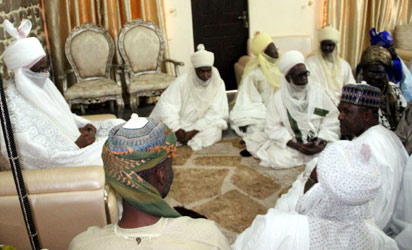
HOMAGE—International business magnate and Africa’s richest man, Alhaji Aliko Dangote, paying homage to the new Emir of Kano, Alhaji Sanusi Lamido Sanusi, yesterday.With them are Makama, Alhaji Abdullahi Sarki Ibrahim; Wali, Mahe Bashir Wali; Jarma, Professor Isa Hashim; Dallatu, Alhaji Muhammad Aliyu and the Deputy Secretary of the Emirate Council, Alhaji Sarki Waziri. Photo: Govt. House, Kano.
By Is’haq Modibbo Kawu
Last Friday, Alhaji Ado Bayero, the Emir of Kano died at the age of 83. He had reigned for 51 years, and with his death, a most significant chapter in the history of leadership, sourced from the traditions of the Sokoto Jihad, closed.
Emir Ado Bayero served with tremendous grandeur and because he was a modernising emir as much as a man of tradition, he provided a remarkable bridge of comforting leadership in a period of often, very turbulent changes.
He sustained the myth of the royal institution by the force of his personality, which seemed so unflappable in different circumstances of existence; as well as showing fidelity to the traditions which made the stool of emir one of the most enduring institutions of leadership in West Africa.
The fact that he reigned for over half a century, made him the constant in a society of fast-paced transitions of leadership types, and the dislocations associated with the bumpy phases of modern Nigerian history. Alhaji Ado Bayero built friendships spanning the length and breadth of Nigeria, that made him the quintessential bridge providing accesses of reconciliation, when the fault lines of Nigeria threaten to tear the country apart.
While Alhaji Ado Bayero has been sincerely mourned by his people in Kano and by others all over Nigeria, the fact of existence, is that a new Emir had to be named as soon as possible, since the institution, just like nature, abhors a vacuum. By Sunday afternoon Malam Sanusi Lamido, former Governor of the Central Bank was named the new emir.
Desperation seems to be the motif of the next couple of months in our country: desperation to retain or win Bola Tinubu and Bukola Saraki, to influence the choice of Kano’s new emir. They made it too obvious that they were interested parties in Kano to mobilise for Sanusi Lamido Sanusi’s emergence.

HOMAGE—International business magnate and Africa’s richest man, Alhaji Aliko Dangote, paying homage to the new Emir of Kano, Alhaji Sanusi Lamido Sanusi, yesterday.With them are Makama, Alhaji Abdullahi Sarki Ibrahim; Wali, Mahe Bashir Wali; Jarma, Professor Isa Hashim; Dallatu, Alhaji Muhammad Aliyu and the Deputy Secretary of the Emirate Council, Alhaji Sarki Waziri. Photo: Govt. House, Kano.
But beyond the political controversy, I feel extremely delighted that Sanusi Lamido finally emerged as the Emir. Apart from the fact that he coveted the position and was eminently qualified for it, I think he is the type of Emir that will be in tune with the needs of contemporary kingship in Kano and Northern Nigeria.
Even his most unrelenting critics agree that Sanusi Lamido Sanusi is an incredibly intelligent individual who gives his all to everything that he lays hands on.
Sanusi Lamido’s critics cannot stand his guts and bravery and they probably also loathe his excessive self-assuredness, which many of them have wrongfully described as ‘arrogance’. But those are the essential ingredients of the complex persona that define the man.
Sanusi Lamido Sanusi will be a modernising emir without forgetting the roots of the institution that he leads. He will grow into his role as emir and will be the poster boy of the creative blend of the traditional and the modern.
What I cannot talk about with any amount of confidence is how he will be able to refrain from commenting on the most contemporary challenges of the day. He had been a public intellectual with an impressive range of writings devoted to detailed analyses of some of the most important issues in the world of the past couple of decades.
He balanced his passionate devotion to scholarship, to polemics, with a very sustained display of competence in his vocation as a banker, rising steadily to become the Chief Executive of First Bank of Nigeria before being appointed as Governor of the Central Bank of Nigeria.
His devotion to the betterment of the Nigerian public space was central to his combative posture, whether he was confronting the “old boys network” that Nigeria’s National Assembly seemed to have increasingly metamorphosed into or daring to challenge the executive arm of government, in the manner that public funds were not accounted for under the watch of Diezani Maduekwe, the sacred cow of the Jonathan administration.
When Goodluck Jonathan exhumed some obscure report to remove Sanusi Lamido Sanusi from office, he couldn’t have envisaged the turn of events that made Sanusi Lamido Sanusi the new Emir of Kano. Allah yajikanSarki, Ado Bayero; Allah yajazamaninSarki, Sanusi Lamido Sanusi!
Maiduguri and the resilience of the human spirit
It was a deep crater in the road, close to the post office on Shehu Laminu way, which brought home just what people have experienced in Maiduguri, in recent years.
The driver attached to me, Malam Ahmed, just perfunctorily told me as we entered the crater, that it formed as a result of the most recent bombing in Maiduguri. It killed many people! I spent a total of nine days in Maiduguri over the past two weeks.
I have not been back in the city for over a year, and as we drove into Maiduguri from the airport, two weeks ago, I could not stop myself from having that eerie feeling, as we passed several military checkpoints that dot the streets of this city of three million people.
That was exacerbated by the feeling I had that I might just be an easy target for an attacker as I was ferried around in a government vehicle. But after the first day, I began to learn to relax just like the residents who honestly feel safe in their city. And it was quite difficult not to feel same after a few days. There are regular traffic jams in the streets of Maiduguri and from all I could see around me, there was still a concerted effort to retain the economic life that Maiduguri used to be known for.
Before the commencement of the insurgency, Borno had been the marketplace for the neighbouring countries: Northern Cameroun, Niger Republic and Chad.
The people here just exemplify the resilience of the human spirit through how they have continued to reproduce the conditions to allow them to live as decent a life as their circumstances allowed for. I met brilliant young men who are building a career in IT and have excelled as software developers, who have expressed their skills in jobs they secured from very important institutions around our country; just as others were endeavouring to give back to society with entrepreneurial development projects.
I spent hours in the company of the ordinary person and those in the leadership of the state. My central take away was that there resides here 1, 200 years of history; such a long history could never have been just a lineal story of successes. Civilizations are about successes and failures; the moments of reverses and of despair; but in the long run, the community reproduces the conditions for its continued existence as a people and a civilization.
There is therefore the underlining thread that tragic as the present moment in Borno history is, it will also pass and this very accommodating and generous community will re-discover the path of peace and progress.
I enjoyed my stay so much that I want to get back soon as possible. And if it felt as peaceful as I found in Maiduguri, there was still no escaping the effects of the Boko Haram insurgency.
The city infrastructure is clearly straining, because more and more people escaping the scorched earth policies of the Boko Haram sect are coming to live within the relative security of Maiduguri. The traffic situation gives an indication of the fact, while each new day is greeted with reports of the senseless killings, the burning down of villages and the disruption of livelihood for the mass of poor people in those communities that have faced the rapacity of the Boko Haram sect. There are daily reports of the raising of the flag of the insurgency in various areas of the state.
This insurgency is clearly the greatest challenge that has confronted the Nigerian state since the tragic events of the 1960s, which culminated in the Nigerian Civil War. Our armed forces confront an asymmetrical challenge which can sap the morale, because it is not the type of warfare that was historically taught in military academies. But in the long run, it is a war that must be won so that all the hopes we are investing in building a society dedicated to confronting the scourges of underdevelopment can then truly be realized.
Those who rule us must find the common purpose to work together to put an end to the insurgency. Borno and Nigeria deserve this common purpose fast!
Disclaimer
Comments expressed here do not reflect the opinions of Vanguard newspapers or any employee thereof.