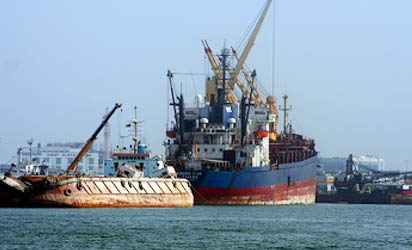
Sea-port
Few months back, the nature of implementation of the International Ships and Ports Facilities Security, ISPS code was a big worry for the nation’s maritime industry especially with regard to security at the ports and other marine facilities.

This follows the alleged ultimatum handed down by the United States, US, after the inspection of ports and other maritime facilities in Nigeria.
The International Maritime Organisation, IMO, through the efforts of the US pushed for the introduction of the ISPS code after the September 11 attacks.
The general agreement was that all maritime nations must implement the code within a given time and that any country that failed to comply would face sanctions.
As a result, the Federal Government of Nigeria set up the Presidential Implementation Committee on Maritime Safety and Security, PICOMS, in 2004 to enforce the implementation of the code.
However, political considerations and desire to transmute into a full flashed government agency became the drive of the body rather than the core function for which it was set up.
This misplaced priority resulted in a huge gap in the implementation schedule of the code, and as months dragged into years without much to show for it, the US Government stepped in.
Although the helmsman at the Nigerian Maritime Administration and Safety Agency, NIMASA, Mr. Patrick Akpobolokemi, told journalists after the ultimatum that the federal government has given it the Designated Authority, DA, since May 21, 2013, but it was only made public after the ultimatum.
It was after then that NIMASA swung into action with Akpobolokemi rolling out an action plan leading to meeting the demands made by the ultimatum.
According to him, “an action plan was developed and immediately activated to aggressively close the reported gaps.
“This effort included dispatching competent recongnised security organisations to conduct security surveys and assessments aimed at identifying and correcting these deficiencies and any other observed vulnerabilities.
“Whilst focusing on these facilities listed in the US Coast Guard report, measures are already underway to address the generality of port facilities (PFs) in the nation’s maritime domain.
“This action plan has been given a nod by the US Coast Guard and it has pledged to support the efforts of the DA in ensuring the issues raised are remedied. The DA has outlined its implementation framework in the form of a handbook to enable the public understand its agenda with respect to this new implementation regime,” he noted.
While this is being worked on, a government delegation went to the Washington DC, to understudy how the ISPS code is being implemented at the Baltimore Port, Maryland.
After a tour of the port which gave the delegation a view of the various terminals along the water front, the Trade Development Officer of Maryland Port Administration, Larry Johnson, told the delegation that “the US Coast guard maintains most of the security, makes the rules and regulations and we have to follow. The ports can also make their own rules and regulations.
“For anyone visiting the port, you have to give us two weeks’ notice, get your clearance identification card and then you have to be escorted to the port in a bus. Everybody must have a visitor’s pass, if you have to get out of the bus, you will be provided an escort for every five people if you want to get off.
“One person can do it if you want to drive round the port in a bus. So security is very tight here,” he said. From personal observation, unlike the Nigeria’s ports where almost all the terminals are separated by a simple fence, those of the Baltimore Port were well separated, and each one is dedicated for specific cargoes.
This, another official explained makes it easy to control in the event of serious incidents.
Disclaimer
Comments expressed here do not reflect the opinions of Vanguard newspapers or any employee thereof.