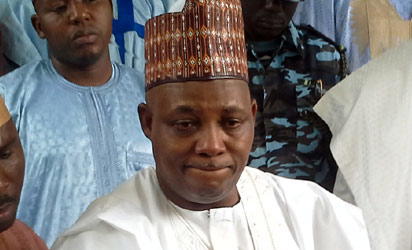
Shettima in tears
By Is’haq Modibbo Kawu
IF I say I was not petrified travelling through that 135km of road to Gwoza, I would be lying because that road had been designated a no-go area for about two months now due to incessant attacks and killings that occur there. But leadership requires courage and sacrifice. Courage, I believe is not the absence of fear but the belief that there is something greater than that fear”- Kashim Shettima, Borno state Governor
We had not left the Abuja airport last Friday, when news broke of the attack on the convoy of three Borno emirs. The initial story, which online news sources carried, was that these traditional rulers were kidnapped by Boko Haram; that was as scary as it could get. But then, things got clearer, but not less tragic: the elderly Emir of Gwoza, Alhaji Shehu Idrisa Timta, had been killed in the ambush and those of Uba and Askira, managed to escape. This is the Boko Haram crisis at a new low for the people of Borno, Northern Nigeria and our country in general. It was the point that everyone in the group I was travelling with was discussing, as we were called for embarkation.
The backdrop made for a tense flight and my mind turned around all types of subjects, especially because we were flying into Maiduguri airport, which had been audaciously attacked by Boko Haram, late last year. The knot in my belly resembled the one I felt when we flew in a similar turbo-prop plane from the Sudanese capital, Khartoum to El-Fasher, the capital of North Darfur, at the height of the crisis in 2006.

Shettima in tears
This is my first visit to Maiduguri since the middle of last year. I have planned to visit severally but just couldn’t manage to pull it through. Travel by road had become too hazardous, with Boko Haram brutally slaughtering wayfarers. The joy I get from driving around the different geographical spaces of our beautiful country has increasingly become subverted by the dangers that haunt Nigeria today; from Boko Haram, to kidnappers through to the familiar robbers, who not only take property but often stuff out life.
The other dangers of drivers-made-in-hell and lunatic government convoys merely spice up the danger on Nigerian roads. Hobbes must have had Nigeria in mind, when he railed against a reality, where life was “nasty, brutish and short”. It sums up the tragic paradox of an incredibly rich country; an enterprising people who nevertheless suffer the consequences of tragic choices in leadership; faulty economic projects and a notoriously persistent level of corruption. This heady mix has finally caught up with the country, threatening to tear it apart at a time when there seems to be a terrible deficit in leadership. Our country resembles an old Mammy Wagon; the break is failing, tyres are not good, our driver is notoriously incompetent and we are stuffed into that contraption, about to travel down a steep hill, on both sides of which are deep ravines! We are in trouble if we don’t become vigilant co-drivers, to assist us navigate our way safely downhill!
Well in Maiduguri last Friday, I was privileged to sit through a fascinating debate between the Governor, Kashim Shettima and a group of officials, that included the Deputy Governor; Head of Service; Chief of Staff; a commissioner and two advisers. It was on the appropriateness or otherwise of travelling to Gwoza, for the burial of the Emir. It was clear that the governor was determined to go. He argued that not to attend the funeral was to concede defeat; dampen the spirit of the people and betray their sacrifices. Without attempting to sound heroic, Kashim Shettima vowed that he would attend the funeral ceremony, in order to provide leadership from the front.
For those on the other side of that debate, they argued that the governor must not be endangered; while there was the need to seek the opinions of the security forces on the advisability of such a trip so soon after the killing. We dispersed because they had a meeting of the state security council for that evening, but I knew in my mind that with the resolve I saw, Governor Shettima would convince his colleagues to do the trip. And they did on Saturday, as the media has reported. They went accompanied by soldiers and policemen; members of the civilian JTF and local vigilantes.
When we saw again on Monday afternoon, I asked why he didn’t ask his people to pick me up for the trip, he answered that he did not have the right to endanger my life. He didn’t know that what I wanted most of all, was to be able to experience the rush of adrenaline which comes with danger, that seems to be wired into the life of every true journalist!
Again he re-iterated his views that there are certain steps that a leader must never be afraid to take. Self-preservation is vital; but in moments of trying crises, when the ordinary people are being called upon by their circumstances to make sacrifices, then leaders also have an obligation to show that they can share the privations of followers and provide hope that no matter the length of the night of despair, it must give way to the light of day.
It is particularly poignant, at a time when there are political circles who still believe that the Boko Haram insurgency is a Northern conspiracy against President Goodluck Jonathan. It is a narrative that even the president does not shy from exploiting. That mindset has paralyzed the administration and has led to a benumbing befuddlement that has cast a frightening pall on the Nigerian state. This is the basis of the serial missteps that continue to dog the administration, the most recent and certainly most incomprehensible, is the ban of all #BRINGBACKOURGIRLS demonstrations, which Abuja police chief, Mbu Joseph Mbu, described as “nuisance” and “lawlessness” he “cannot fold my hands and watch”.
On Monday, the Chibok abduction became more than an event in far away Chibok, when I was also invited to attend a meeting the governor held with 27 of the girls that escaped by jumping from the vehicle which Boko Haram used to convey the girls and the three that ran away from Sambisa Forest when they told their abductors they wanted to urinate, and their parents.
They were typical teenagers, who obviously felt ill at ease in the setting of the Government House, but whose presence brought home so graphically the events of the past fifty days! The Borno government is organizing counseling sessions and has plans to take their education to very high levels. In a tragic season of killings in Borno, Governor Kashim Shettima is providing the leadership that Nigerians also expect from President Goodluck Jonathan in Abuja.
From Jigawa to Plateau: The digital broadcasting resolve
LAST Tuesday, the new Jigawa State Television organized a live interview with Governor Sule Lamido, as part of test transmission which commenced in March. I have told the story of the work we have been doing as the Interim Management of the JTV, since March 2013. In Jigawa, the government took a decision to construct one of the most imposing broadcasting complexes in Nigeria.
But more forward looking was the decision to procure some of the most advanced digital-ready equipment for the television service along with the ambitious challenge the Interim Management was set, to institute programming and news at the highest levels of professionalism.
The vision was to tell the Nigerian and African stories from the setting of Jigawa state, and from that mandate, parochialism was banished deliberately. Out team is resolved to deliver on the mandate with the hope that the JTV can become an object lesson in uniting our country, through the power of broadcasting.
It seems obvious that one good example can often become a trigger for a copycat action. Last week, Pinnacle Communications Limited, which delivered the Jigawa TV procurement was also awarded the contract for the supply of equipment for Plateau State Television. As worked out, it will also be a walk on the path of digital upgrade that will position television broadcasting in Plateau state. It is no surprise that Governor Jonah Jang has taken such a decisive step, because Jos has always been a frontline city for media in Northern Nigeria dating back to decades.
The crises of the past couple of years overshadowed the remarkable story of that beautiful part of our country. But things are gradually taking a turn for normalcy, not even the tragic bombings of the past few weeks, can destroy the resolve. From Jigawa to Plateau, we are witnessing the gradual consolidation of the digital transition, with all the exciting possibilities that we will harvest into the future. I say this with the optimism of a long-term participant in the broadcasting industry.
A lot of new opportunities will open in broadcasting that will challenge our creativity and give access to the most daring. So the investments being made by states like Jigawa and Plateau, are the necessary platforms that will open the aperture for the exciting future of digital broadcasting. So welcome to the future of broadcasting, Plateau state.
Kayode Fayemi: One good term deserves another
I SPENT Easter 2013 in Ado Ekiti, as guest of Kayode Fayemi, the Ekiti State Governor. I took the opportunity to travel round the state to see some of the landmark achievements of his administration but spent even more engaging time, discussing his views of politics as the governor of his state and as a Nigerian intellectual with solid pedigree in the struggle against military dictatorship. Kayode is not the archetypal politician; he is certainly not the rabble-rouser.
He thinks through actions and he reflects very deeply; and in a sea of ordinary politicians dedicated to the service of their bellies, Fayemi represents the few that can inspire belief that we are not doomed afterall.
The Ekiti state elections will be due in the next few days, and it is my hope that INEC will get things right this time, so that we do not get sucked into the type of controversy that will portend serious danger for the 2015 elections. The parties involved in the election must also display utmost responsibility and live up to the billing that Ekiti State is truly, “Ile Iyi, Ile Eye” (Place of Honour).
I do hope Kayode Fayemi gets a renewed mandate to be able to consolidate the work he began four years ago. The success of types like Kayode Fayemi, might just be the harbinger of a more qualitative level of leadership in Nigeria. Believe me, Nigeria can do with truly patriotic, dedicated and responsible leadership!
Disclaimer
Comments expressed here do not reflect the opinions of Vanguard newspapers or any employee thereof.