By Adisa Adeleye
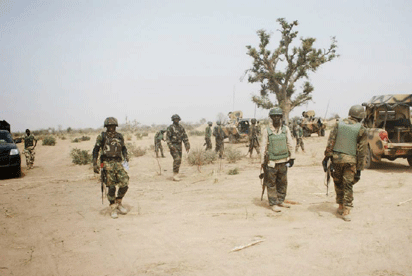
Since the abduction of more than 200 female students from a College in Borno State about three weeks ago, the “Sambisa Forest” has been associated with a place of terror where any type of infirmity could not be ruled out.
Those brave but anxious parents who traversed a part of the forest have been warned by settlers near the forest to abandon the fruitless chase of the `notorious` bandits. So, at the moment, the dreaded forest remains inaccessible.

Group of Muslim sisters during a Peaceful Protest -“Bring Back our Abducted Girls in Chibok Borno state ”- to Lagos state Gov Mr. Babatunde Fashola organized by Women for Peace and Justice Coalition, in conjunction with Market Men and Women Association of Nigeria. Photo: Bunmi Azeez
Angry Nigerians might be at a loss to understand why wiser men might not want to rush in where ‘angels‘ fear to tread‘. The security forces might prefer a cautious and more reliable approach rather than the expected bombardment of the forest. The pertinent question is, could the forest continue to hold the more than two hundred girls and their captors for more than three weeks without any sign of human existence?
It might be contrary to the expectation of many that the Sambisa forest is a fully developed habitation for the insurgents with copious supply of necessary essential needs of life. Some may even believe that the adjoining villages are populated by active supporters of the Boko Haram killers, providing food, shelter and vital information.
If it is correctly assumed that the Sambisa forest is where the insurgents are holding their unfortunate victims, the seemingly cautious approach of the security forces becomes more understandable and reasonable. Who knows what tactics the Boko Haram fighters would adopt in the defence of the uncharted and dreaded jungle?
To them, death is nothing. The sacrifice of young educated girls would satisfy their satanic ego while at the same time, would satisfy their wish for scaring away people from the pursuit of Western education.
The Boko Haram sect has built its myth on general poor security intelligence about its total strength and its organizational ability. The murderous group seems able to strike at will and with deadly precision at their selected objects.
None seems to be sure whether the next neighbour is not that Boko Haram informant or active supporter. However, eyes should be fixed on dismissed soldiers or dismissed police officers and unemployed graduates in every locality.
Writing on the problems of general insecurity or “state of war”, Professor Mabbott once noted that, “In 1928, I came across two valleys in Romania where all civilized activities had ceased, owing to the presence of a band of brigands. Markets were empty, fields untilled, houses barricaded.
The terrorized population must have numbered some thousands. The brigands were finally rounded up by the Army; they numbered thirty-five. Who knows whether the soul of Boko Haram insurgency is not rooted in the towns controlled and directed by a closely knit units far removed from the gaze of security officials.
Poor security intelligence gatherings could at times hamper the fight against insurgency where a small number of people based at strategic positions would continue to provide logistical support for the sect.
It is a matter of fact that the terrorist organization has been able to humble and confuse many Nigerians by the brutality of its attack and thereby, attracted international opprobrium. It is gratifying that the United States and the British Governments have promised counter-insurgency aids which have been accepted by the Federal Government on behalf of the Nigerian people.
The positive changing mood of many Nigerians towards the Boko Haram murderers in different parts of the country is also noted with delight. This is a ‘state‘ war which must be fought with all methods. In the mean time, the ignition of the Sambisa forest pyre is being awaited with eagerness.
The economy
Recently, President Goodluck has joined in the funny debate on whether or not Nigeria is a poor country as it is often expressed at home and by international institutions.
Some argue positively that a country with a population of about 160 million, with only about 70 per cent literacy, with less than 30 per cent of population having access to good drinking water and with majority of its population living on less than a dollar (n166) per day, could be nothing but a poor state.
The hard-working Minister of Finance and the Coordinating Minister for the Economy, Dr. Okonjo-Iweala (also the host of Abuja World Economic Forum) has stated boldly to anyone who cares to listen, that Nigeria is not a poor country.
The country which has suddenly become the largest economy in Africa has one of the fastest growth in the world (6.7% growth rate) with crude oil production of more than 2 million barrels per day, with extensive gas production and reserves; with macro-economic stability and inflation rate at less than 8 per cent and with more than 33 valuable minerals yet untapped, could not be seriously described as a poor country.
President Jonathan has agreed to that assertion, perhaps in a comical version, that Nigeria has one of the world‘s richest men in Aliko Dangote and that Nigeria‘s private jet owners are increasing in number.
Though President Jonathan and his Finance Minister argue faultlessly that Nigeria is not poor (or should not be poor), they agree that the national income of the country has been inappropriately shared among the different sectors of the country by the present government and that rising unemployment has remained a challenge.
It may be conveniently argued that it does not need a doctorate degree in Economics or Zoology to appreciate that an economy which thrives on unequal and unjust distribution of the national income, that breeds unbridled capitalism and its economic resources wasted and mismanaged, would provide a fertile soil for deepening poverty and insecurity to germinate. That is not only a poor country but a dangerous one, waiting for a social revolution.
I agree that Nigeria should not be a poor country which is one of the themes of the present World Economic Forum for Africa in Abuja.
Disclaimer
Comments expressed here do not reflect the opinions of Vanguard newspapers or any employee thereof.