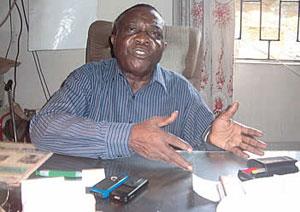
Ikokwu
SECOND Republic politician, former Anambra State Chairman of the defunct Nigeria Peoples Party (NPP) and Peoples Democratic Party (PDP), Chief Guy Ikokwu, in this interview said Nigeria should be restructured and derivation increased to at least 25 per cent to accelerate development in the country.
BY CLIFFORD NDUJIHE
On 13 per cent derivation controversy
It should be noted that at independence, our constitution gave the regions 50 per cent derivation from the resources from their own area whether agricultural or mineral. It was the military that progressively moved the percentage down to 13 per cent and there were negotiations in the last few years to move it to 25 per cent while the Niger Delta kept insisting on 50 per cent derivation.

*Chief Guy Ike Ikokwu
If the percentage is increased to 50 per cent it will apply to resources in the six geo political zones of the federating units as was the case at independence.
Any resolution between 25 and 50 per cent has to be properly reasoned out for the benefit of the federating units.
We all know at the moment that the oil resources are fast depleting and the 50 per cent derivation principle which will apply to other mineral resources in other parts of the country and also to the agricultural and other resources will certainly generate more revenues to each of the geo political zones.
On restructuring of the country: If the Conference fails to recommend the restructuring of the country then we shall be going back to status quo ante, which calls for a proliferation of states which will be no less than 50 in number.
This will increase the level of corruption in the country and reduce capital development exercises because of the enormous expenses involved in the presidential system and the dictatorship of the executive governors and presidency which means that the country will not have true federalism for decades to come.
It should be clearly noted that if this conference fails to restructure the country, then the adage of ‘to your tents oh Israel’ will become a truism for Nigeria.
The prediction for chaos for 2015 would be realized and it is therefore hoped that the present level of insecurity in the country is not a prelude for the 2015 cataclysm. According to old age long parlance “A stitch in time saves nine”.
Let us restructure our country now from unitary federalism to true federalism with the devolution of powers to the six geo political federating units.
His confab expectations
There are very strong indications that the National Conference shall in the next 30days resolve some of the salient issues that will make or break the conference.
Some of the cardinal issues to be resolved are very few whereas the rest can be resolved on a consensual basis now that the 20 committees have submitted their reports.
With regard to the structure of Nigeria, there are two main view points; one is for the retention of existing or more states and for the amendment of the existing constitution by the National Assembly. The other view-point is for the present six geo-political zones to have increased regional powers, in this way the present Federal powers will be drastically reduced and we shall be implementing true federalism.
This issue will now go for referendum under a new law. This issue of true Federalism has haunted Nigeria for the past 50 years during which our constitution and political structure have been militarized to the point where we now have what is referred to as Unitary-Federalism.
The leaders of the six geo-political zones have held several internal meetings with their people and are supposed to represent what is in their best interest. The people of the South-East geo-political zone who are mainly Igbo have unmistakably opted for a zonal arrangement with increased powers and devolution from the centre in Abuja. In this way the zone can deal with a myriad of problems such as infrastructure, education, job creation, health, energy, security and overall wellbeing of her people.
Capital resource capability
It is up to the zone to have as many states as it requires for its administration, while enhancing its capital resource capability.
The Ohanaeze, Igbo Leaders of Thought, The Aka Ikenga, Ndigbo Lagos, Igbo Youth Movement, Igbo traders and peasant groups, MASSOB, and Igbo elite all have come to the irrevocable conclusion that Nigeria has to be restructured now on the basis of the six zones being the federating units of the country. This will enable each zone to develop at its own pace and to establish its own criteria.
On South-West demand for regional autonomy
It is gratifying to note that the Yoruba South-West zonal group agrees on this zonal restructuring arrangement; likewise the South-South, which maintains that this new structure will be the best for Nigeria.
We also understand that the North Central zone comprising more ethnic groups than the other zones believes that this new arrangement will enhance their viability rather than within the numerous unviable state structures which they have presently.
The other two zones: North-West and North-East, which are heavily dependent on the present centralized unitary-federalism will certainly be better off, when their zones have greater power to look after their interests as they would be more endowed than most West African states of the moment.
We want to make it clear that individual delegates from the South-East, who frustrate such restructuring of Nigeria on zonal lines, had better stay back in Abuja and not attempt to come back to the South-East.
It should be noted that once the restructuring on zonal lines is agreed matters like derivation; immunity; Local government; budgetary provisions for capital and recurrent expenditure; security; elections; nationality and indigenship; foreign affairs; customs; aviation; religion; national and zonal legislature; judiciary and others can be easily resolved consensually or otherwise.
The present cost of running this country has to be reduced drastically for developmental purposes. One major issue which obviously follows the restructuring is the preference of a Parliamentary system over the Presidential system which is very expensive and enhances massive corruption as we have witnessed in Nigeria since its inception by the military.
The Governors of the zonal government should be elected as the assembly men are and would have their seats in the zonal assembly. Zones should either have more states without local councils or create councils with part time councilors and minimal expenses, without Executive Governors as we have now.
The current looting of the treasury at the state or zonal level will be drastically reduced.
Disclaimer
Comments expressed here do not reflect the opinions of Vanguard newspapers or any employee thereof.