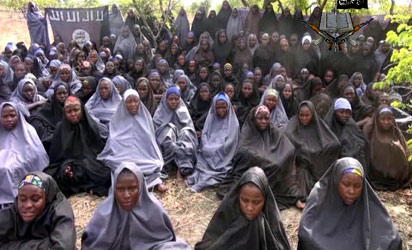
File: A screengrab taken on May 12, 2014, from a video of Nigerian Islamist extremist group Boko Haram obtained by AFP shows girls, wearing the full-length hijab and praying in an undisclosed rural location. Boko Haram released a new video on claiming to show the missing Nigerian schoolgirls, alleging they had converted to Islam and would not be released until all militant prisoners were freed. A total of 276 girls were abducted on April 14 from the northeastern town of Chibok, in Borno state, which has a sizeable Christian community. Some 223 are still missing.
By Alani Olabanji Kuye
The US Patriot Act was revised after the 911 Terrorist attacks in the United States of America. The revisions empowered US intelligence services and Law Enforcement entities to combat terrorism both at home and abroad as part of the Global War on Terrorism instituted by the United States under the Bush Administration.
Title II specifically broadens the ability of US Intelligence and law-enforcement agencies to conduct surveillance on “agents of foreign powers.” This allows interception of all and any communication anywhere in the world as long as there is a suspected link to terrorist activities.
It allows US Intelligence and law-enforcement agencies to share information related to terrorist activities with US federal authorities. This does not necessarily include authorities in the countries being surveilled. Additionally, Title II authorizes roving surveillance — that is, a US court order allowing surveillance on particular person(s), and allows US agencies to utilize any means available to intercept communications, regardless of location. As you can see, this is global in nature.
Previously, a US court order would only allow for wiretaps on specific communications lines after a US judge has authorized such warrants. In the past, warrants were authorized on a case by case basis and on a location by location basis. The Patriot Act authorizes sweeping warrants covering a wider spectrum. In a nutshell, one warrant can blanket multiple swaths of suspected locales.

A screengrab taken on May 12, 2014, from a video of Nigerian Islamist extremist group Boko Haram obtained by AFP shows girls, wearing the full-length hijab and praying in an undisclosed rural location. Boko Haram released a new video on claiming to show the missing Nigerian schoolgirls, alleging they had converted to Islam and would not be released until all militant prisoners were freed. A total of 276 girls were abducted on April 14 from the northeastern town of Chibok, in Borno state, which has a sizeable Christian community. Some 223 are still missing.
A screengrab taken on May 12, 2014, from a video of Nigerian Islamist extremist group Boko Haram obtained by AFP shows girls, wearing the full-length hijab and praying in an undisclosed rural location. Boko Haram released a new video on claiming to show the missing Nigerian schoolgirls, alleging they had converted to Islam and would not be released until all militant prisoners were freed. A total of 276 girls were abducted on April 14 from the northeastern town of Chibok, in Borno state, which has a sizeable Christian community. Some 223 are still missing.
Furthermore, it allows the government to order files from the providers of communications services with details about specific customers’ use of the service. For example, an Internet service provider can be ordered to provide information on IP addresses, login times and sites visited. Title II of the Patriot Act also allows delayed notification of search warrants, meaning a suspect’s house could be searched while the suspect isn’t present, and the suspect would not be notified of the search until after it was carried out.
The wide-ranging Title II included many other relatively minor clauses. In a nutshell, the US can operate in your country under the “Global War on Terror” clause without notifying your government. We saw this in Pakistan and continues to happen in other countries. Do we want to risk our sovereignty by not taking responsibility for our security? What the U.S. Patriot Act is telling the world is basically: If you can’t handle your own security, we will do it for you, but there’s a price to pay. The US as a great ally, is also the guest that ends up with your wife and house if you’re not careful.
History attests to this from Iraq with Saddam Hussein, Iraq with the Shah, and Charles Taylor, all who were initially sponsored and supported by the United States government and intelligence services.
We can draw an analogy to US presence in multiple countries across the world. Pakistan for example where the US went in without notifying the government in an operation that only leaked because one of the helicopters crashed. Though Bin Laden was summarily terminated in that operation. Needless to say, there are many similar operations across the world today that do not make news headlines.
The menace of drones patroling the airspace of sovereign nations is also a cause for concern. The Patriot Act of the United States implicitly authorizes the US to violate any sovereign nations airspace, land borders, or communication protocols under the guises of the “Global War on Terror”. Is this acceptable? Granted many governments are plagued by corruption and questionable ethical practices at best, their sovereignty must still be respected.
Nigeria is toying with occupation by foreign powers under the guises of the “Global War on Terror” by not addressing the ever increasing temerity of Boko Haram. Various government officials are calling on assistance from foreign powers, which implies that the government of the day either lacks the capacity, expertise, or willingness to address the situation. Nigeria and Nigerians must be resolute under one voice to address the menace of Boko Haram or risk inviting foreign powers who come to the table and never leave. This speaks to the indirect recolonization which appears to be spear headed by the US under the guise of the “Global War on Terror”.
The U.S on the 5th of May 2014 introduced a bipartisan resolution condemning Boko Haram and the abduction of school girls in Nigeria. Historically, Western Intelligence agencies did not view Boko Haram as a major threat, given their attacks were focused on the Nigerian government. Even after the UN offices bombing in Abuja. However, according to the United States Africa Command (AFRICOM), Boko Haram are being supported and trained by Al Qaueda in the Lands of the Islamic Maghreb (AQIM) and Al Shabaab. This is a game changer in the eyes of the West.
Given the U.S Intelligence community in the recent past under estimated the intent and capabilities of other terrorist organizations, we can be rest assured there will be no stone left unturned this time around. Any Al Qaeda links no matter where on the planet is a threat to U.S. homeland security in the eyes of the West. This is explicitly referenced in the report: Boko Haram: Emerging Threat to the U.E. Homeland ( Subcommittee on Counter terrorism and Intelligence, Committee on Homeland Security, House of Representatives, United States of America. Once declared an FTO (Foreign Terrorist Organization), there is no limit to the U.S. ability and willingness to pursue. No matter the impact to the host nations sovereignty. This is just the beginning.
While we intellectualize, define, and debate Boko Haram and terrorism, our wives, daughters, sisters, and mothers are getting maimed, killed, kidnapped and allegedly married off by the same Boko Haram. The mere assumption that foreign powers are waiting for input and direction from Nigerian authorities is fallacy at best. The verisimilitude that foreign powers have crafted designs on Nigeria (and Africa) is very apparent to any student of history and post World War II geo-politics that saw the the remapping of world power between Europe and the West (United States). The fall of Muammar Gaddafi, and the movement of weapons across the Sahara desert into other parts of Africa is no coincidence. Gaddafi worked with many tribal groups across the Sahara desert and provided arms in addition to humanitarian aid and support. Upon his fall, sophisticated ammunition now in the hands of various groups are finding their way across and into other parts of Africa. The complex nature of African geo-politics which outsiders don’t understand while trying to control is the genesis of our current instability.
The West is adept at utilizing “order out of Chaos” as a strategic measure by which the sovereignty of nations is overlooked in an effort to restore order.
When Chief Olusegun Obasanjo was president, there was never hesitation by the country’s leadership to bring down the full bearing of the Nigerian Armed Forces (primarily the Army) on any trouble spots. The country needs strong leadership with clear lines of authority. A popular Singaporean adage says “Soft power is only relevant after you have developed hard power”. The Nigerian government needs to engage from a position of strength to achieve any meaningful results because resolve will always prevail over temerity if the cause is just.
Alani Olabanji Kuye is a social commentator.
Disclaimer
Comments expressed here do not reflect the opinions of Vanguard newspapers or any employee thereof.