By Princewill Ekwujuru
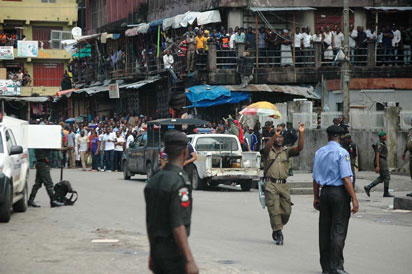
A poll has shown that ninety percent of Nigerians identified insecurity as the greatest problem confronting the country today.
The poll conducted by TNSRMS Limited, a market research firm also revealed that inadequate power supply and corruption were identified as the second and third greatest problem facing the country.
Nigeria recently rebased its Gross Domestic Product, GDP to include previously uncounted growth industries like the Telecoms, Information Technology, music, e-commerce and the movie/film industry; thus making it the biggest economy in Africa valued at $510 billion.
In a finding aimed at feeling the pulse of ordinary Nigerians as it relates to the socio-economic, political landscape, growing sense of insecurity, tagged: ‘The Pulse of The Nation,’ cast dark clouds over the nation’s positive economic outlook.
The Chief Executive Officer of TNSRMS West, East and Central Africa – Mr. Adeola Tejumola, while commenting on the findings of the survey explained that the unrest and upsurge in crime in some of the northern states and other parts of nation may be having negative impact on the psyche of the citizenry, as 65 percent of Nigerians are of the opinion that the security situation in the country has worsened compared to same time last year.
Insecurity which used to be one of the least concerns of the average Nigerian (in order of social problems facing the country); has now assumed alarming proportion. This social problem spans the entirety of the nation; from assassinations, arm robbery, militia groups’ insurgency in the north, and kidnapers in the eastern and southern parts of the nation, to ritual killings in the West. Insecurity is now on the front burner and appears regionalized, he said.
The survey further showed that 70 percent of Nigerians are of the opinion that the growing sense of insecurity is a key driver of the bad image the country has within the international community.
Though for the first time in Nigeria’s 53-year history, the country has successfully privatized the electric power industry with the Minister of Industry, Trade and Investment, Mr. Olusegun Aganga recently saying that the privatization of the nation’s power sector has unlocked investment opportunities (pipeline investments estimated at $50bn currently); Nigerians seem to be dissatisfied with the sector’s performance till date, with about 70 percent saying electricity supply has worsened compared to same time last year.
Disclaimer
Comments expressed here do not reflect the opinions of Vanguard newspapers or any employee thereof.