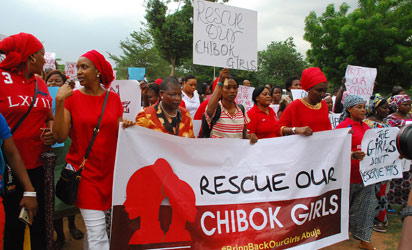
Abuja : Former Nigerian Education Minister and Vice-President of the World Bank’s Africa division (3r L) Obiageli leads a march of Nigeria women and mothers of the kidnapped girls of Chibok, calling for their freedom in Abuja on April 30, 2014.
BY BOLUWAJI OBAHOPO & LAJU ARENYEKA
THE horrors of over 234 girls kidnapped from their hostel in Chibok three weeks ago cannot be put into words. Every second gone confirms the worst fears of parents. Even the far removed person on the streets worries about the security of his children.
But no fear can be as real as that of the girls themselves; if it were possible they would most likely exchange their years of learning just to be home with their families. Chilling nights and torturous days cover the country like a blanket, and Nigerians are getting to the point where all that matters is safety.
Stuck on the lower rungs of Maslow’s hierarchy of needs, Nigerian children, especially those in the North-East, are now being forced to choose between living a life resigned to ignorance and living at all. Terrorists, who fight against Western education, now feed on the undeniable truth that the average parent would rather have a living, breathing, uneducated child than a kidnapped or dead one. This is a double tragedy, as more girls may join the country’s estimated 10.5 million children who are out of school, six million of whom are girls.
Speaking to CNN recently, an unidentified female student from the north said: “If this goes on, many parents will no longer let their girls go to school. Schools around many of the communities are difficult to find, so many times children go farther from home to get good schools. But with the current insecurity, many parents are afraid and might refuse to let their children go to school. When this happens, the girls’ dreams are crushed.
Many girls from the North have dreams; it’s not every young girl that wants to be married off at a young age. They want to be lawyers, doctors…only about two percent just want to be married.”
Amy Oyekunle of the Kudirat Initiative for National Development, KIND, said: “Before now, the North has had really poor indices with regards to girl education and retention in schools. There is a great probability that this will further worsen these indicators. This current wave of insecurity has a deteriorating effect on education, it is like we are going five steps backwards after having gone one step forward.
In this day and age, the importance of education cannot be overemphasized. Investing in education, especially girl- child education is the smartest investment anyone can make. There are so many challenges, especially the heartbreaking situation of these missing girls. But these girls must be found and we must continue the fight for girls to be educated in the northern region.”
The National Coordinator of the Education Rights Campaign, ERC, Mr. Hassan Soweto, told Vanguard Learning: “The incident will no doubt drastically affect school attendance. Ordinarily, school enrolment in the North is low. This will plummet further. While pupils are afraid of going to school, their teachers too will be scared of staying at their duty posts.
The implication is that public education may be annihilated in the North in the foreseeable future and that is one of the principal objective of Boko Haram. For the sake of the Chibok girls; for the sake of other Nigerians who are daily victims and for the sake of public education, we must win the war against Boko Haram. But the capitalist ruling elite cannot win this war because their unjust system and policies gave rise to Boko Haram.
Only the people united and organised can win the war against terrorism and save public education.”
Before now, various challenges have made education of girls in Northern Nigeria a herculean task. Child marriage, which gained widespread condemnation on social media last year, is one of such. “Child marriage, from available statistics, ultimately hampers the efforts of these young adolescents from acquiring an education, as sooner than later, they find it difficult to combine the onerous responsibilities of being a wife and mother, with schooling,” says Maryam Wais, chairperson of the Isa Wali Empowerment Initiative (IWEI).
The IWEI boss, in an earlier interview with Vanguard, spoke on the dire consequences of early marriage on education: “They drop out, if they have not been removed for the purpose of marriage, in the first place.
Consequently, 70.8% of young women aged 20-29 in the North-West zone are unable to read or write.”
UNESCO, in a 2014 report, said that at the current rate, it will be 2086 before access is reached for poor, rural African girls.
According to the United Nations Children’s Fund, “the number of schools, facilities and teachers available for basic education remain inadequate for the eligible number of children and youths. In the North particularly, the gender gap remains particularly wide and the proportion of girls to boys in school ranges from 1 girl to 2 boys to 1 to 3 in some states. Another cause of low enrolment, especially in the North, is cultural bias.
Most parents do not send their children, especially girls, to school and prefer to send them to Qur’anic schools rather than formal schools. Even when children enrol in schools, many do not complete the primary cycle.
According to current data, 30% of pupils drop out of primary school and only 54% transit to Junior Secondary Schools. Reasons for this low completion rate include child labour, economic hardship and early marriage for girls.”
A study conducted by the UNESCO found that school children in Nigeria, particularly those in the northern provinces, are at a disadvantage in their education, with 37 per cent of primary-age girls in the rural north-east not attending school, and 30 percent of boys not attending school; according to the World Economic Forum’s Global Gender Gap Index, Nigeria is ranked 106 out of 136 countries based on women’s economic participation, educational attainment, and political empowerment.
These challenges may be considered as child’s play when compared to the recent insecurity virus plaguing not just the education sector, but the nation as a whole. So why fight for education? Why risk the lives of children? No one can answer that better than a girl like Nobel Prize nominee, Malala Yousafzai, a young Pakistani activist who survived a gunshot to the head, simply because she was fighting for her right to be educated.
At the age of 10 , she told journalists in an interview: “How dare the Taliban take away my right to be educated? It is not true that the Islamic religion forbids girl-child education. If I have a meeting with the Taliban, I will tell them that Islamic religion promotes girl- child education.”
Yousafzai, who is currently lending her voice to the BringBackOurGirls online campaign, understands that the benefits of women’s education go beyond higher productivity for 50 per cent of the population. More educated women also tend to be healthier, participate more in the formal labour market, earn more income, and provide better health care and education to their children, all of which eventually improve the well-being of all individuals and lift households out of poverty.
Disclaimer
Comments expressed here do not reflect the opinions of Vanguard newspapers or any employee thereof.