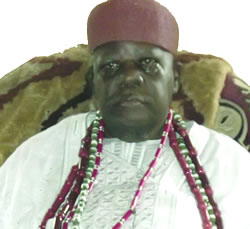
*De Whenu Aholu Menu Toyi 1
Badagry, a coastal town and local government area in Lagos State, was a major slave post and market during the better forgotten slave trade era. Situated between Metropolitan Lagos and the border with Benin at Seme, it remains today one of Nigeria’s most treasured historic sites and tourist destinations.

*De Whenu Aholu Menu Toyi 1
Indeed it has grown in popularity over the years given the belief in many quarters that it represents Nigeria’s most enduring place to re-create and connect with history.
Hence, its traditional ruler, the Akran of Badagry Aholu Wheno Menu-Toyi 1 is widely held in high esteem as a royal father of relevance and repute, with his influence spanning over Badagry town and 70 adjourning villages and districts spread across the mainland and islands in South West Nigeria
Badagry is also reputed for the peace that prevails there, especially as it has little or no history of restiveness arising from heated disputes among its people. But there are presently indication that this state of affairs may soon be put to test over the current quest by the descendants of one Prince Sotin to have their royal and princely status restored to them. According to these great grand children of the late Prince Gogan Sottin, their progenitor, Prince Sotin together with his family members and faithful servants settled in Badagry over 500 years ago after migrating from Dahomey; that was in 1598.
They subsequently founded and settled at a place which came to be known as the Tohon, which later attracted other settlers from elsewhere. Over time, Tohon increased in size and popularity, with the Sotin family members living peacefully with their settler tenants. But in spite of this development and the leadership which Sotin exercised to sustain this, the family was not accorded its royal status.
Speaking on behalf of the descendants, Prince Adeoye Sotin averred that the time had come for them to claim their rightful heritage, adding that “there was no doubt that those who settled in these parts of the vast land were traditional tenants to Gogan Sotin.”
According to him, the late Gogan Sottin established the title of chiefdom as well as a palace to justify his princely status. He said: “Gogan Sotin put in place the title of Chief. Panko is part of the settlements. Those who were settling in those settlements were traditional tenants to Gogan.”
He explained: “We are ready to take over our heritage. His (Gogan Sotin) first son, Zakran, took over from him and this has been on like that over time. We don’t want this lineage and cultural heritage to die. We want to recover the landed property for posterity sake.”
Adeoye argued that the descendants of the Sotin family lineage had been in an undisputed possession of the landed property. He said: “We are calling for the restoration of his (Sotin’s) princely status as a royal blood.”
He added that Gogan Sotin’s noble upbringing, his love for the poor and service to humanity, informed his decision to permit the Panko people (with whom he and his people had affinity) to peacefully settle on a section of the South-agricultural land, which he said Tohon people gave to other settlers on the the land.
Adeoye Sotin noted that the use of farm labour (for bush clearing, crop planting, harvesting, palm kernel nuts cracking and oil processing) became apparent for the Tohon people as well as the people from Age, Dahomey (from Ipokia or Poka) who were employed on Tohon land and were allowed to settle in their respective locations till today as customary tenants of the Tohon people.
Adeoye’s position was also corroborated by Prince Christopher Sonayon Sotin, the secretary to the family, who said there was no doubt about the lineage of their progenitors. According to him, the family decided to take the gauntlet to save the family’s cultural heritage as inherited from their forefathers.
Tracing the history of this heritage, he said that when Prince Sotin and his entourage arrived Badagry in 1598, they were received by one High Chief Boe who happens to be his cousin. Later, Prince Sotin, accompanied by his cousin, went in search of the promise land revealed to him through divination.
As they got to a vast forest after passing through sandy soil and crossing a swampy that opened to a serene river, they stopped and examined the sandy soil and nodded in confirmation that it was the ‘Promised Land’ revealed by divination.
After discussing the matter with his majesty, the Akran, approval was granted High Chief Boe with the Akran subsequently announced that henceforth the vast forest had been absolutely granted to him (Sottin) for his personal use and posterity.
The land comprises extensive forest spreading from the swamp(now known as Agelaso) to eastward to Asisavilopo close to the Gezeland, northward to another swamp opening up to today’s Erikiti(border line) and westward stretching to the swamp overlooking the river now known as Yewa river and south westerly linking another swamp Tozunkanme. Prince Sottin farmed and planted vegetables, coconuts and herbs and also occasionally hunt exclusively on the forest until his death in 1752.
Upon his demise, his son, High Chief Gogan Sottin after departed Port-novo to Tohon land through the guidance of Sumbu Mobee, a successor to High Chief Boe, the original owner of the vast forest, he exclaimed — “Oto shie osu hon na tukla de mimo dogbon jiwheyewhe siho dahli to aholu mikpon si to hogbonu” , which was later contracted to Tosuhon and later to Tohon that is used till today. The customary tenants on the land are Panko, Agadangba, Seje and Agbovipe. It occupied the vast area of land engaged in farming, hunting and practicing Christianity with Thomas Freeman, a Missionary he hosted and built the first Methodist Church and primary school respectively.
The name Boe is a contraction of the Egun name Obodemahuse meaning “there is no drug or medicament (for healing purposes) beyond or above the Almighty God.”
Disclaimer
Comments expressed here do not reflect the opinions of Vanguard newspapers or any employee thereof.