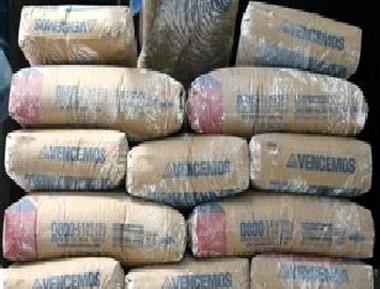
For almost three months now, there had been issues on the standardization of Cement in Nigeria.
What started as a mere grumbling by the coalition of civil society groups and professional bodies in the construction industry, took a major dimension when the Standards Organisation of Nigeria (SON) set up a committee to look at the issues raised by the concerned professionals.

The issues raised were deep and should definitely be a source of concern to any responsive and reasonable government. The coalition, according to Newspapers reports, called on the relevant authorities to initiate actions to make 42.5 grade of cement the standard product in Nigeria.
The stakeholders’ argument is that nearly all the cement manufacturers and importers in the country are in the habit of taking advantage of the lax regulation and lack of enforcement to vary their pigmentation in favour of the lower grade cement (32.5) which in most cases is used in building and seen to be partly responsible for the collapse of houses.
They are of the conviction that the practice, which is quite prevalent, is usually overlooked by the Standards Organisation of Nigeria (SON,) a situation they claim is partly responsible for the worrisome cases of collapsed structures in the country.
The coalition urged lawmakers to probe manufacturers and importers of cement for compromising standards in the building and construction sub-sector. They vowed to confront the Cement Manufacturers Association of Nigeria (CMAN) for poor standard of locally-produced and imported cement.
They contended that their stance is not unpatriotic; rather, it should be seen as a fight not to compromise standards on the altar of monetary gain. They claim in their working document that in advanced countries, there is migration from the lower grade of cement or 32.5 to the higher level of 42.5 specification and even 52.5 with a uniform standard set by government, and manufacturers and importers can be held accountable whenever there is infraction or reduction in agreed specification.
The coalition spokesperson, Mr. Tunde Ojo, blamed the Minister of Trade and Investment, Dr. Olusegun Aganga, for condoning manufacturers’ unethical conduct and vowed to mobilise block makers nationwide against manufacturers and importers of poor quality cement. While some other cement manufacturers were dillydallying and persuading the government to let the 32.5 grade of cement stay or better still, allow manufacturers that want to continue producing the 32.5 grades to continue , Dangote Cement responded swiftly and revealed that it has since increased its cement capacity to 42.5 grades and also started producing 52.5 grades in line with international standard and quality benchmark.
Reacting to the threat of coalition of civil society groups and professional bodies in the construction industry, the company, represented by its Chief Executive Officer, Mr. Devakumar Edwin said Dangote as a company is an international conglomerate, which prides itself in quality and safety and has the capacity to produce the best grade of cement in all its plants across Africa.
He said that though the cost of production of 52.5 is high whereas the cost of production of 42.5 is equal to 32.5, Dangote, as a company has decided to pitch its tent with the highest quality by producing the highest grade of 42.5 grades for sales across its plants and also 52.5 grades for specialized useage.
He noted that 92 per cent of Portland cement produced in the United States (US), are in 52.5 and 42.5 Grades, while other imported cement from China, Japan, Denmark and Paris are all 42.5 Grade.
In further explanation of the different cadres of Cement, he said: “Over 90 per cent of consumers are not aware of the different types of cement available in Nigeria. Their expectations in respect to the performance of cement are the same regardless of the type. The grade (quality) of concrete to be used may allow 32.5 grade cement for certain construction work such as pavements and culverts but would demand 42.5 grade cement for structures, columns, bridges and multi storeyed buildings and would demand 52.5 grade cement for very tall multi storeyed structures and flyovers.”
Edwin said Dangote Cement is conscious of the limited power and the implications of using 32.5 grades of Cement and as such moved to producing a better quality 42.5 grades for public consumption.
To further authenticate his claims, Edwin urged Nigerians to check the entire Dangote Cement bags and will see 42.5 grades boldly written on it and to further reassure the people that it produces the best grades of cement in the country, the company re- designed its cement bag to further show what the Dangote cement is made of.
At the launching ceremony of the new cement bag, Standards Organisation of Nigeria (SON) formally admitted that Dangote Cement, is indeed producing 42.5 higher grade of cement into the Nigerian market.
The agency said it had inspected the company’s manufacturing facilities across the country and found the processes to have been upgraded to efficiently produce the 42.5 cement grade, which provides higher strength in building and construction.
SON made this declaration during Dangote’s pre-media launch of its newly-introduced 42.5 cement grade, Dangote 3X cement, in Lagos, stressing that the indigenous cement manufacturer had been given full certification by the standards agency to produce the high quality cement.
The SON Director General, Dr. Joseph Odumodu, who was represented by an enforcement official of the agency, Mr. Adeoye Onipede, commended the move by Dangote to increase its value proposition to Nigerians with the new product and urged the company to keep abiding by the strictest manufacturing standards.
Edwin, who presented samples of the new product at the event said the launch by Dangote was to show the company’s commitment to the safety of human lives rather than maximising profits alone in the country, maintaining that incidences of building collapses in the country do not only destroy lives and properties, but also bring about huge economic losses to the nation.
Edwin said most of the building collapses in the nation were caused by varied factors among which poor quality cement is significant, pointing out that the lifetime investment by Dangote was to further demonstrate the company’s effort to guard against unfortunate incidents of failure of buildings and the attendant loss of lives and property.
Describing the features of the Dangote 3X 42.5 cement and the differences between the 32.5 and 42.5 cement grade, the Group Chief Marketing Officer, Dangote Cement Plc, Mr. Oare Ojeikere, stated that the 42.5 cement grade is 30 per cent stronger than the 32.5 cement grade, adding that the 3X is specifically designed according to the block maker’s specification.
He said a higher grade of cement is vital in putting an end to building collapse in the country, adding that it is about time Nigeria joined other countries in the sub-region to move away from 32.5 cement grade to 42.5 cement grade.
According to him, the 3X, which stands for “Xtra strength; ‘Xtra life and Xtra yield” is the brand name for the Dangote 42.5 cement grade now sold in 50 kilogramme bags across the country.
He stressed that because of 3X’s higher strength characteristics, 42.5 grade cement gives higher yield than 32.5 to users in situations where strength is not a crucial factor.
The Honorary Adviser to the President, Dangote Group, Mr. Joseph Makoju, said in 2002 local production of cement in the country was less than 2 million tonnes, noting that with the efforts of Dangote cement and other cement producers in the country, the cement industry has come to stay.
Association of Housing Corporation of Nigeria, Mr. Toye Eniola, said there had been issues bothering on building collapse in the country, leading to loss of lives and destruction of buildings, stressing that with the introduction of 3X, the association will collaborate with Dangote to ensure that the product gets the necessary support and patronage it deserves to put an end to the spate of building collapse in the country
The president, Brick Molders Association, Mr. Abel Kayode, said brick molders were very excited about the introduction of the 3X and said the association would recommend the product to it’s over 3000 members.
With the confirmation of the regulatory authorities that Dangote Cement is indeed producing the best grades of cement in the country and the move to make other cement manufacturers take a cue from this, one cannot but thank the coalition of civil society groups and professional bodies in the construction industry, who acted as the whistle blower, that the cement manufacturing sector needs to be thoroughly looked into for the grades of cement they are producing.
Analysts are however blaming the regulators, especially SON for waiting too long before insisting that cement manufacturers upgrade their capacity to producing higher grades of cement in the country, If truly, 32.5 grade cement can only be used for certain construction work such as pavements and culverts. Nigerians cannot be blamed since majority of the populace do not know the difference between grades of cement. To them, cement is cement and no matter the type of construction work to be done, any cement can do adequately well.
Thanks to the coalition of civil society groups and professional bodies in the construction industry, who made it open that cement is not cement and that 32.5 grades, commonly produced and used in the country is not the international standard for structures and could be responsible for most of the building collapses in the country. With the ongoing sensitization, it is now obvious that while 32.5 should only be used for pavements and culverts, 42.5 grade of cement is to be used for structures, columns and bridges, 52.5 grade of cement is best for multi storey buildings and for very tall multi-storey structures and flyovers.
Disclaimer
Comments expressed here do not reflect the opinions of Vanguard newspapers or any employee thereof.