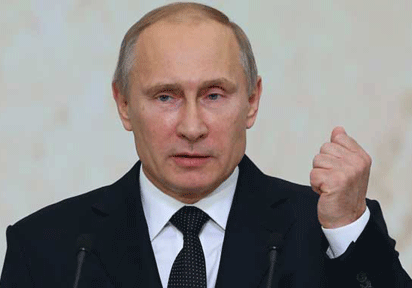
Russian President Putin
By Hugo Odiogor, Foreign News Editor
Russia’s shadow boxing with the United States and its European allies is not about to fizzle away as pro -Russian separatist groups in the eastern regions of Ukraine have opened another scenario for geo-political power play in Eurasia.
The declaration of independence by Donesk and the show of rebellion in Lugansk, Russfied and Kharkiv shows that Ukraine has more headaches to contend with after the Crimea nightmare.
The push for for independence in the Ukraine regions has the potential to provoke military confrontation between Russia and Ukraine.
Russian President Vladimir Putin hinted at the prospects of military confrontation when he warned Ukraine against making irreversible mistakes.

The warning came after Ukraine’s Interior Minister, Arsen Avakov, said there are two options to resolve the crisis: political settlement and the use of force to clear several government buildings seized by separatist groups.
In Donesk, anti-government protesters are still occupying some government buildings with explosives, and wielding AK47 rifles. They erected high barricades in Luhansk, the capital, while negotiation to end the standoff is in place.
Hundreds of supporters have been shouting Putin, Putin, while Ukrainian security forces contemplate using force to end the rebellion.
Since the toppling of pro-Russian government of Viktor Yanulovych in February, the large ethnic Russian population in the industrial, eastern part of Ukraine have been suspicious of the government in Kiev which they regard as illegitimate. Consequently, they have been demanding for greater economic, cultural and political ties with Moscow.
The same situation is playing out in Moldova where Transdnisestr region is agitating for independence.
The US has been quick to accuse Moscow of sponsoring land grabbing in Eurasia and inspiring restiveness in Ukraine even as diplomatic efforts are in top gear to convene the first international meeting between Moscow and Kiev on April 17, in Vienna, which Putin is expected to make a case that Ukraine should become a loose federation, which would allow the regions on the eastern flank to establish their own trade and diplomatic relations with Russia. Kiev has outrightly rejected this proposal which it sees as a precursor to a break up Ukraine.
But ahead of that meeting, Putin told Ukraine that it would start paying a punitive 80-percent price hike on gas supplies and the payment would come in advance. This is a move designed to hit Kiev hard, given its near bankruptcy status.
Already, Moscow has removed the discount on gas to Ukraine which it said was tied to the condition to keep its naval fleet at the black sea. It has formally taken over the Black Sea Fleet base with the annexation of Crimea. Ukraine is in tough economic situation which it needs about $14 billion IMF bail out.
Ukraine, with a population of 46 million, is being cut to size by Putin on all sides while the West is busy badmouthing the Russian strong man.
The West had announced series of ineffectual sanctions against Moscow which has so far shown that it is on top of the game.
Since the end of the Cold War, relations between Russia and the West reached their lowest point over the Crimea crisis but the restiveness in the eastern regions adds another dimension to the equation.
US Secretary of State John Kerry went beyond diplomatic decorum, last week, to accuse Russia of being behind the “the secessionist” movements”. This tone was taken up by British Foreign Secretary William Hague who said the uprisings bore “all the hallmarks of a Russian strategy to destabilise Ukraine”.
What is playing out in the Eurasia conflict is peer to peer show of power between US and Russia and it is all about who should exert influence and control over Ukraine. During the break up of the Soviet Union in 1991, the US and its Western allies saw Russia and the republics that emerged from the ashes of the break up as vulnerable and subject to be manipulated especially as some of them were in dire financial strait.
The resurgence of Russia under the leadership of Putin has been a source of worry to the US and the West. The US is against the emergence of a regional behemoth in the mould of Russia that is fully secured economically and militarily to challenge Washington. With the development in Crimea, Russia has easy access to the sea, which strengthens its defence capabilities.
On the surface, Ukraine has a sovereign right to join EU which was the point that sparked street protests that sacked the government of Yanukovych as the move divided the country down the line. The aftermath of the protests, the exit of former President Yanukovych, has triggered the wave of events which the illegitimate government is battling to contain.
Geo politically, the move to EU would challenge Russia’s hegemony in the region. The US has been working on deploying missile shields in the pro-Western states of Georgia, Poland and Ukraine which would have serious implications for Moscow’s defence.
Those who expect that the situation in Ukraine to result in an all out war between the US and Russia may think twice about the ultimate implication of cost of the US getting into another long distance military engagement. This would take a great deal of time and technology to deploy a fighting force in Eurasia where its forces would be outnumbered. So in a nutshell, there will be no war between the US and Russia over Ukraine.
Another fact against US going into an open war with Russia rests squarely in the fact that US does not have economic and strategic interests in Eurasia to justify a war. As a matter of fact, both countries do not have the appetite to fight a war now, given their economic situations. The human condition in both countries would not support a military confrontation; so Ukraine should tread softly to resolve the matter diplomatically.
Disclaimer
Comments expressed here do not reflect the opinions of Vanguard newspapers or any employee thereof.