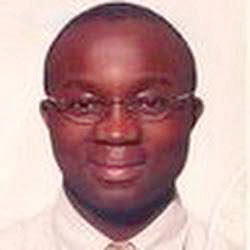
*Dr. Fidelis Ndeh-Che
By EBELE ORAKPO
Dr. Fidelis Ndeh-Che is the Managing Partner at Quanteq Technology Services Limited, an information technology (IT) consulting and systems integration firm with headquarters in Abuja.
An Assistant Professor- School of Information Technology & Computing at the American University of Nigeria, Ndeh-Che, who is particularly interested in social entrepreneurship, is a technology consultant with a flare for finding innovative solutions to seemingly intractable problems. He speaks on Quanteq and doing business in Nigeria. Excerpts:
Background:
After obtaining his undergraduate degree in Electrical Electronics Engineering and PhD in Electrical Electronics and Information Engineering from City University, London in 1996, Dr. Fidelis Ndeh-Che, a Camerounian, moved to the US to work until 2001 when he decided to start Quanteq. Then in 2003, he moved the company to Nigeria with headquarters in Abuja.

*Dr. Fidelis Ndeh-Che
“I worked for a consulting firm in California but that time, I was also involved in projects in Asia, Africa and North America. In 2001, I decided to stop and start Quanteq in California,” he told Vanguard.
What we do:
“In 2003, I moved the company over to Abuja, primarily providing consulting systems integration services to clients both in the public and private sectors. Our mission is really to solve difficult and challenging problems for businesses and organisations using information and communications technology (ICT). We introduced four specific areas of ICT. On the consulting side, we do IT advisory, we help clients look at the challenges that their businesses face and see how IT can assist them.
“We do IT project management in the event that we know what IT solutions they need, we can help them select the vendors by developing requirements and specifications, helping them manage the procurement process and also the project once the vendors have been selected. If we are not the project managers or the consultants, we also do the systems integration which usually falls under either software where we can do custom software development in Oracle, Java, or any language that is most suited for the project.
We do packaged software implementation to manage documents, performance, or the finances within an organisation. We offer infrastructure solutions so in areas where an organisation is to put in a data centre or connectivity, or a platform like the paging systems such as windows and active directory or Linux and other server platforms, or database platforms, we can help them deploy that. We also do IT training and support.”
He noted that although the headquarters is in Abuja, they have staff in more than 15 states of the federation.
Clients:
Ndeh-Che said the clients cut across local and international/public and private sectors. “We have a strong reputation for our ability to deliver on clients’ projects established over time. Our clients include the EFCC, Office of the Accountant-General, Federal Ministry of Finance, Pensions Commission, state governments, financial institutions, UNIDO, EU etc. “Our track record of delivery speaks for itself. In most cases, when clients have really difficult and challenging problems, they come and talk to us.
We get a lot of referrals from clients who have done work with us and recognise our professionalism, integrity, the fact that we are innovative with the solutions that we provide and the fact that our solutions actually make an impact. So rather than outsource projects to other countries, it is better to keep the expertise and experience here and reduce cost.”
Challenges:
He said the challenges of doing business in Nigeria are numerous.
Infrastructure: “To start a business, you need accommodation but most times, the standard of accommodation you get is subpar and they are priced through the roof and you are expected to pay two years rent. That will kill almost any start-up business, plus legal commissions, agreement fees etc.”
Power: “On a monthly basis, we spend between N450,000 and N600,000 on diesel alone. We use about 3,000 litres of diesel just to get by most months and most times, it is not sufficient. We still get electricity bills of N180,000 – N200,000 each month so the fixed cost is quite high.”
Regulatory agencies: “Many regulatory agencies are coming up all of a sudden and want to get a share of everybody’s business. FIRS was the only tax agency before now, but now, we have Industrial Trust Fund, Abuja Municipal Agency, National Housing Fund, Contributory Pensions etc., so at the end of each month, a significant amount of the revenue that the organisation could use to strengthen itself and compete globally, is spent on regulatory compliance issues.”
Coprruption: “We all know this but tend to avoid it. The most competent firms don’t always get the job. In some cases, we are the second or third partner in the project we are working on; we are often the technical partner delivering the project for a small fraction of the actual project cost because the project had been awarded to a prime partner who is just a business partner so a significant amount of the project revenue usually tend to disappear.”
Skills: “The last but not the least is skills. You will never over-emphasise the importance of skills in a business like ours. Ours is purely an intellectual business. We do not sell any hardware, we do not build anything, we solve problems which means we need smart, intelligent and hardworking people who are willing to learn, develop their expertise and experience.
For the large part, we spend almost every single day in the company training people and the biggest challenge is that once people are trained, they leave. We have been in business for 10 years, and today, we have 80 people on staff and over 400 ex-Quanteq people in various places. So we spend a lot of time, effort and energy training people, sometimes even expensive international training in South Africa and India but immediately they come back, they get an offer that is double what we are paying them. These people lacked the skills and the expertise and nobody was willing to invest in them but when we made the investment, they left and if we didn’t invest, they stayed and contributed nothing, so our philosophy is to continue to invest.”
GradUP Programme: “We run what we call unemployed graduate assistance programme. We have trained many unemployed graduates and hired some of them in Edo, Delta, Cross River, Akwa Ibom states and in Gombe State where we worked in partnership with Jewel Development Foundation. We advertise and get unemployed graduates, we give them two-three months rigorous training on ICT, leadership, basic English, Arithmetic, writing and presentation/communication skills, but mostly on ICT and job readiness skills. We identify places where they could go for internship including Quantec where we take the majority as interns. After three months of internship, we pick the best. The graduates get into these programmes free of charge,” he said.
Disclaimer
Comments expressed here do not reflect the opinions of Vanguard newspapers or any employee thereof.