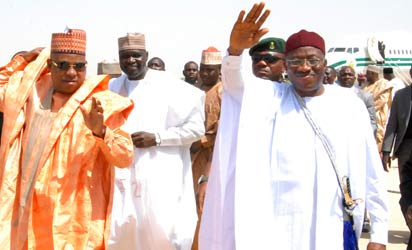
Ex President Goodluck Jonathan (C, R), standing next to Borno State Governor Kashim Shettima (C, L) waves upon his arrival at Maiduguri international airport on March 7, 2013. Jonathan visits two cities in northeast Nigeria, where Islamist group Boko Haram has carried out scores of attacks, his first trip to the embattled region since taking office in 2010. AFP PHOTO
By Is’haq Modibbo Kawu
LAST week, I argued that in moments of crisis, the political elite must unite the country, to ward off a nation endangering process.
However, the vicious rivalries characteristic of neocolonial politics as we have in Nigeria, can make it difficult to find the unity of purpose we are talking about. In the past week, Nigeria’s political leaders have treated Nigerians to a macabre display of rascality, irresponsibility, and a frightening insensitivity, at a time of serious danger to the national weal.

President Goodluck Jonathan (C, R), standing next to Borno State Governor Kashim Shettima (C, L) waves upon his arrival at Maiduguri international airport on March 7, 2013. Jonathan visits two cities in northeast Nigeria, where Islamist group Boko Haram has carried out scores of attacks, his first trip to the embattled region since taking office in 2010. AFP PHOTO
Just when Nigerians were hurting at more heightened levels of exposure to the dangers of the Boko Haram insurgency, those who expected to use their occupation of the mantles of leadership went AWOL; they chose to dip in the gutter of politics. The sheep of the Nigerian state suddenly lost the shepherd! Our leaders were not only fiddling while their Rome burned.
They removed their dresses in the public arena, revealed ugly and unsightly figures and wrestled themselves into the gutter. The serious business of leadership was not only irresponsibly ridiculed, these leaders reduced their own esteem, and helped to endanger their ruling class project, by a significant notch.
The frightening display started last week Sunday in Kano, when Governor Kwankwaso told party elders that Kanawa will not welcome President Goodluck Jonathan in the state last Tuesday, as he had not done much for the people of the state. The governor added further that he regretted voting Jonathan in 2011; while under Jonathan, Nigerians have witnessed corruption, embezzlement and corruption. He added to the mix, the controversially missing $20Billion.
Massive car bombing
Two days later, on Tuesday, that is the day after the massive car bombing which killed 75 people and injured over a hundred in Nyaya, President Goodluck Jonathan entered Kano, to formally receive former governor, Ibrahim Shekarau, into the PDP. At the event, Jonathan issued Kwankwaso a riposte: “Only yesterday…Kwankwaso was saying he regretted voting for me in 2011…When I was about to emerge as PDP candidate Kwankwaso was bitter and walked out of the venues of the election, and I later found out that he did not vote for me in that election.
The money I set aside for Kano delegates during the 2011 convention was not given to them. Kwankwaso pocketed it. And the money I later sent to Kano PDP to campaign for me in 2011 was also pocketed by the governor”. Other accusations about the mismanagement of LG funds followed. The day after the rally, Governor Kwankwaso led members of his cabinet to the Polo Ground, to sweep off the “bad luck” of the previous day’s rally!
The Kano storm had not settled, when Governor Murtala Nyako of Adamawa, another political opponent of President Goodluck Jonathan, issued a letter accusing the president’s administration of being “bent on bringing wars in the North between Muslims and Christians and within them and between one ethnic group and another or others in various communities in the region”. There were other weighty accusations, bordering on genocide and impunity, which received an immediate reply from the presidency through the SSA on Public Affairs, Doyin Okupe. He described the letter as “an unmitigated leadership disaster and a sad betrayal of trust by a major beneficiary of the Nigerian nation”. Nyako, according to the presidency, “definitely defies common sense and portrays Mr. Nyako as unfit for the hallowed position of a state governor”. By extension, even the Nigerian military was dragged into the fray, with the Director of Defence Information, General Olukade dismissing allegations of ethno-religious biases, contained in Nyako’s letter as baseless and untruthful.
In a two week period, some of the most important pillars of the Nigerian state, the president and two governors, vacated the hallowed responsibilities of their offices to publicly trade weighty accusations against each other. They forgot just how important their speeches and conduct are, to the overall health of the country. It is normal for politicians to trade banters, in order to gain political advantage.
Afterall, those are some of the fine points of politicking, especially in the lead to the electioneering process. Politics is literally war by other means but the needs of class solidarity and the survival of the state and the class project, obliges individual political actors to set invisible lines that they will refuse to cross, in order not to jeopardize the entire political process.
The bitterness displayed on all sides by these individuals reveal the depth of the crisis within the ruling class and the break down engendered. It is not usual to see such a public display of the loathing that has crept into their relationship. And what is most frightening is that the public display of obscenities has come at a time of serious security challenge, that should have rallied the political elite across party lines, in order to bring the whole country together.
Unhealthy rivalries
As we come closer to the 2015 elections, such expressions of unhealthy rivalries will become even more common place, unless the more level-headed members of the ruling elite can find means to blunt the bitterness that has eaten deep into the political rivalries between different factions of the Nigerian neocolonial ruling class. They have to self-preserve and stop the indecent and ugly dips in the gutters of politics.
The situation in Nigeria today calls for utmost sense of responsibility all round. Nigerians are dying in thousands as a result of various anti-state acts of resistance; these range from the bombs of Boko Haram to the ethno-religious killings that are recorded around the country. Where the ruling elite cannot guarantee security of lives and property of the citizenry, but is consumed in ugly fights inside gutters, they will sooner, rather than later, destroy the legitimacy of their ruling class hegemony in the society in general. They had better be forewarned, because Nigerians are watching with disgust, disbelief and angst!
Who is against democratic structures in the North-East?
ON Monday, April 21, 2014, LEADERSHIP newspaper’s lead story said that plans were afoot to suspend democratic structures in Adamawa, Borno and Yobe states. The plan is supposed to be an item of discussion at a Security Council meeting scheduled for Wednesday (yesterday); but I am writing on Tuesday night. The story quoted a faceless “top ranking officer in the military”, who accused “top politicians and elite in the Northeast” of “sabotaging the ongoing operations against the insurgents”. That faceless top-ranking officer nevertheless wanted governors and Houses of Assembly in the affected states suspended “while the operation lasted”. LEADERSHIP quoted its source further, that “the political elites, including the governors in those states, are working against our programme; their unguarded utterances are daring the insurgents”. The military officer was said to have “made reference to Governor Kashim Shettima of Borno and Murtala Nyako of Adamawa and a serving senator as being part of the alleged sabotage”. The ridiculous and obviously deluded and anti-democratic ranting went on and on.
But it became clearer to me, that the LEADERSHIP story was part of an elaborate, anti-democratic kite flying, when THISDAY newspaper of Tuesday, April 22, 2014,carried a similar request to set aside democratic structures in the states under a state of emergency. The request this time came from a legal practitioner called Oghenejabor Ikimi, who leads a nondescript body called Forum for Justice and Human Rights Defence. This human rights defender and lawyer, wants the Federal Government “to stop foot dragging” on “taking the appropriate step that would decisively address the menace of Boko Haram insurgency”. And what was his “decisive step”? Well, it is the most anti-democratic suggestion that an alleged defender of justice and human rights can ever think of: “the respective state governors should be temporarily relived of the functions and military administrators should be appointed to oversee affairs in the states as a measure against the insurgency”!
Deluded military officer and lawyer
These individuals are clearly deluded: the faceless top military officer and the legal practitioner. In the first place, the people of the states concerned have democratically elected the governors in power in the states in question, so to suggest their removal because of the security situation is an absurdity. Besides, in what ways have the elected representatives of the people of the three states hamstrung the operations of the security forces in the fight against the insurgency? Are these individuals aware of the amount of financial and other forms of support that these states have continued to put at the disposal of our forces fighting the insurgency?
What would military administrators achieve that they are unable to, with the extensive powers they already wield with the state of emergency? The truth is that there is much more mischief embedded in this ridiculous demand and all democratic forces in our country should stand up without ambiguity against any surreptitious plan to impose military administrators in the states of the Northeast.
In the first place, these are states controlled by the opposition; and since 1999, especially in Borno and Yobe, the PDP has been defeated in every election. So any plan to impose military administrators, on the eve of the 2015 elections, leaves room for suspicion that the Federal administration is trying to “capture” these states by subterfuge. It is clearly unacceptable. Secondly, if a faceless military officer is interested in ruling a state, the simple thing to do is to resign his commission in the Nigerian armed forces, join a political party and contest elections. That is the lawful manner of winning power in a democratizing country, as Nigeria is today. As for the legal practitioner who leads a Forum for Justice and Human Rights Defence, what is consonant with his declared vocation, is to stand for the defence of the tenure of democratically elected governors, not advocate the truncation of their rule. And at a time when children have been abducted in Borno, as much as the extensive destruction of the infrastructure of these states and the killing of thousands of innocent Nigerians, our human rights campaigner ought to be with the people of these states.
It is not by advocating for the suspension of democratic structures and the imposition of the rule of jackboots that the insurgency will be exorcised. The Federal Government should adequately make provision for our gallant armed forces; improve their morale; co-ordinate more proactively with the leadership in these states and improve intelligence gathering as much as working out a comprehensive plans of reconstruction and rehabilitation in the states. These are the steps we should be emphasising, not harebrained, dictatorial and anti-democratic delusions of removal of democratically elected structures of power in Adamawa, Borno and Yobe.
Disclaimer
Comments expressed here do not reflect the opinions of Vanguard newspapers or any employee thereof.