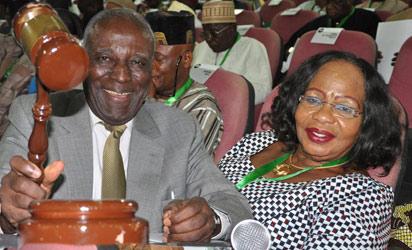
Chairman of National Conference, Hon. Justice Idris Legbo Kutigi with his gavel at Conference on Monday in Abuja. Photo by Gbemiga Olamikan.
By HENRY UMORU, JOSEPH VERUNKE & LEVINUS NWABUGHIOGU
CONTROVERSIES generated last week at the on-going National Conference over voting pattern to be adopted on reaching resolutions in its rules of procedures, was laid to rest Monday, at the resumption of plenary, as delegates unanimously agreed on 70 percent.
Delegates were sharply divided along regional angles last week over whether to adopt two-third, three quarter or simple majority as voting benchmark.

Chairman of National Conference, Hon. Justice Idris Legbo Kutigi with his gavel at Conference on Monday in Abuja. Photo by Gbemiga Olamikan.
While southern delegates rooted for a two-third majority, delegates from northern extraction had canvassed for 75 percent or three-quarter as benchmark.
Arising from the disagreement, the conference chairman, Justice Idris Kutigi constituted a 50-member committee to consult with the conference management on acceptable benchmark, so that it could be tabled before Monday’s plenary.
The affected delegates had met between Thursday and Saturday, when they deliberated and reached a compromise.
At the resumed plenary Monday, the delegates adopted the 70 per cent majority as the voting modality to be used in arriving at decisions.
A delegate from Benue State, Senator Iyorchia Ayu, who is at the conference on the platform of Former Senators Forum, moved the motion for the adoption of the voting pattern and was seconded by immediate past governor of Akwa Ibom State, Obong Victor Attah, who on his part, is standing in for the Former Governors’ Forum in the conference.
The contentious voting pattern, contained in Order VI Rule 3 of the Procedure Rule, provides that any decision in the conference shall be decided by at least a three-quarter majority.
“Any questions proposed for decision in the conference shall be determined by consensus and when this is not achievable, by a three-quarter majority of the delegates present and voting,” the section reads.
Deputy Chairman of the conference, Professor Bolaji Akinyemi, had earlier presented the report of the outcome of the consultative meeting to the house, leading a call for a motion on the issue.
He said: “The committee met on the 25th and 26th March, 2014. Deliberations during these meetings were cordial. Delegates worked in harmony to develop and put into effective use, the spirit of consensus building with the national interest at heart.
“At the conclusion of deliberations, members reached a decision to amend Order VI Paragraph 4, XI paragraph 2 and XII paragraph 4 (e) as follows:“In the case of failure to reach consensus, the matter shall be decided by majority vote of 70 per cent of delegates present and voting. That is the recommendation which that committee is bringing to you, distinguished delegates,” he said.
Bolaji, after his submission, called for discussions on the issue but delegates unanimously rooted for a motion on the recommendation of the consensus group.
This development prompted Senator Ayu to move for the adoption of the motion that was subsequently seconded by Victor Attah.
Speaking after the adoption of the voting benchmark, Professor Bolaji said:” I congratulate the committee for avoiding the impression of a winner and a loser in this matter. I think we are getting to the point where we are making progress”.
Attah, who had seconded the motion thanked delegates for what he called their maturity at reaching an agreement on the issue. He said the agreement was a ‘win-win’ situation, saying there was no winner or loser.
The conference, after adoption of the 70 percent voting pattern moved to committee arrangements.
Speaking on the issue, a delegate from Anambra State, Prof. ABC Nwosu, said that most committees constituted were inappropriate for the items listed for discussion.
Controversial issues
According to him, certain controversial issues such as resource control and state police, were not in line with the president’s suggestions. Mr. President listed certain issues, resource control, state police, etc. Many committees as constituted are inappropriate, they are not in line with the president’s suggestions.They are some that have been buried in the devolution,” he said.
Also while speaking, Pastor Tunde Bakare, a delegate from Ogun State interjected, saying that the work plan has not taken into cognizance, real issues confronting the nation.
“Mr Chairman, sir, it appears to me that we have constantly put our cart before the horse. We are full of mutual suspicions either between religions or regions. Mr. Chairman, sir, Nigerians are expecting something different from this conference. We should face the issues that surround this country.
A Federal Government delegate, Chief Mike Ozekhome, faulted why the committee on media should be subsumed under the committee on science and technology.
Disclaimer
Comments expressed here do not reflect the opinions of Vanguard newspapers or any employee thereof.