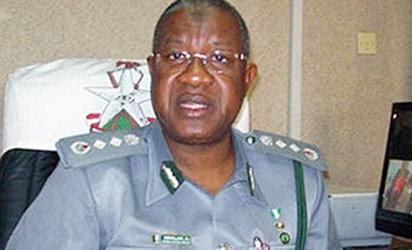
Customs boss, Dikko
By Eddie Iroha & Friday Odemena
December 1st, 2013, will remain an indelible date in the annals of the Nigeria Customs Service (NCS). It was the day the Dr. Abdullah Inde Dikko led management snatched the Destination Inspection’s (DI) “Magic Wand” from the “Service Providers”.
Hitherto, the Service Providers, who had enjoyed over seven years of contract period with the Federal Government to support the work of the Nigeria Customs Service in areas of Risk Management and valuation of imports, designed a product called the Risk Assessment Report (RAR), which were issued to the importers for the clearance of their cargoes, either from the sea or air ports or the land border stations.
Some parts of the contract terms include;To build a state-of-the-art’s infrastructure, which would be handed over to the management of the Customs at the end of the contract, and as such, the Government of Nigeria approved the collection of one percent (1%) Comprehensive Import Supervision Scheme (CISS) from all imports to the country by the Service Providers.
It was, therefore, expected that the Service Providers would acquire functional equipment that are of global standards considering the huge amount of money they collect everyday from the economy.
But this was a fairy tale as the Service Providers were busy accumulating as much profit as possible to enable them embark on the game of intrigues and blackmail against the Nigeria Customs Service aimed at getting the empathy of the Government to extend their contract years the more.
However, when the management of the Customs discovered that the only leeway was to take the mantle by force, it commenced setting up the right and indigenous platforms such as the Nigeria Integrated Customs Information System (NICIS), which is the linch-pin of the newly introduced Pre-Arrival Assessment Report (PAAR) to replace the Service Providers’RAR (Risk Assessment Report).
As envisaged, the Service Providers had to be kicked out of the ports by the management of the Customs on December 1st, 2013, paving way for the customs’ personnel to take absolute control of the Destination Inspection Scheme in Nigeria, with the indigenous platform called PAAR. The NCS had expected to receive efficient and standard equipment from the service providers, but got obsolete and corrupted data based machines. This did not deter it from issuing the first PAAR within 60 minutes after it took over.
The NCS has been fine-tuning the process of issuing PAAR to ensure that all human hitches are cleared while trade facilitation is given utmost attention.One of the strategies employed by the management was to embark on a wide public enlightenment programme led by the Comptroller General of Customs, Alhaji Abdullahi Dikko, CFR. The CGC moved his team to the stakeholders at the Trade Fair Complex, Lagos, where he patiently explained to them the benefits of PAAR, and solicited their support to actualize the project for the development of the Nigerian Economy.
The Customs boss did not rest on his oars after the commencement of the PAAR operation as he had to dispatch his high ranking officers from the headquarters to pay unscheduled visits to the sea ports to have on-the-spot assessment of the performance of PAAR, and the complaints by port users.
However, the four-month old PAAR has been receiving some kudos and knocks from the importers, freight forwarders and trade brokers. Some of them are of the view that the issuance of PAAR takes some reasonable time, thereby generating more days for demurrage and rents to be paid by the importers to the Terminal Operators and shipping companies.
Is PAAR adding value to the nation’s economy or agony and lamentation?
The founder of the National Association of Government Approved Freight Forwarders (NAGAFF) and Chairman, New Nigeria People’s Party (NNPP), Dr. Boniface Aniebonam commends the management of the Customs for introducing such an indigenous platform called PAAR.
Aniebonam points out that the Customs has saved over N20 billion for the nation since January this year representing the one percent CISS hitherto paid to the service providers. “You will agree with me that we have every reason to make this sacrifice. With this N20 billion, the country would move further. By the end of the half year,we will be making between N40 billion – N50 billion which would have gone to the foreigners. We should appreciate the gains in what we are doing”,he noted.
The Customs image maker for the Tin Can Island, Apapa, Lagos command, Mr. Chris Osunkwo (Jnr) a superintendent of Customs,ascribesmajority of the complaints to non-compliance with the guidelines of PAAR. The PRO stresses that PAAR demands importers to submit their import documents for assessment and issuance of PAAR (clearance) before the arrival of their cargoes at the ports.
“But what do we encounter everyday?Importers will not submit their documents to their banks to forward to the Customs office for the processing of the PAAR until the cargo arrives in Nigeria.PAAR is Pre-Arrival and not Post Arrival. After arrival, some importers still find it very difficult to forward their documents to their banks for onward transmission to the Customs for their PAAR due to their insincerity in business”.
Osunkwo explained further that the Customs has been working so hard and tireless to expedite the issuance of PAAR within the shortest period, and recently has about 32,000outstanding PAARs within a week.
Emphasizing the concept of PAAR, he notes that, “it is designed for integrity-driven business community, where there are honest importers and honest declaration. Importers must imbibe the culture of honesty in their business. They should stop short-changing the government, only for them to turn around to shout wolf”.
Osunkwo acknowledges that there were some initial obstacles as a result of the server, which the Customs’Management is attending to with the desired priority. “We need a dedicated broad band network to carry the volume of data being generated every minute.
“However, you don’t expect a four-month old baby to start training with the under – 17 Eaglets. If you study the history of the former Service Providers, you will discover that they experienced even worse scenario than what we are witnessing today”, he notes.
On the ability of the Customs Officers to handle the various machines and valuation associated with PAAR, Osunkwo boasted; “Wehave well-trained officers, capable of handling all the segments of Destination Inspection scheme. Our Officers have been trained in the best training institutions in different countries of the world. That was a priority before the take off of PAAR.
For the National Publicity Secretary of the Association of Nigeria Licensed Customs Agents (ANLCA), Mr. Obi Cee Okonkwo, “This PAAR is like a baby delivered by Nigerians. Every thing that starts newly does not flow very well like that. Just give it six months, Nigerians will be celebrating PAAR.”
Obi Cee frowned at those criticizing the customs management over some of the teething problems associated with any change, pointing out that for over seven years, the Service Providers were still battling with their equipment, while our economy was bearing the cost of their latent inefficiency.
Some of the complaints from the importers could be attributed to the failure of the Service Providers to properly hand over to the NCS as stated in their letter of contract.
“But, was there any hand over to the NCS? If there was a perfect transition and handover, I am sure that many of these problems would not arise or would be minimal. But there was no proper handover because there was acrimony on the part of the Service Providers. So Kudos should even go to the NCS, who has held sway even before now (four months)”, he noted.
Chief Eugene Nweke, President of NAGAFF collaborated ANLCA PRO’s statement that there was no proper hand-over from the Service Providers.
One of the instruments the NCS introduced to cushion the initial effects of the PAAR due to unutilized RARs before the take over, was the Provisional Release, which allowed the importers to clear their goods based on their own assessment and after the processing of their PAARs, any short fall will be collected through the issuance of Demand Notice (DN).
This window of opportunity, a privilege from Customs, was abused according to Obi Cee “as naturally, Nigerians wanted to cash in where they will minimize costs.”
Concerning the poor state of the server, which many importers have attributed to the delay in issuance of PAAR, Obi Cee described the providers of the server as “a threat to the Nigerian economy”.
Eddie Iroha and Friday Odemena are editors of maritime publications in Lagos.
Disclaimer
Comments expressed here do not reflect the opinions of Vanguard newspapers or any employee thereof.