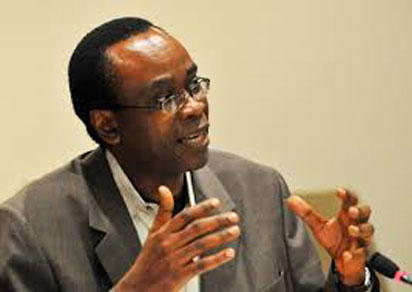
REV. Nnimmo Bassey, is an architect by training, a human and environmental rights activist and a founding member of the Environmental Rights Action (ERA). Currently at the National Conference representing the civil society, he, in this interview, spoke on his expectations at the confab insisting that it would not be a conference to balkanize Nigeria.
BY GABRIEL ENOGHOLASE
As a delegate to the on-going National Conference, what are your expectations?
My expectations are that this confab will not be business as usual. The basic issues that have worked against the advancement, the rights and interests of the citizens will be fundamentally tackled. I expect that at the end of the day, the confab will utilise the space already created by the Executive which we hear that the National Assembly is already working on, which is, at the end of the day the outcome of the confab can be subjected to a referendum so that Nigerians can say, ‘We the people of Nigeria reached this agreement or produced this guideline on how to run Nigeria, how to live as Nigerians.’
I expect that by the time the confab rounds up, produces a report, there would be an enabling platform to utilise the report. The president also emphasised that sovereignty belongs to the people and they could be able to rise up and defend what they believe they need.
On discordant tunes among delegates over issues like resource control and fiscal federalism
It is expected that there will be many issues where agreements will not be easy and this particular issue could be one of the areas. I do believe that every section of this country would want to see the political restructuring of this country. Those who oppose resource control are doing so because of the understanding of the implications of what resource control would mean.
I personally believe that what we should be talking about should not be resource control but resource democracy where territories own the resources and then, there will be a freely reached agreement on what each territory should contribute to the centre. This means, if a territory has coal for example, they own the coal; they own 100 percent of the resources, not 10 percent or 50 percent.
They may decide to give 50 or 90 percent to the centre. So, the issue will be what should the territories or zones contribute to the centre?
What is the nature of the central government and what are the duties and responsibilities of the central government?
Whatever is to be given would be based on what is expected of the central government to do and most people believe that the centre is too unwieldy at the moment. And this does not promote the growth and development of the federating units.
If you are going to have a true federation, the federating units must have a high level of autonomy and ownership of their territories and what they found there, otherwise, we are going to have a system that is dependent on the centre.
So, resource control sound like somebody cornering everything but resource democracy enables everyone in Nigeria to understand that wherever you are, you have something. And that something is valuable; you can decide to exploit it or not to exploit. So, if I have a resource that is harmful when exploited, it can be in my best interest not to exploit it and I will then look for something else to do.
How do you look at the no go area in the president‘s speech?
I have looked at that speech several times and I believe that the President talked about peoples’ sovereignty.
Talking about the unity of the nation from different perspectives clearly show that there is really no known no go area. There is no way you are going to talk about unity without talking about how we live together and possibilities of changing the ways we relate to one another.
Nigeria is a signatory to some of the world’s conventions and attacks are manifestation of other issues and they could degenerate further. So, they have to be nipped while they can still be halted. I believe strongly that one of the causes of the problems could be traced to the damage inflicted on the environment.
One of the reasons for the militancy in the Niger Delta region was that the wealth that was generated there was destroying the environment, young people were unemployed and people have to respond as a way of survival and making their case very loud.
Now we have a situation where some parts of the land is being environmentally degraded – polluted rivers, drying water bodies, increase in desertification, although government is responding to some of these things by way of trying to establish a belt of trees to stop the desert from spreading, but the trees are dying because they are not being taken care off.
When you see people being displaced by environmental factors, they have to move somewhere else.
Some of the conflicts you see in the Middle-Belt could be attributed to environmental problems because more and more people are being displaced. They could be called climate refugees or climate refugees.
The same thing is also playing out in the South where some communities have been destroyed by environmental pollution such that nobody can live in such environment. For example, nobody can live in Goi in Ogoni land because of oil pollution.
So, we have this kind of situation that can generate conflict and more Nigerians are being pressed to move to the Middle-Belt by pollution in the South and desertification and pollution everywhere.
People are looking for an environment that could be more conducive and with this; you are going to have more flash points. We need look at the economic relationship, the economic opportunities available, the environmental situation and if we take all these, the reason for conflicts and violence may abate on its own.
Disclaimer
Comments expressed here do not reflect the opinions of Vanguard newspapers or any employee thereof.