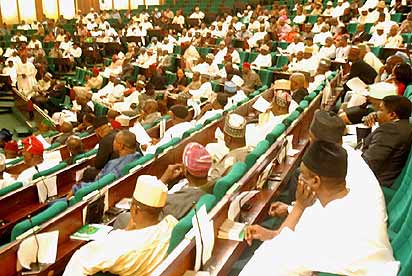
members of House of the Reps
By Victor Ahiuma-Young
COMRADE Peter Akpatason is a member of the House of Representatives Committee on Labour, among others in the National Assembly. A former Trustee of the Nigeria Labour Congress, NLC, as well as immediate past President of the Nigeria Union of Petroleum and Natural Gas Workers, NUPENG, in this interview with Labour Vanguard, he spoke on how The House of Representatives is striving to improve the wellbeing of workers among others. Excerpts
You are one of the labour leaders in the National Assembly, how have you and others impacted positively on workers?
Well, I know that we have pursued the legislative agenda in such a way that will promote good working conditions. There are a lot of Ministries, Departments and Agencies, MDAs, of governments who have come to us with proposals for welfare related issues and I can assure you that at no point in time did we ever touch or reduce any proposal about any MDA for either over head or in particular welfare related issues employment, promotions, training, transfers, medical, housing and things like that we have always given to them 100% of all they request for.
We can do beyond that but we can’t make higher proposals for them. Basically, we give nod to whatever they request for. Beside, we have had situations where we had to intervene in workers management issues in several industries. Like in the oil and gas industry, where we intervened in the crisis in Independent Petroleum Marketers Association of Nigeria, IPMAN, in Delta and Edo States through the House of Representatives Committee in Petroleum downstream. We al so had situation where individual workers were wrongfully terminated and we had to intervene based on petitions from their representatives.
Apart from termination, different types of unethical or inhuman measures were meted out to workers in different companies and we had to intervene to protect workers’ rights and also to ensure that justice is done. We have had situations in the Power industry for instance, in the telecommunications industry among other sectors.

Cross-Section of members of House of the Reps.
In addition, I recall that there was a time that the entire Nigeria workers were on strike called by Nigeria Labour Congress, NLC, and the House of Representatives against all odds had to convene on a Sunday and we passed appropriate resolutions to apprehend the situation.
Even though we were ignored by the executive, we still pushed ahead to ensure that the hostility ceased. They were able to come back to negotiations and pushed for resolution which we actually midwife, and at the end it was resolved. We have had several of such situations, so we make laws to promote healthy work environment and relationship at work place. We also have supported occupational health and safety measures in different areas.
Basically, I think we are doing our best for Labour. An aspect where I have not seen much result is direct relationship with the labour movement where we can interface with them and identify what their challenges are and come up with how to address them.
We have reviewed a lot of Labour policies; we have worked on Nigeria Social Insurance Trust Fund, NSITF, bill to make it more users’ friendly and more protective of workers’ interest. Employee Compensation Act, ECA, is in force and we are doing everything humanly possible to ensure that it is properly implemented by way of giving the necessary tonic to the agencies that are charged with the responsibility. So, we have promoted everything that could possibly support employment, especially appropriating for organizations for that purpose.
The House of Repsesentatives unlike the Senate, in the ongoing review of the nation’s constitution, voted for the retention of national minimum wage in the exclusive legislative list. What informed such decision?
Well, it was not a competition between the Senate and the House of Representatives. We looked at issues separately on our own and they looked at the issues from different perspective. On our own, we saw that removing Labour from exclusive to concurrent list will create more challenges than it could solve.
It is not as if there are no merits in doing so at all. But the demerits outweigh the merits. We know for instance that having minimum wage below which no organisation is allowed to go is capable of insuring that all workers in the entire country irrespective of who their employers are whether private or public sector, whether state or federal, whether local government or whatever, are not paid miserable wage.
Now it helps to check the excesses of multinational organizations which ordinarily will not want to pay reasonable wage to their workers. Also even governors on their own parts, local governments if they are allowed to make laws and determine how much they pay, I can assure you that workers wages wi ll take the back seat and in that case, a whole lot of state will go to the extent of paying very paltry wages to workers.
But if you have it on the exclusive list it does not mean that everybody must pay the same amount but it only declares a minimum, the lowest threshold that nobody should go below. N18,000 for instance, if anybody claims that he cannot pay, I will like to ask that person whether he can survive on N18,000.
If governors could claim that they cannot pay N18,000 while labour is on exclusive list what do you think is going to happen if you now move it to concurrent list, you give them the liberty to enslave workers and deprive workers of the barest minimum that is supposed to afford them the minimum standard of living.
We think that will be very dangerous. So we support the idea of creating that minimum threshold at national level below which nobody can operate but every employer is free to go above that. The argument of some governors is that a lot of them were willing to pay more than the N1 8,000.
For me it does not hold water because the minimum wage being pegged at N18,000 at national level does not mean that state cannot pay N50,000. Any state that can afford it can pay more than that, it is a matter of affordability. We cannot allow workers to be enslaved by any tier or organ of government.
As a member of the House committee of Labour, issues of unfair labour practices by employers including government itself, in terms of over sight functions, how are you addressing them especially casualization, out sourcing non refusal to allow union among others?
Oversight function does not cover everything. Our oversight is to look at how much money is given to organisation, how they spend the money. We vie into some other things when people write petitions or people raise issues we can then invite parties and mediate.
It is not our responsibility to go and ask employers how much they are paying their workers, if we do that we are just doing it because as individuals we are concerned about the working condition of workers, but statutorily that is not our responsibility. So oversight might not necessary cover that, but it covers the areas that have to do with what is appropriated.
But how do you ensure that issues of fair labour practices and abuses are addressed?
The first approach to it is to come up with legislation to set the minimum and to set the standard very clear to everybody and then throw oversight to ensure that these laws are applied properly. In isolated cases of victimization or things like that, we can take up individual issues.
This has happened in company A, workers were so badly treated. For instance, the work environment is not conducive enough and we can then say this is the minimum the law allows you to do, you can’t go below this so because of that you must put this and that in place.
If there are safety measures or health related issues you can insist on the minimum and beyond that. We have done that in a couple of occasions and we can also help them to push for inclusion of their request in the budget. If for instance they desire to increase wages in the coming year and they are having challenges getting the funding for that they can approach us and then we help them to ensure that such monies are put in the budget.
If it were in the private sector, where sometimes workers are owed up to six months, one year without pay is there nothing you can do to ensure that such workers are paid?
Again, except cases are reported to us we will not be able to know about it. If any such case is reported to us obviously we would take action because the law does not even allow it in the first place that you owe workers for up to a year and so we have a great role to play in that but until such cases are brought to our notice we will not b able to detect them, so we cannot act on what we don’t know.
Disclaimer
Comments expressed here do not reflect the opinions of Vanguard newspapers or any employee thereof.