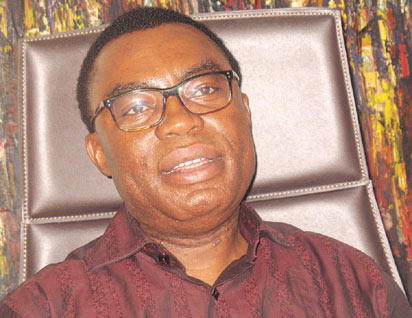
Professor Fidelis Oditah is a Senior Advocate of Nigeria (SAN). Before he relocated to Nigeria, he practiced law in UK, where he was called to the bar (Lincoln’s Inn) and subsequently became a Queen’s Counsel (QC) in 2003.
He was a tutor in Law at Merton College, Oxford and Travers Smith Braithwaite and a lecturer in Corporate Finance Law in the University of Oxford. Prof Oditah has also served as a consultant to the United Nations Commission on International Trade Law (UNCITRAL) from 1995 to 1999. He is an authority on insolvency law. In this interview, he spoke extensively on the National Conference and corruption in the judiciary.
Excerpt:
By Bartholomew Madukwe
SOME lawyers have argued that the nation’s problem is the Presidential system of government that it operates, what is your view on this?
The American Presidential system works, apparently, well enough. There is no reason in principle why our own Presidential system should not work. So I am not sure that the problem is necessarily whether it is a Presidential system or a Parliamentary system. I think the whole problem is the character of leadership. The winner takes all mentality and the abuse of office, including corruption.
These are the many problems associated with governance. Which is why people think it is a do or die affair. If people do not perceive political leadership and political office as given umpire access to pot of gold, to ill gotten gains, to true demonstration of affluence, I do not believe that people will do what they presently do to seek and acquire political power. And so, to say the problem is the Presidential system is a little superficial.
Several Conferences were held during the struggle for independence and Nigerians were involved in the discussion of the affairs of the state, do you see this ongoing National Conference as one that will address a lot of national issues?
In principle, I believe dialogue is a good thing. It is good to talk. Against that background, there is absolutely nothing wrong with this National Conference. It is provides a forum for us to identify and articulate issues which are perplexing us, which are plaguing us as a nation.
To that extent, we must all support it, irrespective of our own private reservations about the wisdom and utility of the exercise. Having inaugurated the exercise, it is our civic duty as Nigerians to support it and to ensure that it works smoothly. It is our civic duty to ensure that it succeeds in its objective, whatever those objectives may be.
I have no doubt personally that a number of our national problem will be identified and debated. But it is one thing to debate or identify the problem; it is another thing to implement it. Very often, we are a nation of several talk shops. We like to talk a lot and to waste the meager resources that we have. We are very poor in implementing. And we have already been told that whatever resolutions or recommendations that emerge from the National Conference be left for the next administration to implement.
But that is not a reason for engaging it because otherwise we will all become very cynical, very comical and somewhat despondent and say nothing good can come out of it. We must give it the benefit of doubt and assume that something good might come out of it. And the possibility, however small, is sufficient to embark on it. It is better than doing nothing.
 Of course, we have to look at the cost of doing so and to align the benefit with the cost. If they were doing it from their own private pocket, many of us will carry out a cost benefit analysis. We must ensure that the cost does not exist the utility of the exercise.
Some activists have said that the outcome of the conference should be subjected to a referendum and not to ratification by the National Assembly, what is your position on this?
If we are starting with a blank slate, it will canvass a lot of options. But we are not starting with a blank slate. Unless the National Conference recommends abolition of the National Assembly; but if it does not, I do not see why the National Assembly cannot be the proper instrument for implementing the findings of the conference; unless we want to abrogate the structures completely.
But by itself, a referendum, to some extent is question begging because referenda are usually suitable for eliciting the vote of people in relation to key issue. For example, you may two, three or five issues that you want to put to referenda. I do not know how many resolutions or recommendations that are going to emerge.
Assuming the National Conference was to come up with a new constitution, I would have thought that it was unnecessary to submit such a new constitution to the people. The National Conference is capable of giving us a new constitution. But since we did not participate in the selection of any of the candidates, why should we think that they represent us? Why should we think that they will give us a constitution which binds us?
I think that it is in that context that there may be said to be merits in subjecting whatever outcome to referendum because for reason of political expediency they have not allowed the National Conference to be representative. The reality remains that it is the government that has populated the National Conference.
Constitutional difficulty
If you take the state nominees for example, it is the governors who have nominated people to represent the state. But the governors are not the law making organs of their state. So there is a basic constitutional difficulty in saying what they recommend can be.
Having said all that, if you regard the conference as a talking shop, provided this is what we want to do, you could submit that to the National Assembly and say this is what the government delegates who came for this conference have recommended. You who have been elected under a representative democracy, you can then look at it and tell us what you think.
To the extent that we have a procedure for making constitution and amending constitution, it will still come back to states via their own state assembly.
But I think that on the whole, that may be a whole enlightening approach than just subjecting it to referendum.
I can see that if you are voting on one or two or three issues, like should we have a Presidential or Parliamentary system, should we have an independent judiciary- you can subject that type of isolated question to a referendum but you cannot subject a whole document to referendum. L
Consents of the people
Like a document with 500 sections, how do the people who have a right to vote, who enjoy universal suffrage, understand the complexities of the framework of constitutional document to enable them vote meaningfully.
The most effective way to receive mandate and consents of the people is through the various elected representatives, provided that the electoral system itself is credible.
And if it is not, we will be begging the question whether these are truly representative of the people. Where the mandate or consent of the people is vitiated at the very basic level of election, then it is impossible to regard the so called representatives as representatives. And because they lack mandate, it becomes just a vicious circle. It becomes also entirely circular.
 If I say that I want to see how the consent of the people is manifested and I say I am doing so through elected representatives who were not elected, who have imposed their self through electoral rigging and other form of electoral malpractices, then it is not wrong to consider them as the people who will represent us. So we have to get the basic structure right.
As preparation for the 2015 general election are underway, do you think the National Conference is coming at the right time?
Well, it is close to the elections. It would have been better if we had it two years before the elections so that there is time to debate the findings before one begins talk about its implementation. And so to that extent you have to wonder whether the timing is auspicious, whether this is the best time to do it. But I always believe that there is no particular good about time to doing something, it depends on the wheel and the enthusiasm of the people.
If you have a set of recommendations, we are told that the conference will not take more than three months, assuming that is true and it will finish in June. They could debate their findings for another three months, which will take us to September. If there was political will, there is no doubt that between September and December, you could make whatever changes you want.
Why do we pay the National Assembly? Why can’t they translate what the National Conference has recommended into legislation or into a constitution in few months? And so, there is no time that is optimal in that sense. And our own experience as human beings tells us that even when you have a lot of time, you might still be late. And when you have little time, you might hurry up and achieve it.
But, of course, the political reality is that people want to be re-elected into office and they are more interested in coming to enjoy power, than translating the findings of the National Conference to any type of binding, articles of governance or constitution, including legislation. In that sense, they are not likely to have time. It is not that the time is insufficient but because they have a more pressing need for themselves, at the expense of society.
Recently, the National Judicial Council (NJC), under the leadership of the Chief Justice of Nigeria (CJN), Mariam Aloma-Mukhtar, sacked two justices, making it four that have been sacked so far, how would you then describe the fight against injustice and corruption in the nation’s judiciary?
I think one must start kindly acknowledging that judges do a very difficult job. Often time when people lose their cases, they attribute it to corruption. In an adversarial system, there must always be a winner and a loser; in England, in America, everywhere.
Sometimes you get to the Supreme Court of the United States and find out that the justices have voted according to their political colouration; whether they are republican, whether they are democrats or whether they are independent.
So to that extent, one must appreciate that judges are human beings. They have their own biases, they have their own loves, and they have their own dislikes. And these vices and prejudices, unconsciously or subconsciously influence decision making. It is not in every case that you lose your case that the judge is corrupt.
And one needs to understand that a judge may also be incompetent, apart from being bias. Why on earth do we assume that because somebody is a judge, he or she may not be incompetent? Also, some of these judges are not necessarily the best lawyers we have in Nigeria.
We must also acknowledge the prevalence of corruption in the judiciary system. I often say that judges are part of the society, our society is very corrupt. Our society has abandon and surrenders all values.
Source of money
The only value that is important is money. And when the only value you have is money and the public is uncritical and unquestionable about the source of money, the chase for money becomes almost inevitable. And people become consumed by the desire to acquire money which they do not need and will not enhance their lives in any way. Judges are part of that problem. A number of judges unfortunately are corrupt.
It is our duty as a society to ensure that we reduce the incidence of judicial corruption to the minimum. If I cannot change the system through the rules, then you are encouraging anarchy, violence and break down of law and order. Law and order is not the monopoly of the judges, they cannot do as they like. And everyone must perform their role to the best of their ability without fear or favour.
But a lot of the cases should also go to the lawyers who offer bribes to judges. And so when I hear that people never lose their case, I laugh. Who is a lawyer that never loses a case? If you never lose a case, then there must be something wrong with your practice. Such a person must be doing something profoundly and unethical.
Disclaimer
Comments expressed here do not reflect the opinions of Vanguard newspapers or any employee thereof.