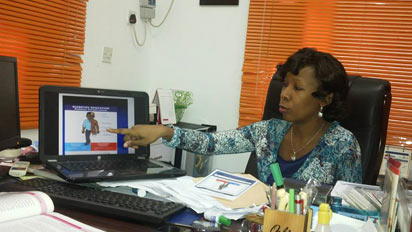
*Dr. Afokoghene Isiavwe of Rainbow Specialist Medical Centre, Lagos, explaining a point about the high incidence of diabetic foot ulcers in persons living with diabetes.
By SOLA OGUNDIPE
THE lack of local capacity and training of podiatrists (medical specialists in foot care) for people living with diabetes in Nigeria is currently taking its toll on the management and care of the disorder in the country.
Currently there are no podiatrists in Nigeria, neither are there training facilities or institutions equipped to build capacity for the speciality.
Findings by Good Health Weekly reveal that even if a trained podiatrist comes into Nigeria from abroad, such specialist would find it difficult to integrate or practice.
Contributions of podiatrists
Yet other specialists such as endocrinologists that are trained to look after diabetics, cannot effectively carry out their role without the support and contribution of podiatrists.
Amputations: As a result of this gap, a high number of cases of diabetic foot ulcers are ending in amputations and even deaths. As one of the major complications of diabetes, diabetic foot (also known as diabetes mellitus foot) affects a signifcant number of people living with the disease. Findings from a Lagos- based study showed that diabetes mellitus foot is the second leading cause of diabetes-related deaths in Nigeria accounting for 19.5 to 24 percent of all diabetes mortality. A study on diabetes mellitus foot ulcer in Midwestern Nigeria showed an amputation rate of 52.2 percent and mortality rate of 14.3 percent in a cohort of diabetes patients with foot ulcers.

*Dr. Afokoghene Isiavwe of Rainbow Specialist Medical Centre, Lagos, explaining a point about the high incidence of diabetic foot ulcers in persons living with diabetes.
More findings from a tertiary hospital in Lagos indicated that diabetes mellitus foot syndrome was responsible for most amputations in the surgical unit (55.14 percent of all amputations).
Data also show that the direct socioeconomic costs of successfully treating the diabetic foot ulcer in the country are about N220,000, whereas average monthly wage is about N10, 120.
Prevalence: The International Diabetes Federation, IDF, says Nigeria has the highest number of people with diabetes in Africa, as well as the highest number of persons with impaired glucose tolerance in Africa.
In 1997, prevalence of diabetes in Nigeria was put at 2.2 percent while different studies across the nation give prevalence ranging from about 2.8 percent to about 6.8 percent and as high as 23.4 percent in the oil-rich Niger Delta region in some cohorts.
People most affected are at the lower class, including persons already burdened by poverty, illiteracy and inability to care for their daily needs.
Policies: The Federal Government in collaboration with the World Health Organisation, WHO, launched the Stop Diabetes Initiative in 2013. There is also a policy of free insulin for persons living with diabetes in the 56 Federal hospitals nationwide, as well as a policy of free diabetes treatment for children, however the extent of implementation or successes of these policies are unknown.
Currently, there are no national or localised foot care training policy in existence in the nation. However, to help bridge the gap and raise awareness on diabetes foot care and the subspecialty of Podiatry, the Podiatry Initiative, Nigeria is calling for increased local capacity and better attention to diabetic foot care in Nigeria.The team, headed in Nigeria by an endocrinologist and diabetologist Dr. Afokoghene Rita Isiavwe of Rainbow Specialist Medical Centre, Lekki Phase 1, Lagos, is supported by a team in the USA headed by Dr. Rahn Ravenall.
Partnership: In an overview, Isiavwe described the upcoming conference as the first of its type. “We are working in partnership with the Podiatry Institute of America, in Georgia to try to build local capacity in foot care in Nigeria.
Diabetic foot care workshop: “We hope to bring together these trainers from the USA to empower us in Nigeria in the area of Podiatry Medicine, especially targeting the diabetes foot ulcers in Nigeria. The pilot training is in Lagos, but we will reach out to doctors in the different geo political zones.
Diabetic sores
The first lap is scheduled to take off from March 17-21, 2014 at the Lekki Peninsula Hotel, Lagos. They would train our doctors, general practitioners, surgeons, nurses, plastic technicians and people that look after diabetics. They will teach us technics that when we see people with diabetic sores, we know what we can do to make the sores heal better and faster.
“At the diabetic foot care workshop, healthcare providers will be enabled to do more for the foot. They will teach primary prevention which is care education so the patient does not come down with an ulcer on the leg. Nobody wants to lose a limb.
“We know there is a need. We know that if we are able to build local capacity so that doctors and nurses know what to do, we would be able to save more limbs and lives,” Isiavwe told Good Health Weekly in a chat.
Regretting that limb amputation is often inevitable if there is total blockage of blood supply or destruction of nerves, she however, observed that there are symptoms at the early stage.
Symptoms: “There are symptoms when the blood supply is getting narrower and narrower, for some time, the person will feel pain, When the person living with diabetes comes to the hospital, for primary prevention the symptoms can be picked up early and a procedure known as vascularisation surgery can be carried out.
“It is just like a heart bypass. We can bypass the blockage. But beyond a certain period, there is nothing more to be done. Although podiatrists look after diabetic foot sores, they still require a vascular surgeon to carry out the bypass.
Living with diabetes: “Every person living with diabetes must see the their eye specialist and dentist for regular examinations. They must do regular kidney function tests and also obtain proper foot evaluation. We don’t have to cut off a limb except if it is gangrenous, that is, dead and there is no blood there. When the skin tissue is dead or dying, the colour changes, it ets darker and becomes dry. When you start noticing all that, it is time to get help. Fast.”
Neuropathic ulcers
Further, the medic warned that poorly controlled blood sugar often leads to development of neuropathic ulcers. “Bad sugar control leads to ischaemia. We aim to teach the patient from the beginning about the danger of ulcers – neuropathic, (nerve), ischaemic (poor blood supply) or combination of poor blood supply and sugar control.
Medical research shows that there are two types of diabetes. In Type 1 diabetes, the body fails to make insulin at all while Type 2 occurs as a result of old age, infection and inactivity or overweight.
Risk factors: Risk factors include poor diet, overweight, family history, etc. “When you are diabetic, you must do the right things. If your diabetes is not well managed, it can lead to stroke, blindness, erectile dysfunction and amputation.
“The unusual thing about diabetic limb amputation is that if one limb has been amputated, the chances of the other limb becoming affected are high because the problem of the first leg is very likely to happen to the second leg.
“Gangrene is the problem. If somebody comes in with a gangrenous toe or part of the leg that is black, they would not realise that the problem goes deeper. But by the time a scan is done, and it is discovered that there is no good blood supply from the knee down, the person may not understand why we need to cut from the knee when it is only the toe that is black. In medical wards of government hospitals, such as the Lagos University Teaching Hospital, LUTH, and the Lagos State University Teaching Hospital, LASUTH, Ikeja, as well as most General Hospitals, a significant number of admissions is as a result of diabetic foot ulcer.
Expensive disorder: Diabetes is an expensive disease to manage. If it is not well controlled, it affects all systems in the body. “A person living with diabetes will need too see an eye specialist at least once in two years if there are no complications, but if the blood vessels in the eye have been affected, they will need to go more often for procedures. The diabetic will also need to see the dentist more often, and will need to have the heart looked after because diabetes affects the heart.
“In fact it is said that the person with diabetes that has not suffered a heart attack is like a normal person that has suffered an attack. That is the cardiovascular risk.
“We try to give medications to reduce the risk of all this. Diabetes care is not only about sugar control. You need to check the weight, cholesterol, eyes, heart, kidneys, liver, nerves and so on. During my interaction with a person living with diabetes, I want to make sure the person understands the risks. I want to emphasise foot care, and to explain why shoes should be bought the the evening when the feet have expanded,” she stressed.
Disclaimer
Comments expressed here do not reflect the opinions of Vanguard newspapers or any employee thereof.