“The greatest challenges we encounter are from the victims themselves”
By Kehinde Ajose and Aderonke Adeyeri
With the proliferation of baby factories and child trafficking in some parts of the country, the Zonal commander National Agency for Prohibition of Trafficking in Persons (NAPTIP) Lagos zone, Joseph Famakin, opens up on what the agency is doing to curb the scourge of human trafficking and also how members of the public can synergize with the agency to nip the situation in the bud.
How would you explain activities that go on in baby factories vis-a-vis NAPTIP act?
Human trafficking is the movement of a person from one place to another for the purpose of exploitation.The aspect of baby factory in Nigeria is a new trend by the law of NAPTIP, but there are things that happen in the process before the sales of babies that are covered by NAPTIP Act. I give you an example.

Joseph Famakin
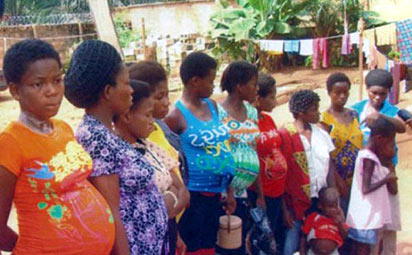
A pregnant little girl may be in the eastern part of Nigeria and she is coerced, deceived, and taken into a herbal home where the operators of the herbal home keep other pregnant ladies in preparation for their deliveries before the sales. So, keeping of the baby away from the guardian without their consent amounts to deprivation of liberty. Once the baby factory is discovered, the place is raided, the girls are rescued and whoever is the owner of the place is charged to court.
The sale of the baby itself falls within the purview of the Nigerian police. However, the NAPTIP Act 2003 as amended in 2005 has just passed another round of amendment that will soon be passed into law because of the new trend.
The aspect of baby stealing is now embodied in the new act that is coming, so that we will be able to cover from the issue of kidnapping to unlawful imprisonment, to sales of the embryo which was not covered under the act when the law was promulgated.You can hear from people that sales of babies is not under the purview of NAPTIP. It is because it is not under our law. We deal with matters of baby factories up to the point of taking the victim from wherever they are taken from to the factory but the eventual sale of the baby is what is not in our law.
What is your agency doing to stop the trend?
When you talk about trafficking like I said earlier, trafficking is the movement of one person from one point to the other for the purpose of exploitation.
This involves sexual exploitation or labour exploitation. In the case of children, they are taken from the villages to urban areas to serve as house helps. Now, considering the fact that we are mandated to rescue all victims of human trafficking irrespective of the fact that it is internal or external trafficking, we have been going out to sensitize members of the public through our public enlightenment department and our main objective is to get to the vulnerable.
We warn that parents should not release their children to those who are promising to be God-send good Samaritans whereas they are devil’s incarnate. We collaborate with faith based organizations, non -governmental organizations and community based organizations. Last year, we had a 26-episode programme of ‘Itohan’ on national television. These are some of the things we are doing because a lot of people are not aware.
Your agency is different from the police, what strategies do you use in achieving your objectives?
We have a 4-approach strategy which we call the 4’Ps. These are based on what we call the prevention, which I had earlier mentioned that using the public enlightenment department, we go out to sensitize members of the public. The second of the P is called protection.
Crime is dynamic, you can only succeed in reducing it until gradually, you eradicate it. There will be children that will be trafficked and it’s our responsibility to ensure that they are protected when rescued.
That is why in each of the eight zones of NAPTIP, we have shelters all over Nigeria where victims of trafficking are kept. During the protection stage, we also protect their families from reprisal attacks of traffickers because traffickers will not stop at collecting their money if the victims are rescued. So, we need to protect the families of these victims from attacks. Victims that are rescued are sent to our centers where we have professionally trained counselors.
Their duty is to counsel the victims on how to overcome the traumatic experience they went through and they are also introduced to vocational trainings where they are trained as professional hairdressers, tailors,etc. They are also introduced to informal form of education.
Empowerment are given to them to enable them start life all over again. We provide materials like –sewing machine, generators and then we rent shops and we continue to monitor them so that they are reintegrated into the society. The next P is prosecution. If we prevent, if we protect, if we don’t prosecute, those that are making money from this illicit trade will be having a field day.
So, we have the investigation and monitoring department that go all out to seek for information either from rescued victims, from our international partners (foreign countries), or anybody that gives us information; we investigate and the person will be charged to court. As at 2013, we have recorded 208 convictions from inception to end of December 2013. In Lagos zone last year, we rescued 314 victims of human trafficking. Out of these number, 279 are females, the rest are males and they have been able to undergo the process of rehabilitation, counseling and reintegration into the society.
As I speak to you, two of our ex-victims are in the university. This has also made us to establish an informal school in Ibadan where we have about 69 students that are to be reintegrated to the formal school in Oyo state. That is an ongoing project sponsored by the American government.
The last P is what we call partnership. We are in partnership with international organizations; we are here because of partnership. I have appeared to several TV stations. We have gone to churches to sensitize them.
What are your challenges?
The victims themselves are our greatest challenge. Those of them who are recruited are made to go through a process of barbaric oath-taking. They have what they call oath of secrecy.
This involves the removal of their pubic hair, menstrual pads, finger nails which are used to make incisions on the body of victims and because they are Africans, they believe in the efficacy of these oaths. So, sometimes when they are rescued, it becomes difficult for them to talk to us or tell us how they were recruited, who their traffickers are and this is a very big challenge.
But we’ve been able to overcome that through our counseling department. The churches are also helping us. They come to the shelter to talk to them. The counselors counsel them. Once they are counseled to a point where they can trust us, they give us information. It’s a very big challenge and the last but not the least challenge is that a lot of people see trafficking not as a crime depending on who you ask.
There are places that cases of human trafficking are endemic, they don’t see anything bad in it. So we try to see to it that we can carry the message there. We tell them that apart from the health hazards associated with human trafficking, it is another form of slavery. It’s an act of man’s inhumanity to man. People should not see it as a process where their daughter is trying to make money. It is something done out of greed, getting rich quick syndrome.
What will be your advice to members of the public?
They should believe that nothing good comes easy and that the easiest way to getting there is to persevere and to be dedicated. The youths need to understand that get-rich-quick syndrome does not take people to the top, that it leads to condemnation.
A lady who is trafficked to Europe and asked to pay 50,000 Euros, if you convert that to naira, it’s about N12 million? How many men will she sleep with to make N12million. There are other ways of making money apart from selling one’s body. Parents should not because of greed sell their children into slavery. They should not give out their children to people to go and work.
They are suppose to work, and take care of the children. Members of the public should know that under the child rights law and child right convention, a child is only permitted to work within his immediate family environment. If they need a house-help, they should employ people above the age of 18. Children are meant to be in school, they are not meant to be house-helps. Above all, we should be our brothers’ keepers.
Disclaimer
Comments expressed here do not reflect the opinions of Vanguard newspapers or any employee thereof.