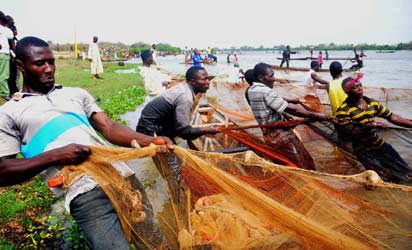
FISHERMEN DRAGGING THEIR NET DURING NWONYO FISHING AND CULTURAL FESTIVAL, IBI, TARABA STATE
By Jimoh Babatunde
While aquaculture is gaining popularity and momentum in Nigeria, the sector is still underdeveloped and inefficient. Fish farming inputs such as fish meal, fish feed, fish health supplies are mostly imported and their costs are too high for small scale fish farmers.
Locally produced fingerlings are also expensive and many are of questionable quality, this has created a phenomenon in which every fish farmer seeks to undertake both forward and backward integration without regard to scale of operations or skills.
Consequently, specialization or division of labour in the aquaculture sector is currently non-existent. It is not uncommon to find a micro-scale fish farmer attempting to hatch their own fingerlings, produce their own fish feed and concoct their own medicine.
To address the above issues, experts in the field of aquaculture from the Economic Communities of West African States (ECOWAS) gathered recently in Lagos under the World Bank assisted program, the West Africa Agricultural Productivity Program (WAAPP).
The objectivity of WAAPP is to improve agricultural productivity in the sub-region as well as encourage integrated development of agricultural research into technological generation.
Addressing the gathering, the Permanent Secretary, Federal Ministry of Agriculture, Mrs. Ibukun Odusote, said aquaculture plays a very significant role in Nigerian agricultural economy as it offers employment to millions of people along its divergent value chain.
She added that it was on the basis of its role that the ministry created the fisheries and aquaculture value chains under the Agriculture Transformation Agenda.
“The main emphasis of these value chains is to create an enabling environment for increased and sustainable production of over one million tons of fish and gradual reduction of fish imports which lead to conserving foreign exchange.”
Odusote disclosed that the fisheries and aquaculture value chain is set to increase the annual production of fingerlings by 1.25million; 400,000 tons of fish feed and an additional 250,000 tons of table fish, and 10,000 tons of value added fish and fisheries products.
She added that the key identified areas for development and strengthening are hatchery management and brood-stock bank development for increase in production of improved fish fingerlings, table fish production, fish feed-milling, fish processing and fish marketing.
“The intention therefore is to increase annual fish production from the current level of 780,000 to three million tons per year in order to achieve self sufficiency in fish production by the year 2015.
The Permanent Secretary said to accelerate and improve on the technologies of brood-stock, fingerlings and table sized fish production, fish feed research and adaption as well as post harvest using available local adaptable technologies that meet increasing commercial demands of aquaculture and associated products are being promoted.
“The subject of fish biotechnology and genetics in the sub region are relatively at their infancy and deserve greater attention to increase fish farming.
She urged WAAPP to help find solutions to the lingering problems of aquaculture development in Nigeria and the Africa sub region.
The National Project Coordinator, WAAPP-Nigeria, Prof. Damian Okey Chikwendu in his remark said the body seeks to unbundled and increase technical proficiency and productivity of various sub-component services in aquaculture.
WAAPP-Nigeria, according to him, has sponsored the formation of a national aquaculture value chain innovation platform represented by stakeholder groups.
He added that he has turned the National institute for water Fresh Water Research in Niger State into a National Centre of Specialization in Aquaculture, “the objective is to develop and release top-notch technologies in aquaculture for adaption in Nigeria and ECOWAS countries to increase productivity.”
Disclaimer
Comments expressed here do not reflect the opinions of Vanguard newspapers or any employee thereof.