By Uduma Kalu
THE town folks said it, it’s been a long time they witnessed it. Indeed, cultural carnivals, like in many other Igbo communities, are becoming a relic. Worse still, traditional burials, one of the people’s carnival expressions, which used to be their cultural exhibitions in the days of yore, are becoming rarer.
But today, very few elders in Uzuakoli, a sleepy but ancient town in Abia state, can recall such carnivals as everything is now done in the Christian ways that heroes these days are interred without lavish cultural farewell.
 Uzuakoli, once a slave trading post, was among the early recipients of Christianity in Igboland, hosting the famous Methodist Boys College. Ravished by Christianity and westernization, the traditional burial of heroes is almost forgotten. The rituals, songs and dance, the drama, the sights and sounds that accompanied the burial of a great Uzuakoli man is now almost forgotten.
Nation of dancers
And yet, these were among the Igbo people Olaudah Equiano, in the 18th Century, celebrated as “a nation of dancers, musicians, and poets. Thus every great event, such as a triumphant return from battle, or other cause of public rejoicing is celebrated with public dances, which are accompanied with songs and music suited to the occasion.”
Chief Egbule’s burial followed the pattern of a traditional Igbo burial carnival. It was culture, funeral,song, dance, drama, entertainment, history, ritual and tourism all in one. Though the cultural aspect of the burial carnival started on Monday after the Christian vigil on Sunday, the main course of the funeral was Tuesday.
On Wednesday, the Ekpe Secret Society danced round the Uzuakoli community with its Okonko masquerade. The mandatory local cow was slaughtered the next day, along with other cultural dances involving the youth, young women , married ones and elderly men.
In Igboland, during burials, the first son leads a procession of family and friends around the town, singing and dancing. Carrying enlarged portraits of the deceased, the dance group would, with the already washed body in a casket, pay homage first to the village council of elders, then to his compound council of elders, followed by the relations and friends, chiefs and to the living and late heroes of the town.
And these were some of the things the people of Uzuakoli reenacted last January, when the Arisa family bade farewell to their patriarch, Chief Arisa Egbule (Nwa Okpokpobiriokpo). But it was not just the burial of a great man. It was a re-enactment of the history of Uzuakoli community as the story of the late chief encapsulates the history of the community.
A scion of one of the founders of Uzuakoli, his forebears were reputed to be in the slave business, along with some Aro merchants. Vanguard Arts was shown the slave routes around the town, which passes through the Methodist College to Ozi Item, down to far away warriors’ land of Abam and Arochukwu, reputedly, the slave headquarters of Africa then. It told of the sacred areas of Uzuakoli, its historical and revered places, its personalities , history of origin, honour and rites of passage.
That Monday morning, the male relatives of Egbule, whose first son, Mr. Chnweuwa Arisa Egbule, an English graduate of the University of Nigeria, Nsukka, now a nurse in the USA, in attendance, held a meeting in front of the compound, an estate of many houses where the burial plans of the deseased were discussed with all kinds of alcoholic drinks being consumed. The women in the compound cooked all kinds of food. About three cows were slaughtered for them that morning as large crowd would be feasted that day. And the posters of the late Egbule all over the town, stared at them from the black gate of the estate.
Then the journey to the mortuary began. It was less than five kilometers away but the convoy was long. The return journey, led by Chinweuwa, stopped severally at the late chief’s friends, in laws, a fellow chief, etc, and cannons were shot. That day, over 200 of them were fired. The shooting would continue throughout the festival, from morning till night.
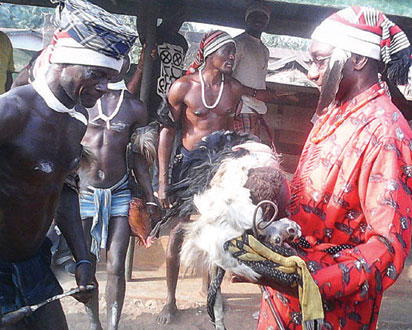
And the Ohafia Warriors’ troupe were the escort. At every spot where the body visited, the warriors performed, the host paid the deceased his tribute and gave some presents like drinks and kola nuts before the body would be driven off again, to the next place.
Funeral mass
And all Uzuakoli was at home that day as no work was done during the festival. And so all the people were about, some in the square, in their homes, on the road, or just everywhere for the burial. As the body passed, they hailed the group, till the body returned to the family compound where a funeral mass was held.
Even then, the warriors were there till his body was lowered into the grave by 3 pm. But that was not the end of the burial.
The next day, the traditional burial truly began. That Wednesday morning, the young men of the town gathered for the oso uzo, that procession of young warriors led by a young man carrying the head of the slaughtered local cow, leaves match round the town and to the maternal home of the deceased in Isikwuato.
This procession was to begin in a more elaborate style in the evening. This time, instead of a man carrying a cow head, it was the warrior troupe that led the procession.
And instead of only young men the group this time was all encompassing. All were there, men and women, children and teens, boys and girls in their best traditional attires. They sang and praised the late chief, his achievements, titles, attributes etc. His children were part of his legacy, with their wealth, reach and achievements.
And they held the town spellbound. The warriors, with their rhythmic chests and zigzagging feet, falling to the fury of drums and songs, the carnival was an honour rarely given to the an Igbo hero. And the community, even when the darkness came, still wanted more. So, that night, they converged at the Egbule estate. And the celebration continued.
Disclaimer
Comments expressed here do not reflect the opinions of Vanguard newspapers or any employee thereof.