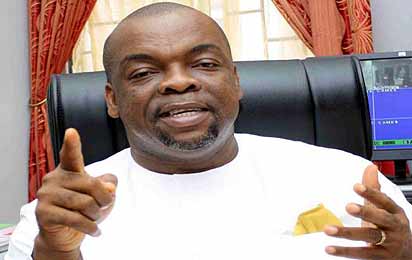
*Chief Emeka Wogu, Minister of Labour and Productivity
BY VICTOR AHIUMA-YOUNG
THE 9th Labour Summit of the Michael Imoudu National Institute for Labour Studies, MINILS, last month, will for a long time to come remain a subject for discourse especially within the labour movement. Besides the theme; Labour Laws, Institutional Reforms and Development Process in Nigeria, speakers were unanimous that current employment laws are not such that guarantee development process in the country.
Presenting the lead paper, presiding judge, National Industrial Court, NIC, Lagos Division, Justice Benedict Bakwaph Kanyip, said Nigeria’s focus on unbridled free-market theories might be her undoing as the examples of economies that ‘made it’ in recent times showed that a good deal of government planning went into the economic policies that saw them move to what they are now.
In a 53-page presentation, Justice Kanyip argued that the magic wand was that the policy framework to be adopted must be pro-employment/jobs building in the decent work agenda espoused by the International Labour Organisation, ILO.
Kanyip said: “We only need to appreciate what developed economies are doing presently to create and safeguard jobs for us to appreciate the point being made. Which nation has developed in history with the kind of high unemployment rate that we presently have in the country?”
On the crisis of labour law in terms of the quality of labour justice as seen in the treatment of labour rights by the law, he said “whether or not labour law today performs its desired goals remains the question.
“In all, there is the need for some sort of re-conceptualization of the basic assumptions of labour law if the goals of labour law are to be realizable.
“This is where the stakeholders come in; and my thinking here is that labour law suffers from certain basic doctrinal or conceptual problems that have not engaged enough attention of the stakeholders and academics in Nigeria in the manner that these problems have elsewhere.”
” The time to begin to address these problems is actually now. The Third Alteration to the 1999 Constitution provides for us the starting point. It provides for us the yardstick to develop labour jurisprudence in the country to enviable heights. It is a piece of legislation that so far, by my reckoning, has been grossly underutilized.”
Fundamental re-evaluation of labour laws
“Labour law faces many new challenges. A changing labour market requires new conceptions of the notion of the worker.
“The flexible labour market has melted the boundary between employment and unemployment, with job insecurity elevated into a market asset.”
“The frontier between paid work and the home is challenged by the entry of women into the labour market. Globalization threatens to prioritise competition, undercutting basic social rights: and the role of the state is undermined by increasingly mobile corporate capital.
“Technological change means that knowledge resources are a crucial future asset; and there are significant demographic changes such as ageing, low birth rate and immigration.”
“These changes create new challenges. Trade unions have traditionally catered for those in work, to the exclusion of those out of work; and it is only relatively recently that trade unions have focused their efforts on marginal workers, women, minorities, disabled people and older people. In addition, because it eschews positive collective rights, collective laissez-faire is dependent on individual might, and therefore, on full employment.
“In this scenario, all you have to do to undercut trade union power is to induce high levels of unemployment.
“Labour law needs a fundamental re-evaluation if it is to continue to have a transformative effect. It needs to move beyond the formal labour market, and address the increasingly fluid boundaries between work and family, employment and unemployment, and different types of workers.
“It cannot continue to assume autonomy from other branches of the law, and in particular, from welfare and family law.
“Equality must be couched not only in terms of countervailing power of workers and employers, but also in respect of heterogeneous parts of the labour force and the broader society.
“In facing the challenge of globalisation, it is crucial to create a framework of social rights to counterbalance the hegemony of free trade ideology. At the same time… the effectiveness of the law in bringing about social change should not be over-estimated. ”
Review of employment law
Declaring the summit open, Governor Abdulfatah Ahmed of Kwara State called for the review of employment laws to protect the interest of workers no matter where employed in the country.
Represented by his deputy, Elder Peter Kishira, the governor argued that “a situation where workers are summarily dismissed, especially in the private and informal sectors without due process or where employees are barred from forming, or joining labor unions is inimical to freedom of association and the right to fair hearing and must therefore be stopped through appropriate legislation”.
Governor Ahmed also insisted that government must create space for engagement with key stakeholders such as labour to gauge public needs, noting however that such engagement with labour was often forced by threats of or actual industrial action.
Earlier, Minister of Labour and Productivity, Chief Emeka Wogu, disclosed that “In the next months, we intend to focus on where and how we can intervene to ensure that finalization of several other labour law-related initiatives activated in the past, which are now at different stages in the legislative process.
“The goal is to bring our labour statutes and the labour administration system in line with international best practice.”
“Any casual observer of the work of the Federal Ministry of Labour and Productivity will not fail to notice our emphasis on pro-active measures. By espousing dialogue and democratic participation, we have been able to resolve very many industrial relations challenges before they degenerated to disruptive levels.”
Disclaimer
Comments expressed here do not reflect the opinions of Vanguard newspapers or any employee thereof.