By Emeka Mamah
Does this government or indeed the Supervisory Minister of Education, Mr Nyeson Wike, take delight in allowing things to get out of hand before paying attention to it. This question is pertinent because similar bungling on the part of government was witnessed during the strike by the Academic Staff Union of Universities, ASUU, and it seems to be happening now in University of Nigeria, Nsukka (UNN). During the ASUU strike Wike talked down on the teachers and even threatened to sack all of them. President Goodluck Jonathan was said to have apologised to ASUU officials at a meeting, leading to the end of the strike.
There are numerous other instances. Yet the wisest thing to do for anyone in a public office is to nip a trouble in the bud. The reason you spend so much on this branch of mass communication is because it serves as a barometer that monitors public opinion. Public opinion is an indicator of how the people being served feel about the service they are getting.
It does not matter whether you have all the instruments of coercion to whip everyone to fall in line. Instruments of coercion really do not work in the long run, unless the use is based on justice and fairplay.
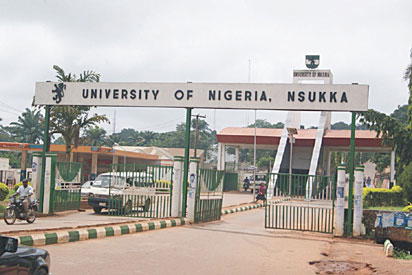
A day or so after ASUU suspended its half a year strike, Nigeria’s first indigenous university, UNN, was plunged into a different cataclysm of its own, for a different reason but not without warning.
Unions representing the lecturers and non-academic workers in the institution had called a press conference about two months previously asking the Federal Government, owners of the university, to call its Vice Chancellor, Professor Bartho Okolo, to order. They alleged numerous administrative wrongdoings in the institution and demanded an enquiry. They complaints centred around the university’s internally generated funds, funds received from government, handling of admission processes, NUGA Games, and so on. Quite weighty, by the standards of university administration! My position is not that the professor is guilty as charged.
No. My position is that if all the workers of the university feel that things were not going on well, what did government do? Did it try to hear both sides? Or was it contented, as the unions said, following the events that happened afterwards, at taking sides with the Vice Chancellor?
 It was reported that when the new Governing Council of the university under one of the most illustrious alumni of the university, Professor Emeka Enejere, came in, they too raised questions over certain things that they saw in Okolo’s administration. In one of their sittings, the account that was presented to them was allegedly rejected. The Council allegedly demanded that the account be broken down into receipts and expenditure, including the sources of such receipts and what the money went into.
Issues involving that account are yet to be fully resolved, Sunday Vanguard was told. Enejere earned for himself the image of a liberator, without meaning to do so. “We had been suffering in silence before the Enejere Council came,” a lecturer in the Faculty of Education who asked that her name should not appear in print said. “The new Council Chairman, Professor Enejere, came to our rescue.”
Next was the provincial press. The newspapers based in Enugu State devoted special editions articulating the issues that Okolo’s administration had with members of the university staff, the host community, and in some cases with donors sponsoring projects in the university. The Starlite based in Nsukka went as far as publishing photocopies of some of the documents. In one case the Central Bank of Nigeria, CBN, allegedly, suspended funding of the University’s Centre for Entrepreneurship and Development Research due to what it reportedly considered unsatisfactory handling of the funds it had released.
The previous Council was said to have been ineffective in checking the alleged excesses of the Okolo administration.
In an advertorial, the Alumni Association of the university described the administration: “We are deeply worried considering our knowledge of how the Vice Chancellor, Professor Bartho Okolo, overwhelmed and subdued the immediate past Governing Council and ran the university as an ‘emperor’ administering his personal estate.”
In a move that surprised a large number of the university community, the supervising Minister of Education reportedly suspended Professor Enejere as Chairman of Council and did not say a word on the allegations against Okolo. Worse still, he told the public nothing about whatever Enejere did wrong. Nobody knows what made the Minister to suspend or sack the Governing Council Chair.
The result was a spontaneous massive demonstration by the entire workforce of the UNN led by the Joint Action Committee on Trade Unions, JAC, of the university. Anchored on a three-point demand, the demonstrators held out for three days despite heavy police presence in at least three truck-loads of their anti-riot men. The demonstrators have promised to regroup.
Their three demands contained in a statement that was circulated to the press and signed by leaders of the various unions in the university are:
·Immediate and unconditional reinstatement of Enejere as Chairman, UNN Governing Council.
·Apology from the Federal Government to him (Enejere) for the alleged embarrassment of suspending him without valid reason; and the
· Setting up of a judicial commission of enquiry to probe the tenure of Okolo as Vice Chancellor of the UNN.
The demonstrations or prayer rallies have paralyzed activities in the university. Students who returned following the suspension of the ASUU nation-wide strike had to go back frustrated.
But government thought differently. Rather than yield, it was alleged that Wike had appointed one of his former Chamber mates, Mr Emmanuel Ukala, SAN, to replace Enejere as the Chairman of the UNN Governing Council.
The present demonstration by the university workers is coming on the heels of a different one on December 1 by members of the host community alleging unfair treatment by the Okolo administration. It took the intervention of Chairmen of two neighbouring local government councils who raced to the university to end the siege. The protestors refused to listen to officials of the UNN including the Deputy Vice Chancellor, Professor Malachy Okwueze.
Government’s action on the Enejere matter raises some crucial questions. Does this government or the Supervisory Minister, Wike, in particular, gain anything in courting avoidable troubles? Why must Okolo be treated as a sacred cow? What has Enejere done that he must be removed peremptorily and unceremoniously? I think Wike can do better than he has managed to do in this matter.
Disclaimer
Comments expressed here do not reflect the opinions of Vanguard newspapers or any employee thereof.