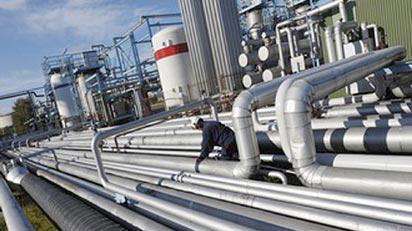
File photo of a refinery.
By Ifeanyi Nwabugu
Vessels loaded with illegaly refined products
If there is any issue that has attracted both national and international discourse these past years in this country, it is the petroleum sector and it has to be because succeeding government in the country has used it as a benchmark for our national development and a means of primitive accumulation of wealth. Since over 80% of corruption in the country occur in that that sector, oil production and management has and will continue to keep the train of corruption going.
In November last year the Minister of Petroleum Resources Diezani Allison-Madueke hinted government resolve to privatize it’s four refineries. This according to the Minister is part of President Goodluck Jonathan’s efforts to transform the sector and end years of underperformance and ease the financial burden on the government. The purpose of reform suggest that the current state of the industry is inefficient in service delivery and ineffective in promoting societal welfare objectives.
In her words “government does not want to be in the business of running major infrastructure entities and we haven’t done a very good job all these years”. Presently the government has four refineries comprising Port Harcourt I and 2, Warri and Kaduna with a combined capacity of 445,000 to 450,000 barrels per-day translating to 70.75 million liters per-day. These refineries have continued to operate below capacity owing to decades of mismanagement, corruption and the lack of political will by succeeding leaders to take the gauntlet since most of them are neck deep in the practices. .It is very regrettable that Nigeria remains the only OPEC country which relies mainly on importation of refined petroleum products to meet its domestic demands.
The department of petroleum resources has so far licensed about six private refineries of which only two has been completed and are in operation, while others are delayed for what they say is government high regulation. It will be recalled that a bold attempt was carried out by the then government of Chief Olusegun Obasanjo only to be jettisoned and reversed by his successor late Shehu Yaradua . Nigeria still relies on massive oil importation for about 80% of its petrol product needs even as importation for meeting internal consumption has led to round tripping and massive fraud. Nigerians were shocked by the revelation of massive fraud arising from the management of oil subsidies which would have been practically impossible if private operators were licensed to refine this product locally.
I sincerely believe that it was in an attempt to address these issues of inadequacy in the supply and the associated infractions that the government constituted special task force otherwise known as National Refinery Task Force (NRSTF) headed by Idika Kalu which recommended that government should relinquish control of the operations and management of the four refineries by divesting a majority of its 100% of its equity to competent, resourceful and experienced private partner refiners in accordance with the Public Enterprise Act 1991 . I do believe and rightly too that the recent pronouncement by the Minister of Petroleum Resources, Diezani Allison-Madueke of Federal government plans to privatize the four refineries is a direct response to the recommendations of Idika Kalu NRSTF recommendations.
The benefits of privatization is that it will take advantage of the perceived cost efficiency of the private firms which will result in the better performance of the needed service at lesser costs owing to competition . Apart from creating jobs, it will also create multiplier effect in the economy and leverage so many Nigerians. Besides, privatization has become part and parcel of the recent global trends which places emphasis on market forces and less dependence on government control of resources.
In his recent article –Felix Ayanruoh opined that it is evident that corruption, inefficiencies and heavily regulated downstream sector in Nigeria has been a significant barrier to private investment in the country and to overall development and economic growth . A close examination of the failures of our refineries suggest that aging equipment, poor maintenance, inefficiencies and corruption remain the major factor coupled with the fact that substantial annual budget is being allocated for subsidies and Turn Around Maintenance (TAM) that is producing below capacity.
Ifeanyi Nwabuogu is a Lagos based media consultant
Disclaimer
Comments expressed here do not reflect the opinions of Vanguard newspapers or any employee thereof.