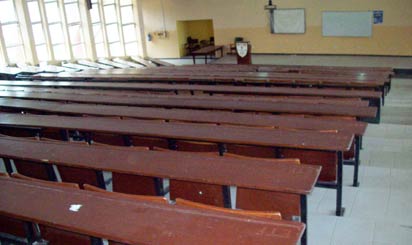
*Law lecture theater, University of Ibadan
BY Amaka Abayomi & LAJU ARENYEKA
Even the brightest minds in the country would never have guessed that 50% of the academic calendar of Nigerian universities would be lost in 2013. Research and investigations would not have been able to reveal beforehand the loss of lives in Northern schools, the results of the West Africa Senior School Certificate Examinations, the abysmal performance of students in the Unified Tertiary Matriculation Examinations or the limited admission spaces akin to the passage of a donkey through the eye of a needle.
However, investigations carried out by Vanguard Learning present a calculated guess of what the education sector might look like in 2014.
Projections based on budgetary allocation
Education garners about N493.4bn, 10.7% of the N4.6 trn budget with 373.4bn for recurrent expenditure, which is about 15.4% of the total amount for recurrent expenditure and capital expenditure estimated at 120bn. Is this inching closer to the 26% stipulated allocation for education by UNESCO? Not as much as experts would like.
These estimations imply that over 75% of the budget would be spent on running already existing structures in the sector, such as paying of salaries, running administration costs etc. With less than 25% on innovative projects and investments, the 2.1% increase from last year’s allocation might make barely a dent on the sector.
More strikes in the New Year?
Needless to say, the year 2013 was wrought with strikes in the education sector. The doyen of all strikes, embarked upon by the Academic Staff Unions of Universities, ASUU, went on for nearly six months before it was called off. The Academic Staff Union of Polytechnics, ASUP, was on strike for 81 days. Although the ASUP strike was suspended in July, the Federal government failed to tackle relevant issues within the one-month time frame given by the union.
Although ASUP suspended its 81-day-old nationwide strike in July, stakeholders in the sector have expressed concern that members of the union may, again, down their tools after the one-month time frame given to the Federal Government to tackle relevant issues.
ASUP had embarked on a nation-wide strike on April 29, 2013, to press government to address among other things: the need for constitution of the Governing Councils of Federal Polytechnics, the migration of the lower cadre on CONTISS 15 salary scale, the release of the White Paper on the Visitations to Federal Polytechnics, the worrisome state of state-owned Polytechnics in the country, the continued appointment of unqualified persons as Rectors and Provosts of Polytechnics, Monotechnics and Colleges of Technologies by some state governments, as well as the need for the commencement of the Needs Assessment of Nigerian Polytechnics, among others.
 In the light of these, another strike might be simmering beneath ASUP’s exterior, especially considering the progress made as a result of ASUU’s refusal to budge.
The Colleges of Education Academic Staff Union, COEASU, also shows some signs of embarking on some sort of industrial action in 2014. It would be recalled that COEASU embarked on a seven day warning strike in September 2013 as a result of the Federal Government’s refusal to honour an agreement made with the union in 2010.
Speaking to Vanguard Learningon the issue immediately after the strike, the Vice President of the union, Mr. Smark Olugbeko that some of the features of the agreement include addressing the infrastructural deficit in Colleges of Education as well as the peculiar academic allowances to the tune of N5bn which the lecturers have not been paid.
Another warning strike that might go full-fledged in 2014 is that of the Association of Civil Servants of Nigeria, ASCSN.
In November 2013, ASCSN in the Federal ministry of education including the federal headquarters of the ministry, inspectorate departments, and the 104 Federal Unity colleges nationwide embarked on a four day warning strike over government’s alleged refusal to implement an agreement between the FG and labour members’ conditions of service among others.
Implementation of 2013 MoU
ASUU President, Dr. Na sir Fagge, said the union decided to call off the strike after diligent and careful appraisal of various report, especially the resolutions signed by ASUU and the Federal Government.
ASUU also highlighted the remaining areas in the 2009 agreement, which require policy and legislative steps for the challenges facing the system to be effectively addressed and expressed hope that the provisions of the extant agreements for revitalisation of the university system will immediately focus on these needs. They include government’s faithful implementation of the resolutions reached and signed, even as it vowed to work assiduously for the revitalisation of Nigerian universities where students and parents will begin to see the fruits of the struggle.
ASUU expects that the revitalisation funds for the next five years will be provided as agreed in the resolutions, while the implementation monitoring committee will ensure that funds released will be used to meet genuine revitalisation needs of public universities with strict and disciplined supervision of the implementation processes by the universities themselves.
ASUU also expects the monitoring committee to conclude, within a short time, the verification of the level of implementation of the Earned Academic Allowances and that government should also, as agreed, provide fund for the payment of outstanding balance. It also expects government to act quickly to engage the services of the universities in special consulting services as contained in the resolution.
The ASUU Chairman, Dr. Nassir Isa Faggae told newsmen: “What we believe is that if the Federal Government faithfully implements the resolutions with ASUU, with students and parents playing their essential roles, further crises would be avoided to the benefit of our education and our country.”
The Presidency, in its immediate reaction through the Senior Special Assistant to the President on Public Communication, Dr. Doyin Okupe, said: “It is a great relief to parents and students that ASUU has called off the strike because the students have suffered so much. Government, on its part, will honour its word by implementing the agreement.”
The sanity of entire university education system in 2014 hangs on the integrity of this single statement.
Between an overloaded calendar and admission crisis
Not every student waited home for six months for ASUU to resume academic activities. Some simply switched to the private sector while others traveled abroad in search of a more stable academic journey.
But in the midst of this migration, over 1.7 million students battled for 700,000 admission spaces in the nation’s tertiary institution.
Even before the strike was called off, Jambites, thankful to get admission albeit into an unstable sector, trooped to begin their registration on campus.
However, as a result of the strike, many universities will be in a rush to finish the incumbent academic calendar to make room for the new students.
The eight new universities have not yet begun to make a mark in solving the admission palaver. A new education minister is yet to be sworn into office since the sack of Prof. Ruqquayatu Rufa’I, and Nigeria still has the highest number of out-of-school-children in the world – 10.5 million. That is 10.5 million reasons why the country may not achieve education for all by 2015.
Vanguard Learning sought the views of some educationists on their expectations for the sector in the New Year.
Pointing out that 2013 was filled with trainings and retrainings for teachers in public schools, the Lagos State Universal Basic Education Board Chairperson, Mrs. Gbolahan Daodu, said she looks forward to more commitment and focus from all stakeholders to make the sector better.
 “It would be appreciated if more money is devoted and utilized in the education sector so as to impact positively on all. Also, I hope to see more improvements in the trainings and welfare of teachers who impact knowledge to the students.”
For the Special Adviser to the Lagos State Governor on Education, Otunba Fatai Olukoga, 2013 was remarkable, especially with the progress recorded in the WAEC results of students in Lagos State.
“2014 can be better if only the Federal Government can replicate what the Lagos State government is doing in the education sector.”
Disclaimer
Comments expressed here do not reflect the opinions of Vanguard newspapers or any employee thereof.